




Published 3 Jun 2021
PPC Marketing Techniques and Strategies: A Complete Performance Guide

Master elite PPC marketing techniques and strategies. Learn how to combine AI automation with smart guardrails to scale ad ROAS. Get your free quote today.
PPC Marketing Techniques and Strategies: A Complete Performance Guide
PPC marketing techniques have crossed a decisive technological threshold. Running profitable paid search and paid social campaigns today demands far more than a basic account setup — it requires a disciplined blend of automation control, intent engineering, and privacy-first data infrastructure.
Quick Answer: Modern PPC marketing techniques center on automation layering — letting machine learning handle real-time auction bidding while human strategists enforce strict guardrails around bidding targets, keyword intent, negative lists, and conversion infrastructure. Accounts that master this hybrid approach consistently outperform those that either fight automation or surrender to it completely.
Why Do PPC Marketing Techniques Matter More Than Ever?
The historic era of manually tweaking keyword bids by pennies, maintaining extensive alpha-beta account structures, and stuffing ad variations is over. Today, search and social platforms rely on advanced machine learning algorithms, predictive modeling, and privacy-first data streams.
The gap between ad accounts that bleed budget and those that scale into reliable revenue engines comes down almost entirely to how well the advertiser controls the machine. Accounts that fight platform automation face volatile cost-per-acquisition figures and declining conversion rates. Accounts that learn to architect the system, rather than work against it, gain a compounding performance edge.
The single most important shift in modern paid media is this: the job is no longer to manage bids — it's to design the system the algorithm optimizes within. This guide breaks down the precise PPC marketing techniques needed to take control of that system, from structural setup to creative execution to post-click conversion.
How Does the Modern Paid Media Landscape Actually Work?
Before deploying significant media budget, it helps to understand exactly how ad networks function beneath the surface. Paid search and paid social platforms have shifted almost entirely toward opaque AI ecosystems.
Instead of serving ads based on rigid keyword matches, platforms analyze real-time intent signals, past browsing patterns, and behavioral profiles to decide when and where an ad appears. Understanding this shapes every strategic decision.
The core channels in a modern multi-platform performance matrix are:
Google Search Intent — capturing active demand from users searching for an immediate solution to a specific problem.
Performance Max (PMax) — Google's cross-channel AI campaign type accessing inventory across Search, YouTube, Display, Discover, and Gmail simultaneously.
Paid social disruption — using Meta, Instagram, and TikTok to create demand through hyper-targeted visual assets, reaching users before they're actively searching.
Microsoft Advertising — often overlooked, but Microsoft Advertising's audience skews toward corporate and higher-income demographics, frequently delivering lower competition than Google.
Conversion rates and click-through rates vary significantly year to year and industry to industry, with benchmark reports like WordStream's annual Google Ads benchmarks study updating these figures regularly — automotive repair, healthcare, and similar high-intent verticals consistently rank among the strongest performers. Knowing where your specific industry benchmarks currently sit, rather than relying on a remembered number from a previous year, is the foundation of any realistic PPC performance target. Applying the right PPC marketing techniques to your campaign structure is what closes the gap between average and top-quartile performance.
What Is Automation Layering and Why Is It the Core PPC Strategy?
The single greatest mistake modern advertisers make is either blindly trusting platform automation or fighting against it entirely. Among all available PPC marketing techniques, automation layering is the one that consistently separates high-performing accounts from those that bleed budget.
Automation layering means letting machine learning handle the heavy lifting of real-time auction bidding while strategists enforce strict, human-driven guardrails. The advertiser acts as the architect who directs the system, setting the boundaries within which the algorithm operates, rather than a manual button-pusher trying to outthink millions of data points per second.
To implement automation layering successfully, configure the account around value-based bidding targets:
Target ROAS (Return on Ad Spend) — instructs the algorithm to hunt for users statistically more likely to generate the target revenue-per-click.
Target CPA (Cost Per Acquisition) — locks the algorithm to a maximum acquisition cost threshold, preventing runaway spend during learning phases.
Maximize Conversion Value — best used after sufficient historical conversion data exists for the algorithm to work with.
A critical point: smart bidding requires adequate conversion volume to function reliably. Google's own guidance for Smart Bidding strategies generally recommends a meaningful baseline of monthly conversions before results stabilize — below that threshold, the algorithm lacks sufficient learning data, and cost-per-acquisition can swing considerably from week to week.
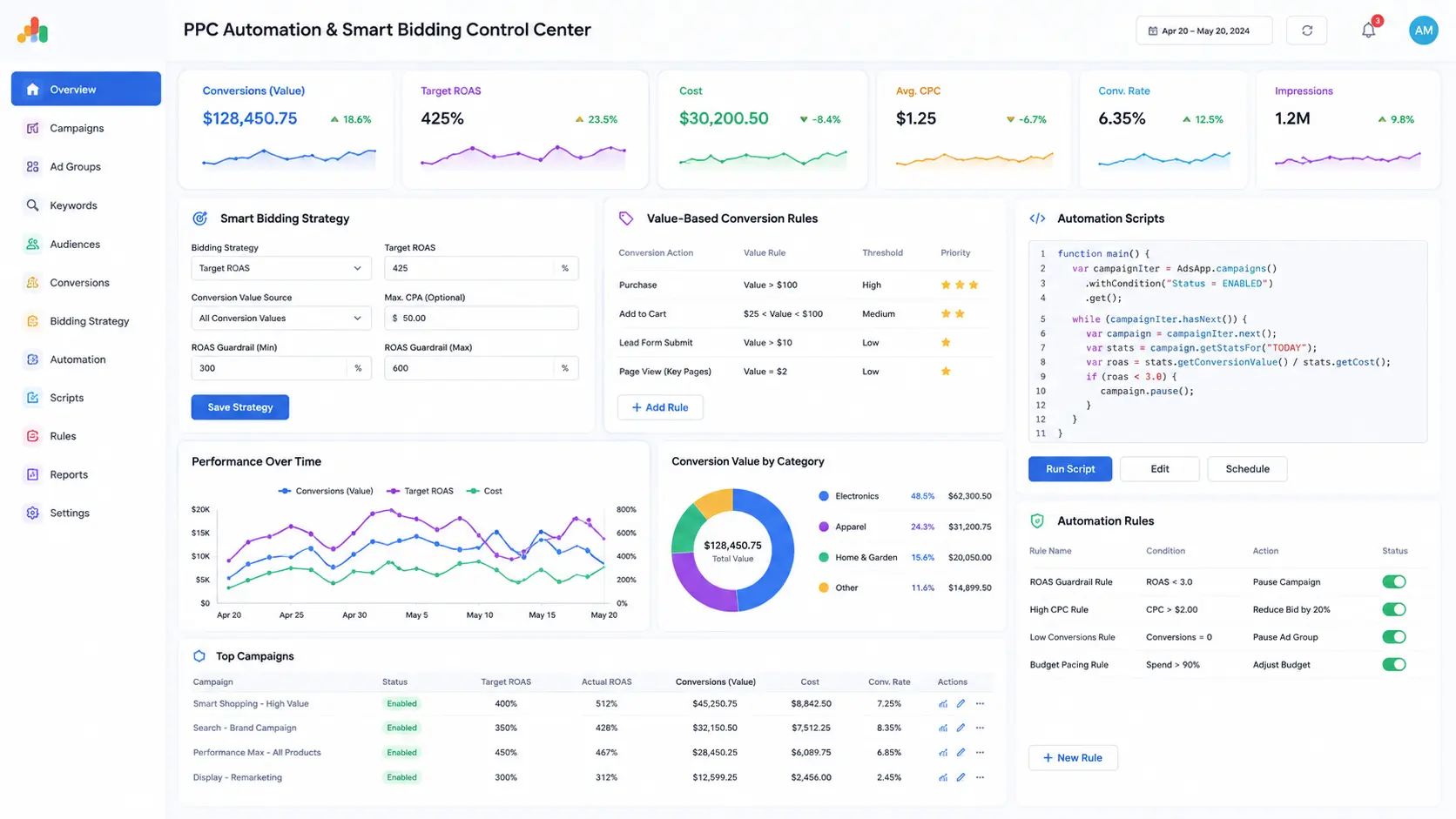
Automation layering doesn't mean handing control to a black box. It means building the box, then letting the algorithm work inside it. The results compound over time: as the algorithm learns from controlled conversion signals, bidding efficiency improves, quality traffic share increases, and cost-per-acquisition trends downward without manual bid adjustments.
How Should You Structure Keywords for Maximum Search Intent Capture?
Even with advanced automation, keywords remain the foundational blueprint of search intent. The goal of modern keyword architecture isn't volume — it's precision. Organizing search terms around a clean user intent funnel is one of the most high-leverage PPC marketing techniques available.
Avoid dumping hundreds of mixed-intent terms into a single ad group. Keep ad groups tight, bundling a small number of highly related keywords to maintain a strong Quality Score and minimize overall cost-per-click.
The intent funnel maps like this:
Informational queries (TOFU) — low commercial intent, focused on educational content and awareness.
Commercial queries (MOFU) — solution comparison, focused on trust signals, case studies, and feature breakdowns.
Transactional queries (BOFU) — immediate purchase intent, focused on direct offers, specific CTAs, and pricing pages.
Primary budget should generally prioritize bottom-of-funnel transactional variations — queries like "enterprise PPC agency pricing" or "buy accounting SaaS subscription" carry direct buyer intent and convert at meaningfully higher rates than broad informational terms. Spending the majority of budget on BOFU terms while using remarketing to recapture MOFU users is one of the fastest paths to a profitable account structure.
Why Is First-Party Data Infrastructure Now Non-Negotiable for PPC?
Traditional browser-side pixel tracking is no longer sufficient to maintain stable campaign performance. With major browsers restricting third-party cookies and ad blockers now in use across a substantial share of desktop traffic, standard pixel implementations routinely lose a significant portion of attribution data, a gap that directly undermines the machine learning a bidding strategy depends on.
The solution is a privacy-first, first-party data stack built around server-side tracking and consent management. This infrastructure upgrade is no longer optional — it's one of the foundational PPC marketing techniques that determines whether bidding algorithms receive accurate signals or optimize against incomplete data.
Server-side tracking moves event processing from the user's browser to infrastructure under direct control — a server sends conversion data directly to ad platforms via API, bypassing ad blockers and browser restrictions entirely. The performance impact is real: first-party data sent through server-side APIs reliably achieves substantially higher match rates than pixel-only implementations, since pixel-only setups lose a meaningful share of events to browser restrictions and blockers before they're ever recorded.
The core components of a modern tracking stack are:
Google Enhanced Conversions — uses hashed first-party customer data to attribute conversions without relying on third-party cookies.
Meta Conversions API (CAPI) — sends server-side event data to Meta, improving Event Match Quality (EMQ) scores and algorithmic optimization accuracy.
CRM data integration — connecting offline conversion data from a CRM back to ad platforms gives the algorithm verified purchase signals, not just click events.
By feeding the machine learning algorithm rich, verified offline conversion data, an account avoids optimizing toward surface-level micro-conversions and ensures budget is allocated against real revenue outcomes. This infrastructure also supports GDPR and CCPA compliance by centralizing data governance at the server layer before any data reaches third-party platforms. Teams without this infrastructure in place can explore tracking and implementation services for support tailored to a specific platform setup.
How Do You Write PPC Ad Copy That Filters Traffic and Drives Clicks?
In modern paid media, creative execution functions as a primary targeting lever. Among the most underestimated PPC marketing techniques is using ad creative as an audience filter — and yet it's one of the highest-leverage adjustments available. Because ad networks automate audience distribution based on engagement signals, ad copy and visual assets have to do the heavy lifting of attracting the right users while filtering out low-intent traffic.
When engineering ad copy variations, test completely different psychological angles, not
minor word swaps. Each variation should represent a fundamentally different value proposition:
Angle A — direct financial benefit: "Cut Your Customer Acquisition Costs This Quarter."
Angle B — authority and social proof: "Partner with a Trusted Performance Agency Managing Significant Ad Spend."
Angle C — urgency and direct value: "Scale Your Ad Infrastructure Safely — Book Your Comprehensive Audit Today."
Weave target keywords naturally into primary headlines to maintain strong ad relevance scores, while writing in a direct-response tone that stops the user mid-scroll — relevance scores mean little if the ad doesn't create a genuine reason to click. The creative asset that wins isn't always the cleverest one; it's the one that most precisely matches what the searcher actually wants at the moment they see it.
For Responsive Search Ads (RSAs), supply a wide range of distinct headline variations and several unique descriptions. This gives Google's system enough creative combinations to test across different audience segments and identify the highest-performing combinations over time. Reviewing recent web development and digital marketing case studies is a useful way to see how integrated creative and technical strategy drives measurable performance improvements in practice.
How Do You Build a Negative Keyword Framework That Stops
Budget Waste?
Identifying winning keywords is only half the equation. Deciding which search queries ads should never appear for is equally critical, and far too often neglected. A thorough negative keyword framework is one of the highest-ROI PPC marketing techniques available, and one of the fastest ways to redirect wasted budget toward high-converting queries.
Without clean negative keyword lists, ads continuously trigger for irrelevant, low-intent
searches that drain budget without generating pipeline. Common waste categories include:
Generic research modifiers: "free," "cheap," "DIY," "how to"
Career and educational intent: "jobs," "course," "certification," "salary"
Competitive research terms: "[competitor name] review," "alternative to [competitor]"
Unrelated brand associations: if selling SaaS, excluding physical product terms in the same category
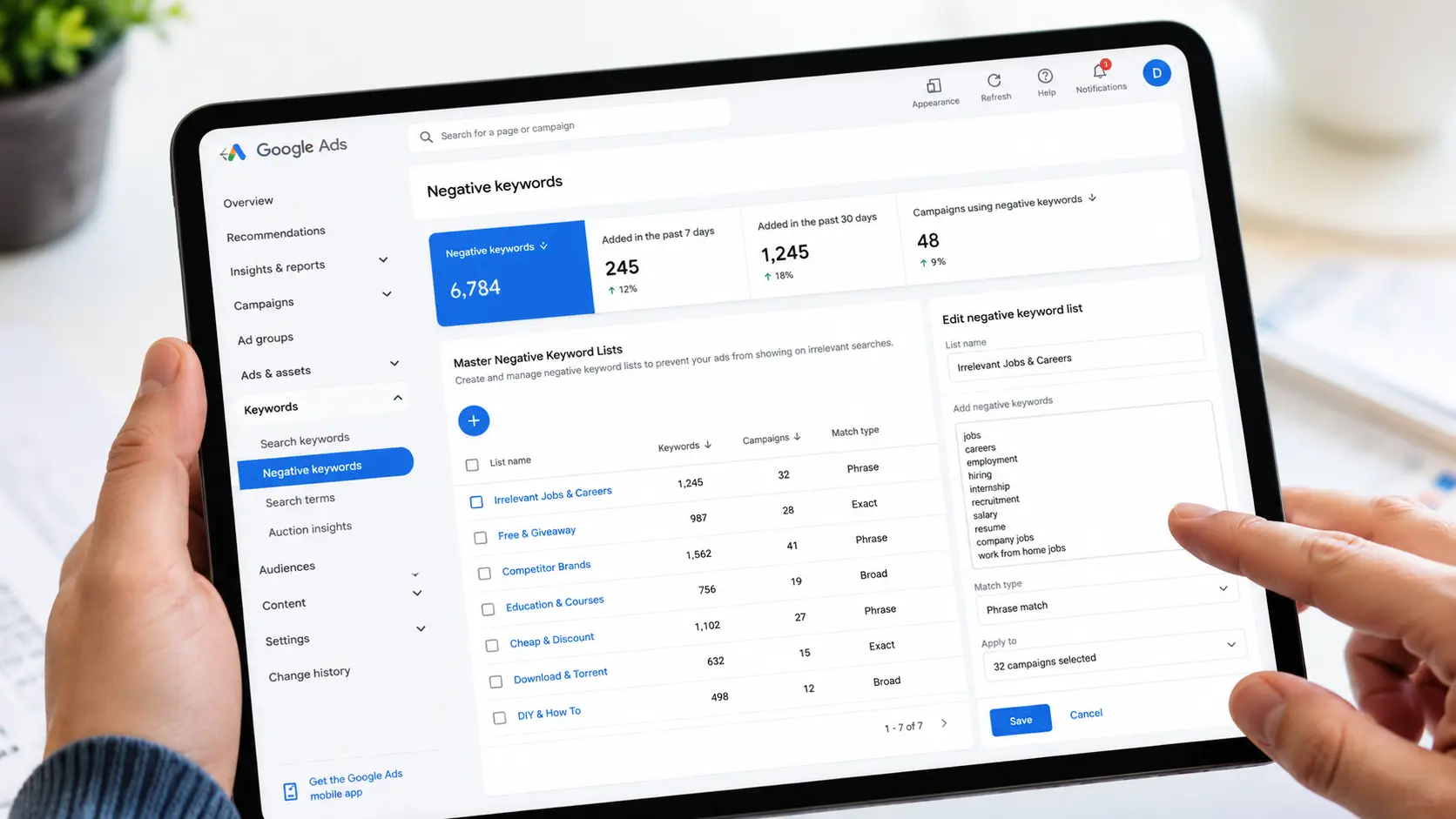
Conduct a thorough search terms report review every week and immediately add irrelevant phrases as negative entries. Build a shared negative list at the account level for universal exclusions, and layer campaign-specific negatives on top for more granular control. A disciplined negative keyword strategy meaningfully reduces wasted PPC spend over time, instantly redirecting capital toward search queries with genuine conversion potential, and that efficiency gain compounds as search term reports get cleaner.
What Makes a Landing Page Convert Paid Traffic Effectively?
The most technically advanced PPC campaign in the world cannot overcome a slow, message-mismatched landing page. This is why landing page optimization sits at the heart of advanced PPC marketing techniques — post-click experience is where the conversion loop either closes or breaks.
The fundamental principle is message match: a landing page must feel like a natural extension of the ad that delivered the click. If the ad promises a specific solution or offer, that exact offer needs to be mirrored prominently in the landing page headline.
Beyond message match, high-converting landing pages for paid traffic share these structural
characteristics:
Removed navigation — no top menu, no footer links, no exit paths that pull users away from the conversion goal.
Minimal form fields — asking only for what's actually needed at this stage; reducing the number of fields can lift conversion rates noticeably.
Trust signals above the fold — client logos, review counts, case study results, or certifications that immediately establish credibility.
Fast load times — page speed directly affects both Quality Score and conversion rate, and even a small delay in mobile load time can measurably reduce conversions.
Conversion Rate Optimization (CRO) for landing pages is not a one-time fix. Running structured A/B tests on headlines, form layouts, and CTA button copy continuously, using paid traffic volume to reach statistical significance faster than organic testing allows, keeps performance improving rather than plateauing.
How Should You Structure Your PPC Account Analysis Routine?
Maintaining a high-performing PPC account requires disciplined, multi-layered data analysis. Without regular review cycles, even the most advanced PPC marketing techniques degrade — campaigns drift, costs spike, and budget pours into underperforming segments. The "set-and-forget" approach is one of the most expensive mistakes an advertiser can make.
A structured analysis routine breaks into three cadences:
Daily — monitor total spend velocity against daily budget pacing, watch for sudden CPC spikes or conversion tracking anomalies, and check impression share trends for core campaigns.
Weekly — conduct a full search terms report review with negative keyword updates, analyze ad copy variation performance (pausing underperformers, promoting winners), review Quality Score across top ad groups, and check smart bidding status to flag campaigns still in the learning phase.
Monthly — run full-funnel attribution analysis mapping ad spend to CRM revenue pipelines, reallocate budget based on hard ROAS and CPA evidence rather than assumptions, assess creative for fatigue signals (rising CPC, falling CTR), and check competitor landscape through impression share and auction insights.
The accounts that compound performance over time are the ones where this analysis routine is non-negotiable: scheduled, documented, and acted upon.
Frequently Asked Questions About PPC Marketing Techniques
How many conversions does smart bidding need to operate stably? There's no single universal threshold, but smart bidding generally needs a meaningful baseline of monthly conversions before performance stabilizes. Below that volume, the platform's machine learning lacks sufficient data and cost-per-acquisition tends to swing considerably. If volume is too low, consider consolidating campaigns or temporarily using a maximize-conversions strategy without a strict cost cap to build volume before adding tighter constraints.
What is the primary difference between Google Ads and Microsoft Advertising? Google Ads commands the majority of global search volume and offers unmatched scale for most industries. Microsoft Advertising (Bing) covers a smaller audience but typically attracts a higher-income, corporate demographic, making it disproportionately valuable for B2B advertisers. CPCs on Microsoft are frequently lower than comparable Google terms due to reduced advertiser competition, making it a useful complementary channel for efficiency-focused accounts.
How often should ad creative assets be refreshed? Creative refresh cadence depends on daily budget and frequency metrics. For high-spend paid social accounts, monitor CTR trends and CPC benchmarks weekly. When click-through rates drop and cost-per-click rises without audience or targeting changes, that's a reliable signal of creative fatigue, and underperforming assets should be replaced with new creative angles testing different psychological hooks.
Should you bid on your own branded keywords? Yes, in most cases. Branded keyword campaigns are typically one of the more cost-effective PPC investments available. They allow control over the top search position for a brand name, protect against competitors bidding on those terms, and allow customized messaging for specific promotions. CPCs for branded terms are usually far lower than competitive non-branded terms, making the return on spend strong for most accounts.
What is the difference between Target ROAS and Target CPA bidding? Target ROAS instructs the algorithm to optimize for a specific revenue multiple relative to spend. Target CPA instructs the algorithm to acquire conversions at or below a specific cost threshold. Target ROAS is generally preferable when conversion values vary significantly, such as e-commerce or variable deal sizes. Target CPA tends to suit fixed-value lead generation better, where every conversion is worth roughly the same amount.
How do you measure true PPC ROI beyond platform-reported metrics? Platform-reported metrics, particularly ROAS figures inside Google Ads or Meta Ads Manager, often reflect attributed revenue rather than actual profitability. For a clearer picture, connect ad platform data to a CRM using server-side conversion APIs, then map attributed conversions to closed revenue in the CRM pipeline. This produces a true revenue-per-spend figure that accounts for lead quality, sales cycle length, and actual deal values rather than surface-level click events.
How Do These PPC Marketing Techniques Come Together?
Navigating modern paid media requires mastery of PPC marketing techniques that span technical infrastructure, automation strategy, creative execution, and data integrity. Accounts that still rely on click-focused, manual methodologies are paying a compounding cost, not just in wasted budget, but in the missed intelligence that a well-structured, data-fed account accumulates over time.
The best-performing PPC accounts are not the ones with the biggest budgets — they're the ones where every element of the system is intentionally designed to work together. The path forward is consistent: implement automation layering with strict value-based bidding guardrails, build a first-party data tracking stack that survives browser restrictions, engineer keyword structures around genuine buyer intent, and maintain the disciplined analysis routines that keep performance compounding over months and quarters.
Explore Our Digital Marketing Services→
Get Your Free Performance Audit→