



Published 15 Jun 2024
Guide to Success in Digital Marketing Careers: Skills, Strategy, and Growth

Explore this complete guide to success in digital marketing careers. Master SEO, lead generation, and multi-disciplinary skills. Get a free consultation today.
Guide to Success in Digital Marketing Careers: Skills, Strategy, and Growth
This guide to success in digital marketing careers is built for anyone serious about turning their skills into a sustainable, high-income profession, whether you're just starting out or ready to level up.
Quick Answer: Success in digital marketing careers comes from combining technical skills (SEO, web development, analytics) with creative capabilities (design, copywriting, video) and business acumen (lead generation, client strategy). Professionals who build a multi-disciplinary skill set consistently earn more and advance faster than those who specialize in just one channel.
Getting noticed is only half the battle in modern business. Sharp skills alone don't guarantee career growth — what matters is translating them into measurable results for clients or employers. The secret of the most successful digital professionals isn't a single expertise; it's the ability to operate confidently across the entire digital ecosystem.
A skilled digital marketer isn't just someone who schedules social media posts. They're a strategist, a business analyst, and a persuasive communicator rolled into one. Employment of advertising, promotions, and marketing managers is projected to grow 6% from 2024 to 2034, faster than the average for all occupations, with a median annual wage of $161,030 as of May 2024, according to the U.S. Bureau of Labor Statistics. The opportunity is real, but so is the competition — continuous skill development is one of the most important investments a professional can make in this field.
Why Is Digital Marketing One of the Fastest-Growing Fields for Building a Successful Career?
Digital marketing is no longer a supplementary function; it's a core business driver, and that shift has produced significant job growth and salary potential for skilled professionals.
A growing majority of overall marketing spend now flows through digital channels, with offline media spending declining steadily as a result. Companies aren't just hiring more digital marketers — they're paying more for the ones who can deliver results across multiple channels rather than just one.
The professionals who capture the highest salaries and best opportunities tend to be those who understand the whole game, not just one piece of it, as digital advertising spend continues climbing and AI, short-form video, and data-driven personalization keep reshaping how businesses reach customers.
What Does It Actually Take to Build a Successful Digital Marketing Career?
Anyone can learn marketing terminology. Not everyone can generate scalable results for a client. The difference lies in how technical execution combines with creative conversion strategy.
When a client asks for more sales, they're not asking for an ad campaign — they're asking someone to diagnose a revenue problem and fix it. A professional marketer knows how to frame services, whether that's SEO, web development, or paid social, as the solution to that specific business challenge, not just a deliverable on a project brief. Reviewing the actual digital marketing services clients hire for is one practical way to see which skills the market is currently paying for in real projects, not just in theory.
The most valuable professionals in this field tend to share three characteristics:
They understand the full funnel. From brand awareness to conversion to retention, they know how each element affects the others and can identify where a client's system is breaking down.
They communicate business value, not just deliverables. Clients don't care how many posts were scheduled — they care what those posts generated in leads and revenue.
They never stop building. Digital marketing evolves faster than most fields, and strategies that worked a couple of years ago can actively hurt results today. Continuous learning isn't optional here; it's the job.
What Skills Does a Real Guide to Success in Digital Marketing Careers Need to Cover?
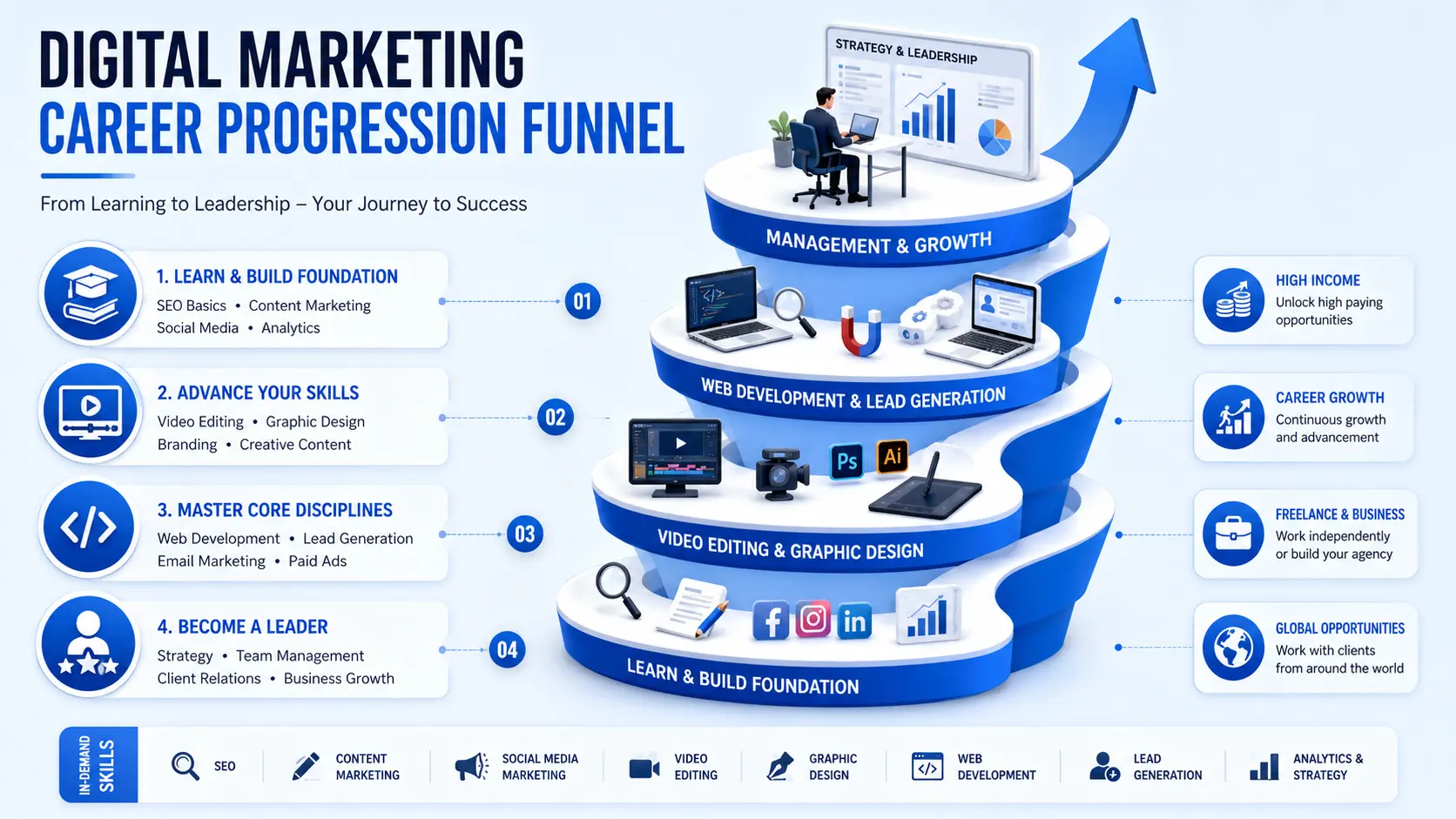
Building real success in digital marketing careers means being honest about which skills actually move the needle. Here's what the market consistently rewards.
Search engine optimization (SEO) remains one of the most in-demand skills in the field. Understanding on-page optimization, technical SEO, content strategy, and link building gives a direct line to driving organic traffic, one of the most cost-effective channels for any business.
Graphic design and video editing matter because visuals drive clicks. Professionals who can produce scroll-stopping graphics and compelling short-form video are consistently in demand across every industry and platform, and these skills also make a marketer significantly more self-sufficient without waiting on a separate creative team.
Web development fundamentals don't require becoming a full-stack developer, but understanding HTML, CSS, and how websites are built makes implementing campaigns, diagnosing technical issues, and communicating with development teams far more effective. Clients who need a seamless online presence pay a premium for marketers who can bridge the gap between design and code.
Lead generation and sales strategy is where strategy turns into revenue. Knowing how to build B2B lead funnels, qualify prospects, and convert them into paying clients makes a marketer an indispensable asset rather than just another vendor — this is the skill that separates high-earning professionals from average ones.
Data analytics and performance tracking matter because every campaign lives or dies by the numbers. Proficiency in tools like Google Analytics and Meta Ads Manager means identifying what's working, fixing what isn't, and presenting clear results to clients and stakeholders.
Paid advertising (PPC and social ads) skills are increasingly expected in mid-to-senior digital marketing roles. The ability to manage ad spend profitably is one of the highest-value additions to any marketer's toolkit.
Why Do "Good Enough" Skills Limit Your Career Potential?
A limited skill set doesn't just slow a career down — it actively costs clients and opportunities. Here's how that plays out in practice.
The stagnant skill set trap: If strategies are based on outdated tools or single-channel thinking, the market signals this quickly. Clients move on, platforms change, algorithms update, and professionals who don't adapt find themselves competing only on price, a race they generally can't win. The solution isn't knowing everything — it's maintaining enough breadth to stay relevant while deepening expertise in the strongest areas.
The missing conversion layer: Many marketers can drive traffic. Far fewer can convert that traffic into paying customers. Understanding how to use urgency, social proof, targeted retargeting, and persuasive copywriting to guide users through a decision is where the real money gets made. Generating clicks without generating leads usually points to a gap worth addressing directly.
The coordination gap: The most in-demand professionals can coordinate across disciplines, aligning creative output with technical execution, managing timelines, and communicating clearly with both clients and technical teams. This ability to operate at the intersection of strategy, creativity, and execution is what produces genuine career advancement, not just incremental raises.
How Does a Guide to Success in Digital Marketing Careers Translate Into a Long-Term Growth Strategy?
This is where a genuine guide to success in digital marketing careers earns its value: not just listing skills, but showing how to sequence them into a career strategy that compounds over time.
Phase 1: Map your skills to market demand. Don't learn random tools — learn what the market is actively rewarding right now. Research job postings in the roles you want to reach, identify which skills appear most frequently in the requirements and compensation brackets you're targeting, and build a learning plan around that data rather than whatever happens to be trending online.
Phase 2: Build authority through real-world output. The digital landscape favors professionals who demonstrate expertise with evidence — a portfolio that shows actual results, not just projects worked on, but outcomes those projects produced: conversion rates improved, revenue generated, organic traffic grown. Numbers speak louder than descriptions. Investing in structured digital marketing training can accelerate this meaningfully by giving both the skills and a framework for building an early, portfolio-worthy track record.
Phase 3: Generate your own leads and clients. A skill set is itself a product. Once lead generation is understood, applying it to one's own career means building a personal brand, publishing case studies, and actively positioning as a specialist in target industries. The professionals who grow fastest aren't waiting to be discovered — they're marketing themselves with the same discipline they apply to client campaigns.

Which Digital Marketing Roles Offer the Strongest Career and Salary Growth?
Understanding where to focus development requires knowing which roles the market values most highly, and this is exactly the kind of practical detail a guide to success in digital marketing careers should spell out rather than gloss over.
Marketing manager — with a median annual wage of $161,030 according to the U.S. Bureau of Labor Statistics, this is among the highest-compensated professional roles across all industries, with demand growing as organizations need leaders who can coordinate creative, digital, and analytics work at scale.
SEO and content specialist — one of the most consistently in-demand roles, with strong salary potential for specialists who can demonstrate measurable organic growth results, and natural career progression toward SEO management and head-of-content positions.
Paid media specialist / performance marketer — managing significant ad budgets and delivering profitable ROAS puts performance marketers near the top of many agencies' priority hire lists, with strong analytical skills combined with creative judgment making this role particularly valuable.
Marketing automation manager — a role seeing steady growth in hiring activity, reflecting how aggressively companies are investing in scaling marketing operations through automation and AI tools.
Digital project manager — as digital campaigns become more complex and multi-channel, professionals who can coordinate teams, manage timelines, and keep everything aligned are in genuine demand across agencies and in-house teams alike.
What Mistakes Do Most People Make Early in Their Digital Marketing Career?
Even motivated professionals stall out in this field, usually for predictable, avoidable reasons that any honest guide to success in digital marketing careers needs to name directly.
Specializing too early, too narrowly. While deep expertise has value at the senior level, early-career professionals who limit themselves to one platform or one channel shrink their marketable surface. Starting broad, identifying strengths, and specializing once there's enough cross-disciplinary context tends to position that specialization far more effectively.
Measuring the wrong things. Impressions, followers, and engagement look impressive in reports. What clients actually care about is cost per lead, conversion rate, and revenue impact. Reorienting measurement toward business outcomes rather than platform metrics changes how every campaign gets evaluated.
Treating a portfolio as an afterthought. In this field, the portfolio functions as the resume. Every completed project should produce something measurable worth documenting. Work that can't be shown might as well not have happened, from a hiring or client-acquisition standpoint.
Not investing in structured learning. Self-study has real limits. Industry-recognized certifications and structured programs signal credibility to clients and employers in ways a casual endorsement doesn't — credentials like Google Ads, Meta Blueprint, or HubSpot certifications, paired with hands-on portfolio projects, tend to carry real weight in hiring decisions.
Frequently Asked Questions About Digital Marketing Careers
These are the questions that come up most often when people work through this guide to success in digital marketing careers and start applying it to their own situation.
What is the best way to start a digital marketing career with no experience? Build before applying. Create a personal website, run a small paid ad campaign with a personal budget, write SEO-optimized content on a familiar topic, and document the results. Even modest real-world results tend to be more credible than theoretical knowledge alone.
Can I specialize in just one area of digital marketing, like social media? Specialization is valuable, but ideally built on a foundation of broader knowledge. Knowing how social campaigns integrate with SEO, web development, and email marketing makes the specialization significantly more effective. The most successful specialists understand the ecosystem their specialty lives within, even without executing every part of it themselves.
How do I know if my digital marketing career strategy is actually working? Track client acquisition rate, the quality of leads generated, and the outcomes of delivered projects. Struggling to close high-value clients or advance into senior roles is data worth acting on directly rather than ignoring.
How much can I earn in a digital marketing career? Earnings vary significantly by role, location, and specialization. Marketing managers, specifically, have a median annual wage of $161,030 according to BLS data, with the field generally rewarding professionals who combine technical skills with measurable business results over those who specialize narrowly.
Should I update my portfolio regularly? Yes. Design trends shift, platform algorithms update, and the results from recent projects are more relevant than work from several years ago. Continuously adding current work, showing current tools, platforms, and measurable outcomes, is one of the more effective ways to attract better clients and stronger opportunities.
What is the single most important trait for long-term success in digital marketing? Adaptability combined with business acumen. Platforms change, algorithms shift, and tools become obsolete, but professionals who build lasting careers tend to prioritize understanding business problems over mastering any single tool, since business problems don't change as quickly as the tools used to solve them.
Do I need a degree to succeed in digital marketing? A formal degree is increasingly less critical than demonstrated results. Industry certifications from Google, Meta, and HubSpot, combined with a strong portfolio of real-world outcomes, frequently carry real weight in hiring decisions alongside or instead of academic credentials.
What's the Real Takeaway From This Guide to Success in Digital Marketing Careers?
A digital marketing career is not just a job; it's a business asset built over time. The professionals who treat it that way, investing in skills systematically and positioning themselves around measurable outcomes, consistently outpace those who wing it.
Real success in digital marketing careers comes down to a few principles that hold regardless of how platforms or tools change: build real skills, document real results, stay genuinely adaptable, and market yourself with the same discipline applied to client work. The opportunity in this field remains substantial, and it rewards those who show up prepared.
Get Your Free Digital Marketing Career Consultation →
Explore Our Digital Marketing Training Programs →