
Published 15 Aug 2024
Facebook Advertising Agencies: How to Choose the Right

Looking for top Facebook advertising agencies? Learn what separates great agencies from average ones — and get expert ad strategies that drive real ROI. Get you
Facebook Advertising Agencies: How to Choose the Right Partner for Your Business
Facebook advertising agencies are the difference between ad spend that quietly drains your budget and campaigns that generate real, measurable revenue. If you've ever wondered why some businesses scale rapidly on Meta while others bleed money, the answer almost always comes down to who's running the ads.
Quick Answer: Facebook advertising agencies are specialized firms that plan, build, and optimize paid campaigns on Meta's advertising platform. The best ones combine precise audience targeting, high-converting creative production, and data-driven scaling strategies to maximize your return on ad spend (ROAS). Choosing the right partner can be the single most impactful growth decision for your business.
Introduction
Running ads on Facebook has never been more competitive — or more rewarding for those who get it right. With over 3 billion monthly active users, Facebook remains the largest social media platform in the world, and it still delivers the highest ROI of any social channel for a significant share of businesses. But that reach comes with complexity. The algorithm, the creative requirements, the bidding strategy, the retargeting logic — there's a lot to get wrong, and most businesses do.
That's exactly where professional Facebook advertising agencies earn their place. This guide breaks down what they actually do, what separates good agencies from average ones, and how to make sure your campaigns are built to scale — not just to run.
What Makes Facebook Advertising Agencies Worth the Investment?
The numbers make a compelling case on their own. 29% of marketers report that Facebook delivered the biggest ROI for their organization compared to any other social media platform. And yet, the majority of businesses running their own ads never reach that potential. Why? Because they're making technical and creative mistakes that a seasoned agency catches in the first audit.
A capable agency brings three things most in-house teams can't match without years of dedicated focus:
Platform expertise: Understanding how Meta's algorithm rewards creative quality, ad relevance, and audience fit — and penalizes poor performance signals
Creative production systems: The ability to test, iterate, and refresh ad creatives at a pace that prevents ad fatigue
Data interpretation: Knowing the difference between a campaign that's underperforming because of creative, audience, budget, or funnel issues — and knowing which lever to pull
The bottom line: Facebook advertising isn't about boosting posts. It's about building a system.
Why Do So Many Businesses Waste Money on Facebook Ads?
The single biggest reason businesses lose money on Facebook ads is running the same creative for too long. Ad fatigue is real and mathematically damaging. When users repeatedly scroll past your ad without engaging, Facebook's algorithm interprets this as a relevance signal — and responds by raising your cost per thousand impressions (CPM). Your reach shrinks, your costs climb, and your ROAS collapses.
The second biggest reason is poor conversion architecture. Getting a click is only the first step. If your landing page isn't aligned with the ad message, if your offer lacks urgency, or if there's no retargeting sequence in place for users who didn't convert on the first visit, you're leaving the majority of your potential revenue untouched.
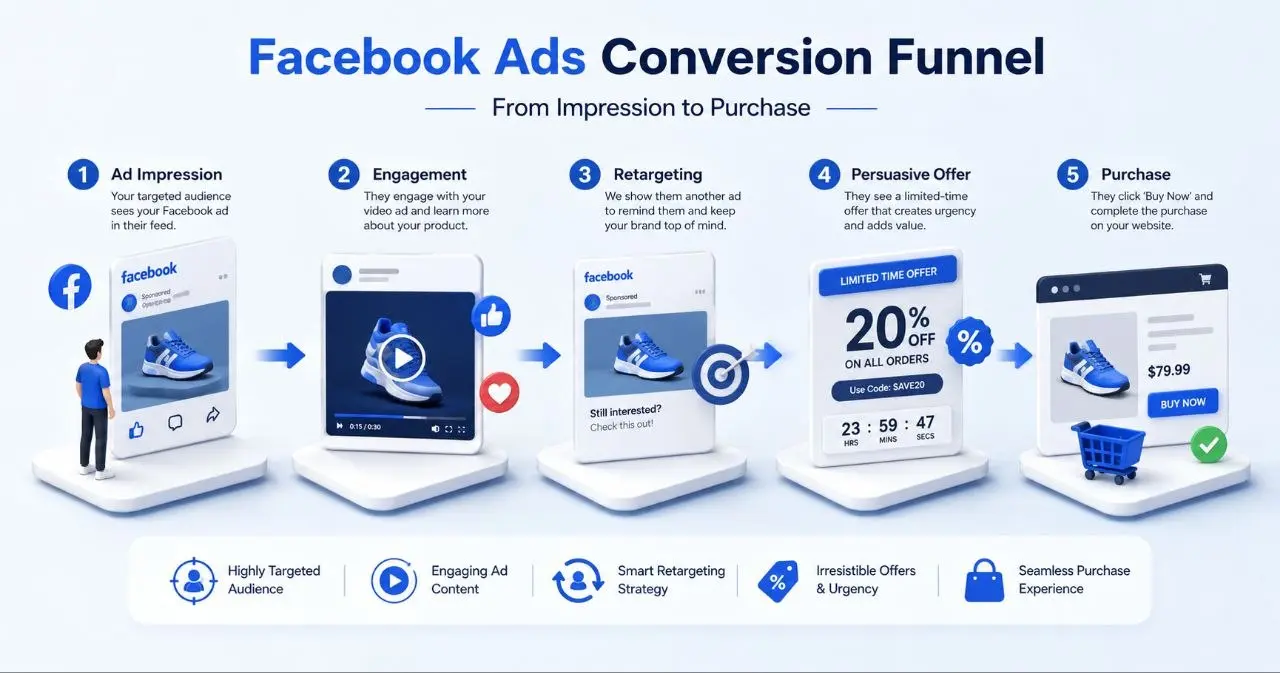
Professional Facebook advertising agencies address both of these problems systematically. They maintain creative calendars, run continuous A/B tests, and build multi-touch retargeting sequences that guide users from the first impression to the final purchase. Retargeting typically delivers 3 to 5 times higher ROAS than cold prospecting — but it only works if the infrastructure is built correctly from the start.
What Does a Great Facebook Advertising Agency Actually Do?
The work of a strong agency goes far deeper than setting up a campaign and hitting "Publish." Here's what the best Facebook advertising agencies are doing behind the scenes:
Audience Architecture
When someone is scrolling through Facebook, they aren't actively looking for your product. They're being entertained, informed, or distracted. Interrupting that scroll and converting it into a purchase requires understanding demographics, interests, behaviors, and purchase intent signals — and layering them into a targeting structure that finds buyers without wasting spend on the wrong people.
Creative Strategy and Production
According to Meta's own research, creative quality accounts for up to 56% of ad performance variance. That's not a small variable — it's the dominant one. Agencies build high-performing creatives by combining scroll-stopping visuals, persuasive copywriting, and format selection (video, carousel, static, DPA) based on what the algorithm is rewarding for each objective.
The process typically includes:
Competitor research: Analyzing what's already running in your niche to identify creative gaps and positioning opportunities
Hook testing: The first 3 seconds of a video ad determine whether a user keeps scrolling. Agencies test multiple hooks to find what stops the scroll
Copy frameworks: Emotion-first messaging that builds desire, then justifies with logic — because that's how buying decisions actually happen
Pixel, Tracking, and Attribution Setup
Without proper tracking, you're flying blind. Agencies ensure the Meta Pixel or Conversions API is correctly implemented, custom events are firing accurately, and attribution windows are configured to reflect your actual sales cycle. This is often where budget is silently being wasted in self-managed accounts.
How Do Facebook Advertising Agencies Build and Scale Campaigns?
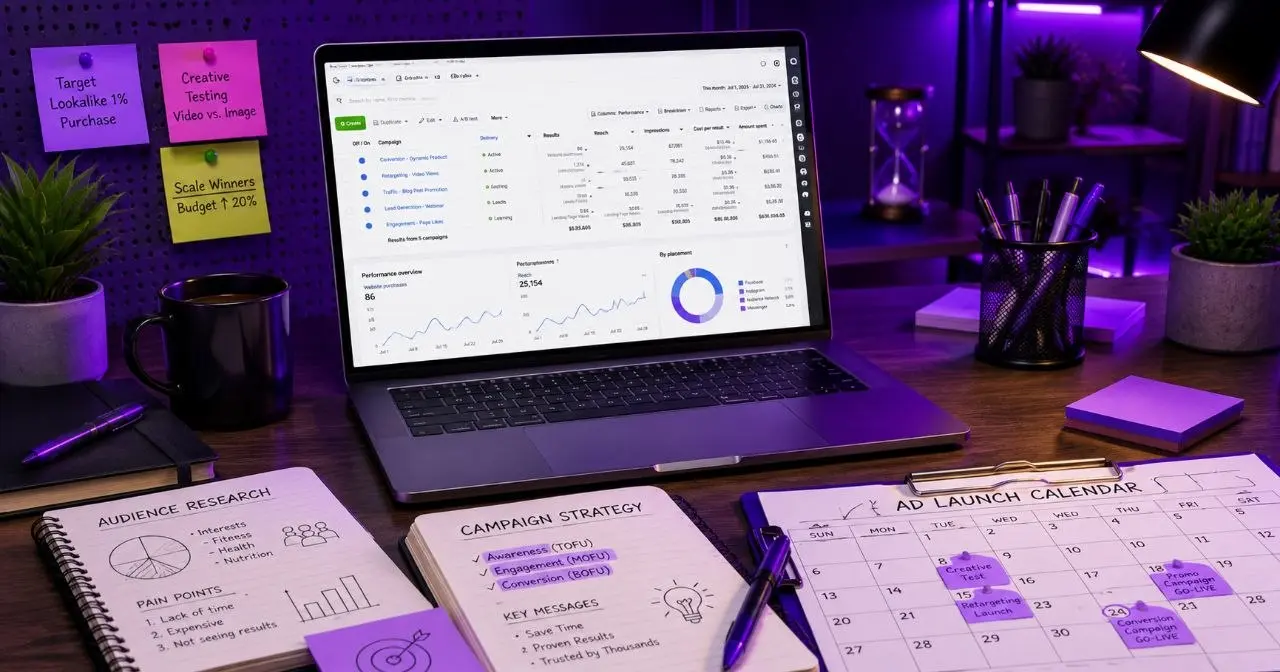
The best agencies follow a structured campaign lifecycle rather than improvising. Here's a breakdown of the three-phase approach that drives consistent results:
Phase 1: Market Research and Campaign Architecture
Before a single ad goes live, a thorough agency reviews your industry landscape — what ad formats are currently performing, what audiences are oversaturated, and what angles are untested. Whether your business is in retail, services, e-commerce, or B2B, this research shapes the entire campaign structure. Launching without it means spending money to learn lessons that shouldn't need to be learned.
Phase 2: Creative Production and Testing
67.55% of Facebook advertisers report that video ads generate more clicks than other content types — which is why strong agencies lead with video while maintaining a healthy mix of static and carousel formats. The first two to four weeks of any new campaign are a testing phase: multiple audiences, multiple creatives, multiple ad copy variants. The data from this period drives every subsequent decision.
Phase 3: Optimization, Retargeting, and Scaling
Once winning combinations emerge, the focus shifts to scaling what works while systematically refreshing creatives to prevent fatigue. Retargeting campaigns are layered in for users who've engaged with ads or visited your website but haven't converted. This is where campaigns move from "running" to genuinely compounding — each touchpoint making the next one more effective.
Which Ad Formats Do Facebook Advertising Agencies Prioritize?
Different formats serve different funnel stages. The agencies that produce the best results don't pick one format and stick with it — they match format to objective at every stage of the funnel.
Video Ads and Reels The highest-engagement format available on Meta. Short-form video is especially effective for cold audiences because it delivers more information in less time and holds attention longer than static images. Essential for awareness campaigns and product demonstrations.
Carousel Ads Ideal for showcasing multiple products, highlighting several features of a single service, or telling a sequential story. Carousel ads let interested users self-select the image or frame most relevant to them, which tends to drive higher click quality.
Dynamic Product Ads (DPAs) These automatically serve each user the exact products they previously viewed on your website or app. For e-commerce businesses, DPAs are among the highest-ROAS formats available because the audience is already pre-qualified.
Lead Generation Forms Built natively into Facebook, lead forms capture contact information without requiring users to leave the platform. Highly effective for service businesses, B2B companies, and any campaign where the goal is generating qualified inquiries rather than direct purchases.
Advantage+ Shopping Campaigns Meta's AI-driven campaign type that automates audience targeting, creative delivery, and budget allocation. In current benchmarks, AI bidding delivers a 27% higher ROAS than manual bidding for advertisers using Meta's Advantage+ format. Agencies know how to set these up correctly — and when to override the automation with human judgment.
What Should You Look for When Choosing Facebook Advertising Agencies?
Not every agency that claims Facebook expertise actually delivers results. Here's what to evaluate before signing a contract:
Transparent Reporting Any agency worth working with can show you exactly how your budget is being allocated and what results it's generating. If the reporting is vague, the results probably are too. Look for clear ROAS, CPA, CTR, and CPM data broken down by campaign, ad set, and creative.
Creative Capabilities Ask to see examples of ads they've produced — not just metrics from accounts they've managed. Creative quality is the #1 performance driver on Meta, and agencies that can't produce strong visuals and compelling copy will hit a ceiling regardless of their technical setup.
Retargeting Architecture Ask specifically how they build retargeting funnels. An agency that runs only top-of-funnel cold traffic campaigns is leaving a substantial portion of your revenue potential on the table.
Realistic Expectations Credible Facebook advertising agencies don't promise a specific ROAS before they've seen your account, your offer, and your funnel. They set benchmarks based on your industry's data and adjust as campaigns generate learnings. Anyone who guarantees specific numbers before starting is overpromising.
Frequently Asked Questions About Facebook Advertising Agencies
What exactly does a Facebook advertising agency do? A Facebook advertising agency plans, builds, manages, and optimizes paid campaigns on Meta's advertising platform. This includes audience targeting, creative production, pixel setup, A/B testing, retargeting, performance reporting, and ongoing campaign scaling. The goal is to generate the highest possible return on your ad spend while continuously improving campaign efficiency.
How much should I expect to spend on Facebook ads? Budget depends heavily on your industry, goals, and competitive landscape. Most professional Facebook advertising agencies recommend a minimum monthly ad spend in the range of $1,000–$3,000 for meaningful data collection during the testing phase. Scaling profitably typically begins once winning audiences and creatives are identified, which usually takes 30 to 90 days. The average cost per action (CPA) across Facebook ads is $19.68, while the average cost per lead is $23.10 — though these vary significantly by industry.
How do I know if my Facebook ads are actually working? The primary metrics to watch are Return on Ad Spend (ROAS), Cost Per Acquisition (CPA), and Cost Per Lead (CPL). If your ROAS is below 2:1, you're not yet at the profitability threshold most businesses need. Track these inside Meta Ads Manager and compare them against your industry benchmarks. A good agency will flag performance issues before you have to ask.
Can't I just use Facebook's automated ad settings instead of an agency? Meta's automation tools have improved significantly, but automation alone has limits. It optimizes for the signals you give it — and if your creative is weak, your audience is wrong, or your tracking is broken, the algorithm will optimize efficiently in the wrong direction. Human strategists are essential for identifying these issues, refreshing creative angles, and making judgment calls that automated systems can't.
How often should ad creatives be updated? As a general rule, ad creatives should be refreshed every 2 to 4 weeks for active campaigns, and sooner if frequency rises above 3 (meaning the average user has seen your ad three or more times). Waiting too long triggers ad fatigue, which raises your CPM and drops your ROAS. The best agencies build creative refresh schedules into their workflow so performance never has a chance to plateau.
What is a good ROAS target for Facebook advertising? This varies by industry and margin, but as a benchmark, the median ROAS across all Facebook advertisers is approximately 2.24 — meaning the typical advertiser earns $2.24 for every $1 spent. A well-managed campaign with strong creative and targeting can significantly exceed this. Agencies with experience in your industry will be able to give you a more specific performance target based on comparable accounts.
Do Facebook ads work for B2B businesses? Yes, though the strategy differs from B2C. For B2B, lead generation forms and awareness campaigns that feed into a sales funnel tend to outperform direct-purchase campaigns. Facebook's detailed targeting allows B2B advertisers to reach decision-makers by job title, company size, and industry. Combined with a well-built retargeting sequence, Facebook can be a highly cost-effective channel for B2B lead generation.
Conclusion
Your Facebook ad account is a business asset — not just a line item in your marketing budget. The brands that treat it that way, and invest in the expertise to run it properly, consistently outperform those that manage it as an afterthought. Choosing the right partner from among the available Facebook advertising agencies isn't a minor operational decision. It's one of the highest-leverage growth moves your business can make.
The difference between a profitable Meta campaign and a money-draining one often comes down to creative quality, targeting precision, and systematic optimization — exactly the disciplines that experienced Facebook advertising agencies have spent years refining.
Ready to stop guessing and start scaling? Explore the digital marketing services available to your business, or get in touch to discuss how a tailored Facebook ad strategy can drive measurable growth for your brand.
Get Your Free Facebook Ad Strategy Consultation →
Explore Our Digital Marketing Services →