



Published 24 Jul 2024
Future of Artificial Intelligence: Key Trends, Opportunities and Risks
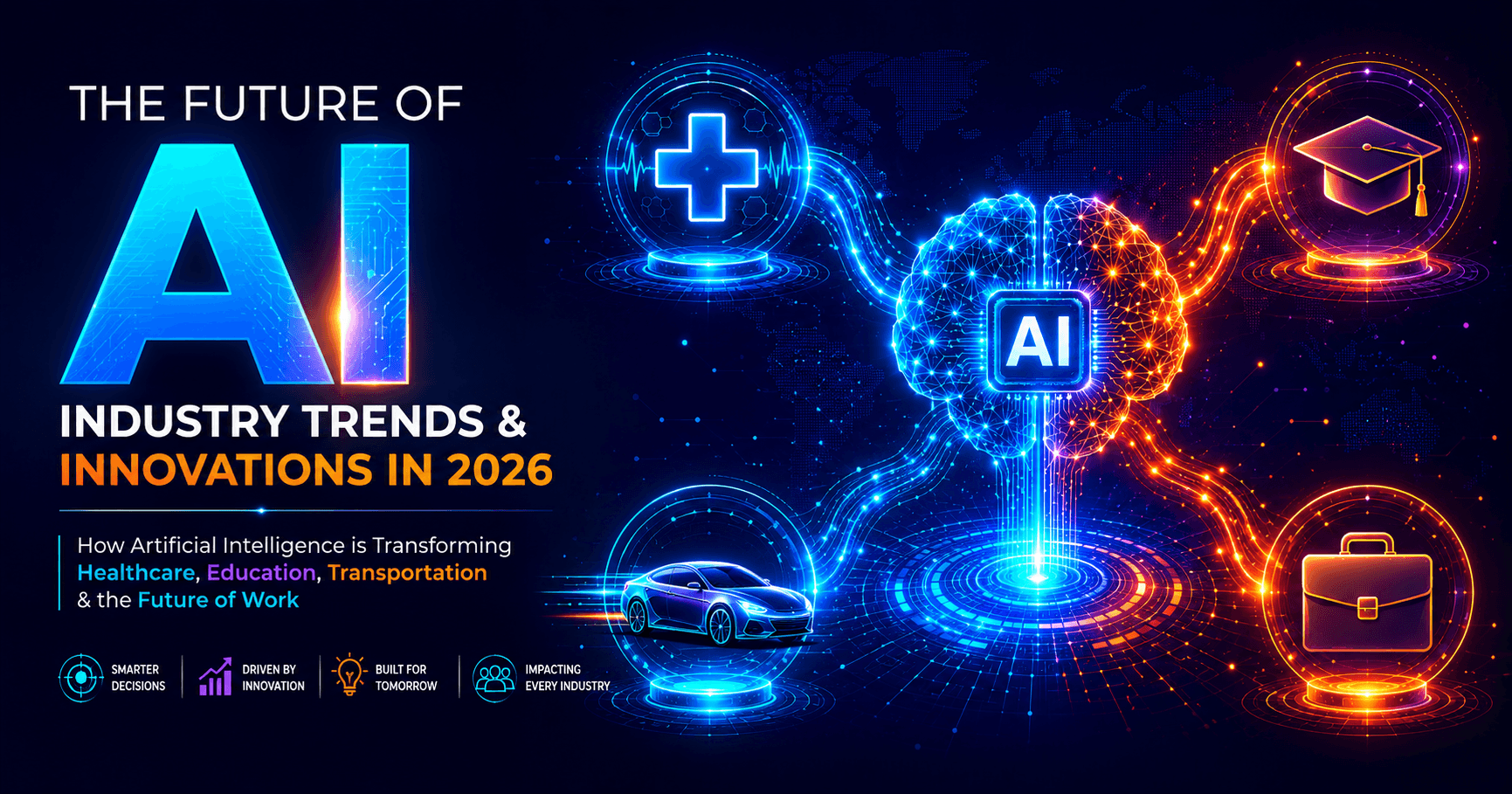
Explore the future of artificial intelligence, including key trends, opportunities, and risks across healthcare, education, transportation, and the workplace.
Future of Artificial Intelligence: Key Trends, Opportunities and Risks
Artificial intelligence has moved well past science fiction and research labs into daily life, often without people noticing it's there. This guide looks at where the future of artificial intelligence is headed across healthcare, education, transportation, and work, along with the risks worth taking seriously along the way.
Quick Answer: The future of artificial intelligence points toward more personalized healthcare, adaptive education, broader autonomous transportation, and continued automation of repetitive work, balanced against real risks around job displacement, algorithmic bias, data privacy, and accountability. The most realistic path forward treats AI adoption as something to manage deliberately, with human oversight and clear regulation, rather than something to either rush into blindly or avoid out of caution.
What Is Artificial Intelligence?
Artificial intelligence refers to computer systems that can perform tasks normally requiring human intelligence, including learning from data, recognizing patterns, understanding language, solving problems, and making predictions.
Most modern AI systems rely on machine learning, a branch of artificial intelligence that lets computers improve their performance by analyzing large amounts of data rather than following a fixed set of instructions. A traditional software program follows predefined rules; an AI system can learn from examples and continually improve its ability to identify patterns and make decisions. This capability is what allows AI systems to recognize speech and convert it to text, recommend products based on behavior, detect fraudulent transactions, analyze medical images, translate languages, generate written content, and support customer service operations. The rapid growth of computing power, cloud infrastructure, and data availability has made all of this more accessible and more capable than ever before.
Narrow AI vs General AI: What's the Difference?
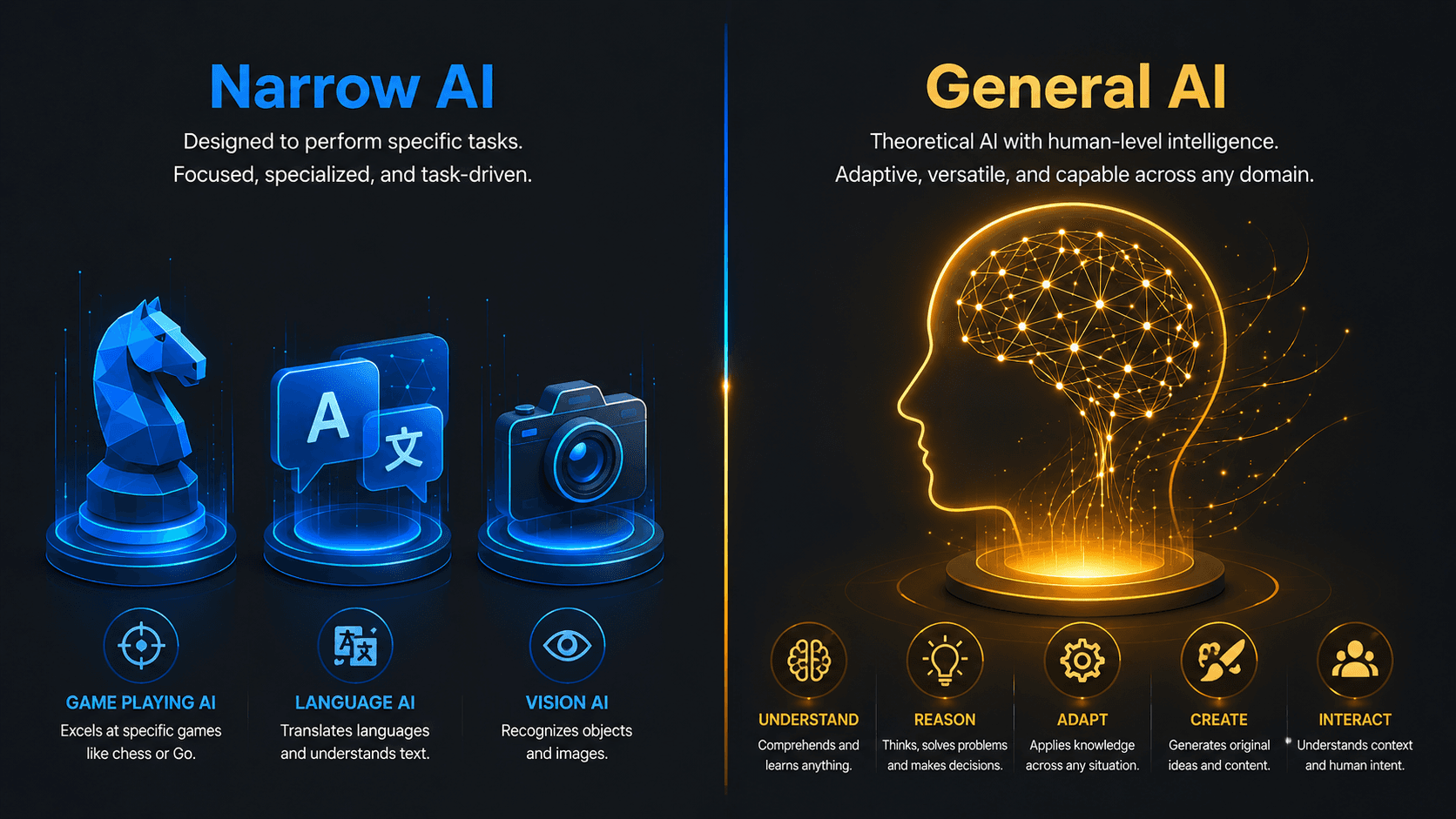
Discussions about the future of artificial intelligence often come back to two distinct categories: Narrow AI and General AI.
Narrow AI, sometimes called weak AI, is designed to perform specific tasks — virtual assistants, recommendation systems, image recognition software, translation tools, spam filters, and self-driving vehicle systems are all examples. These systems can be highly effective within their designated area but can't apply that knowledge outside it. A chess-playing AI may defeat world champions, but it can't drive a car or diagnose a medical condition. Nearly every AI system currently in use belongs to this category.
General AI refers to a hypothetical system capable of performing any intellectual task a human can perform — learning across multiple domains, adapting to unfamiliar situations, applying knowledge from one field to another, and demonstrating human-like reasoning. General AI remains theoretical. Researchers continue exploring its possibility, but no existing system possesses true human-level intelligence across all domains, and for the foreseeable future, most advancement will likely keep happening within Narrow AI rather than General AI.
What Current Applications Are Shaping the Future of Artificial Intelligence?
Understanding the future of artificial intelligence starts with its present-day applications, which are already transforming industries worldwide.
Virtual assistants help users set reminders, answer questions, control smart devices, and manage schedules, continuing to improve as natural language processing advances.
Financial services use AI for fraud detection, credit risk assessment, trading analysis, and customer support automation — analyzing millions of transactions in real time to flag suspicious activity faster than traditional systems. Adoption of this kind is no longer a minority trend: generative AI is now used in at least one business function at roughly 70% of organizations, according to the Stanford AI Index.
Retail and e-commerce platforms use AI to recommend products, personalize shopping experiences, forecast inventory demand, and improve customer support, helping businesses raise both satisfaction and operational efficiency.
Content and media platforms increasingly rely on AI for content recommendations, video analysis, content moderation, and automated content creation, a role expected to keep growing as these systems mature.
How Will Healthcare Benefit From the Future of Artificial Intelligence?
Healthcare is widely considered one of the sectors with the greatest potential for AI-driven transformation.
Improved diagnostics: AI systems can analyze medical images such as X-rays, CT scans, and MRI scans, helping healthcare professionals identify abnormalities more quickly and accurately than manual review alone often allows.
Personalized treatment plans: By analyzing patient histories, genetic information, treatment outcomes, and risk factors, AI enables more individualized healthcare, helping doctors develop strategies tailored to a specific patient rather than relying purely on population-wide averages.
Drug discovery: Developing new medications traditionally takes years of research and billions of dollars. AI can accelerate parts of this process by identifying promising compounds, predicting biological interactions, and reducing research timelines.
Remote healthcare: AI-powered virtual assistants and monitoring systems can support patients outside traditional clinical environments, expanding access to care for people who can't easily reach a clinic.
How Is Education Changing in the Future of Artificial Intelligence?
The future of artificial intelligence in education centers on personalization and accessibility. Traditional education often relies on standardized approaches that don't address individual learning needs, and AI is starting to change that.
Adaptive learning systems can adjust lesson difficulty, track student progress, identify knowledge gaps, and recommend targeted resources, creating a more customized learning experience than a one-size-fits-all curriculum allows. Adoption among students is already substantial: more than 80% of U.S. high school and college students now use AI for school-related tasks, though only about half of middle and high schools have formal AI policies in place, according to the same Stanford research.
Intelligent tutoring systems provide instant feedback, practice exercises, and personalized guidance, supplementing classroom instruction and supporting independent learning between sessions.
Administrative efficiency improves as schools and universities automate scheduling, enrollment processes, data analysis, and reporting, freeing educators to focus more on teaching and student engagement — a shift visible across recent web development case studies, where several education-sector clients have automated exactly this kind of administrative overhead.
What Role Does the Future of Artificial Intelligence Play in Transportation?
Transportation is another industry experiencing rapid AI adoption.
Autonomous vehicles continue to evolve through advances in computer vision, sensor technology, machine learning, and real-time decision-making. Fully autonomous transportation remains a work in progress, but meaningful progress is being made year over year.
Traffic optimization uses AI to analyze traffic patterns, reduce congestion, improve route planning, and enhance public transportation systems.
Logistics and supply chains benefit as companies use AI to optimize delivery routes, warehouse operations, fleet management, and demand forecasting, reducing costs while increasing efficiency across the chain.
The Future of Artificial Intelligence in the Workplace: What's Changing?
One of the most widely discussed topics surrounding AI is its impact on employment.
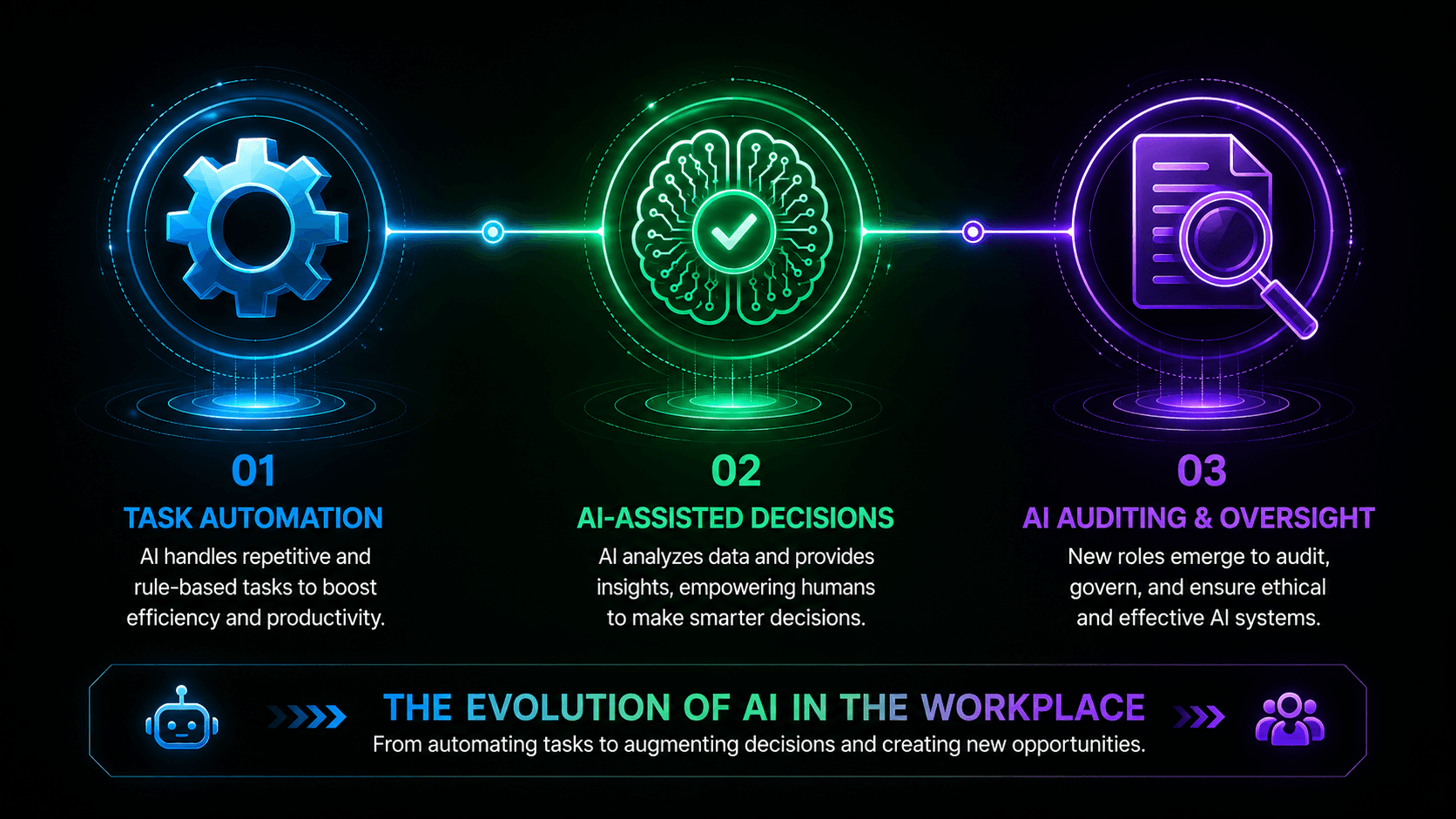
Automation of routine tasks is where AI is already most effective — data entry, basic customer support, invoice processing, and scheduling are all prime candidates, letting businesses cut time spent on manual processes.
Human-AI collaboration is replacing outright replacement in many organizations, with AI-assisted research, automated report generation, decision support systems, and predictive analytics helping employees become more productive rather than eliminating their roles outright.
Emerging career opportunities are growing alongside this shift, including AI engineers, machine learning specialists, AI auditors, AI ethics consultants, data scientists, and prompt engineers. Demand for these skills is climbing fast — AI-related skills now appear in roughly 2.5% of all U.S. job postings, a near-300% increase over the past decade, even as employment for software developers aged 22 to 25 has fallen close to 20% since 2024 in roles most exposed to automation.
What Ethical Challenges Come With the Future of Artificial Intelligence?
The future of artificial intelligence offers real opportunity, but it also introduces challenges that deserve honest attention rather than being waved away.
Algorithmic bias: AI systems learn from historical data, and if that data contains bias, AI can unintentionally reinforce discriminatory outcomes in areas like hiring decisions, lending approvals, and facial recognition systems. Addressing this remains a major priority for AI developers.
Privacy concerns: Many AI applications depend on large amounts of user data, raising legitimate questions about data collection practices, user consent, data security, and information ownership. Organizations need responsible data governance policies to manage this well.
Job displacement: Some occupations may see significant disruption from automation, particularly roles built around highly repetitive tasks. Governments and businesses will likely need to invest meaningfully in workforce retraining programs to manage that transition.
Accountability: As AI systems take on more influence, determining responsibility for errors becomes genuinely complex — who is accountable for AI mistakes, how AI decisions should be audited, and what regulations should govern deployment all remain active, unresolved questions worldwide.
Why Does Regulation Matter for the Future of Artificial Intelligence?
Effective regulation will play a crucial role in shaping the future of artificial intelligence. Governments are increasingly exploring frameworks designed to keep AI systems safe, transparent, fair, and accountable — efforts the OECD's AI Policy Observatory tracks across different countries as the rules continue to take shape.
Regulation isn't meant to stop innovation. It helps build trust and reduce the risks tied to rapid technological change. Organizations that proactively address compliance and ethical considerations now will likely be better positioned for long-term success than those treating regulation as an afterthought.
What Should Businesses Do Today About the Future of Artificial Intelligence?
Organizations don't need to wait for future breakthroughs to start benefiting from AI. A few practical steps make sense right now:
Identify repetitive processes — look for workflows that consume disproportionate time and resources relative to their complexity.
Evaluate data readiness — AI systems depend on high-quality data, so information needs to be accurate, organized, and accessible before any serious AI project starts.
Start small — pilot projects let organizations test AI solutions without major risk exposure.
Focus on human oversight — AI should support decision-making rather than operate unsupervised in high-risk scenarios.
Invest in skills development — employee training remains one of the most valuable investments companies can make as AI adoption expands. A site or platform built with this kind of integration in mind, like the work covered through dedicated AI integration services, tends to handle that transition far more smoothly than one retrofitted after the fact.
Frequently Asked Questions About the Future of Artificial Intelligence
Will artificial intelligence replace all jobs? No. AI is expected to automate specific tasks rather than eliminate entire professions outright. Many roles will evolve rather than disappear completely.
Is artificial intelligence dangerous? AI itself isn't inherently dangerous, but misuse, poor design, lack of oversight, and biased data can create real risks that need to be managed carefully rather than ignored.
How soon will General AI become reality? There's no consensus among experts on a timeline. Most researchers agree that current systems remain far from true General AI, and estimates vary widely even within the research community.
Which industries will benefit most from the future of artificial intelligence? Healthcare, education, transportation, finance, manufacturing, and technology are expected to see some of the largest benefits, though the pace of adoption varies significantly by sector.
Can small businesses use AI? Yes. Many affordable AI-powered tools are already available for marketing, customer support, analytics, automation, and content creation, making AI adoption realistic well beyond large enterprises.
Why is AI regulation important? Regulation helps ensure AI systems stay transparent, accountable, safe, and fair, protecting both consumers and organizations from avoidable risks as adoption accelerates.
What's the Realistic Outlook for the Future of Artificial Intelligence?
The future of artificial intelligence isn't a distant possibility — it's already unfolding, transforming healthcare, education, transportation, finance, and the workplace at a pace that would have seemed unimaginable just a decade ago.
At the same time, the technology brings legitimate concerns around privacy, bias, accountability, and workforce disruption. Ignoring these issues would be a mistake, but so would overlooking the genuine opportunities AI offers. The most realistic future lies somewhere between blind optimism and excessive caution — and organizations that embrace AI thoughtfully, invest in responsible implementation, and prioritize human oversight will be the ones best positioned to benefit from it. Artificial intelligence is unlikely to replace human ingenuity; it's more likely to become one of the most powerful tools people use to solve problems and drive innovation in the years ahead.