


Published 6 Jul 2021
How to Become a Full Stack Developer: The Ultimate Roadmap
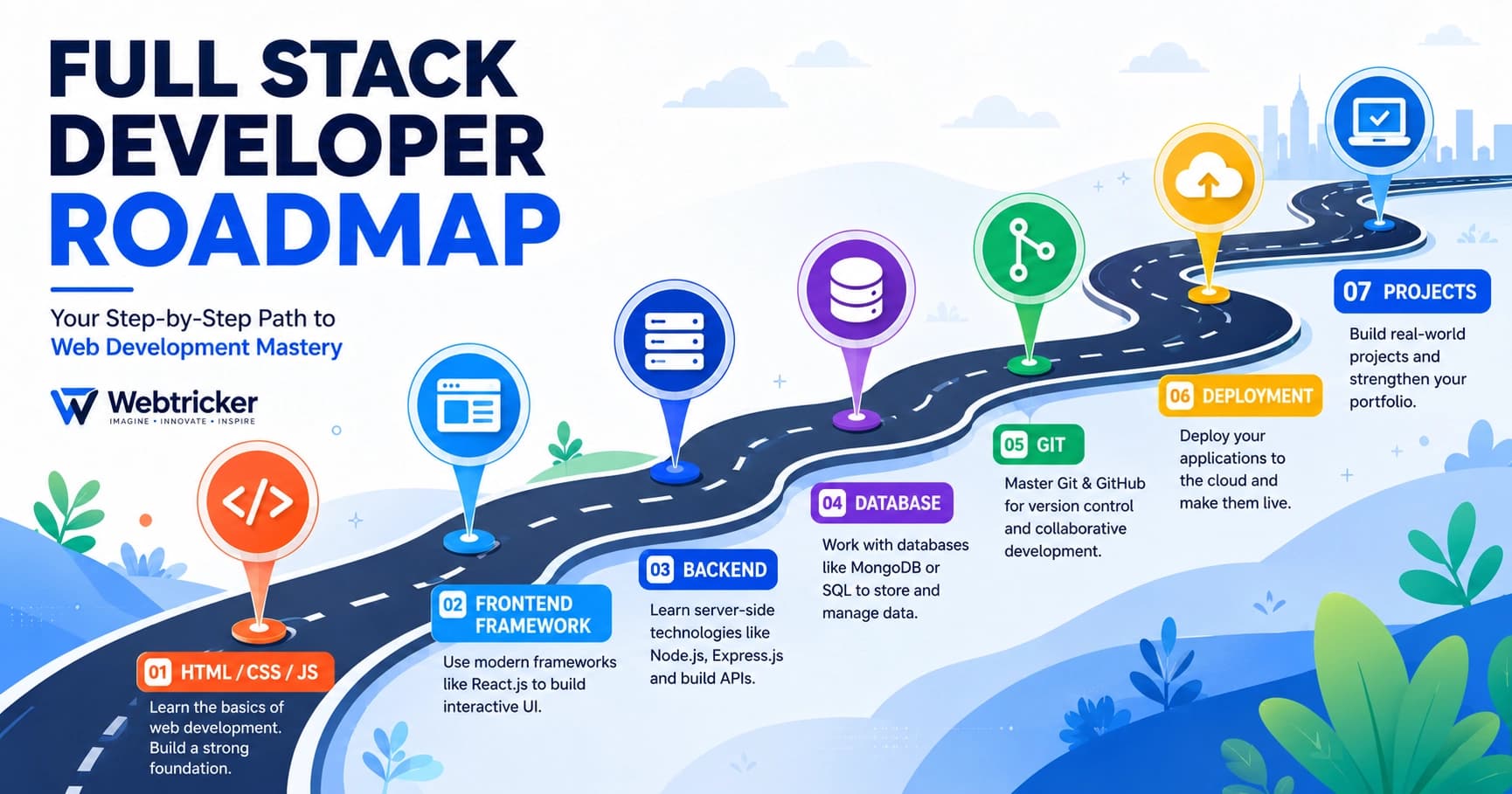
Follow this full stack developer roadmap to learn frontend, backend, databases, and deployment step by step. Join Webtricker's training program today!
How to Become a Full Stack Developer: The Ultimate Roadmap
Quick Answer: A full stack developer is someone who builds both the frontend (what users see) and the backend (servers, databases, and logic) of a web application. This full stack developer roadmap follows a clear order: HTML/CSS/JavaScript, a frontend framework, a backend language and framework, databases, Git, deployment basics, then real projects that tie everything together. Most beginners following this full stack developer roadmap reach a job-ready skill level in six to twelve months of consistent learning.
A full stack developer is someone who can work across the entire web application, from the interface a user sees to the server and database behind it. That breadth makes the role attractive, but it also makes the learning path feel overwhelming if you don't know where to start. This is exactly why a structured full stack developer roadmap matters more than randomly jumping between tutorials.
This full stack developer roadmap breaks the journey into a clear order: what to learn first, what comes next, and how each piece connects to the others. It's written for beginners and for developers who already know one side of the stack and want to round out their skills using a dependable full stack developer roadmap rather than guesswork.
1. What Does a Full Stack Developer Actually Do?
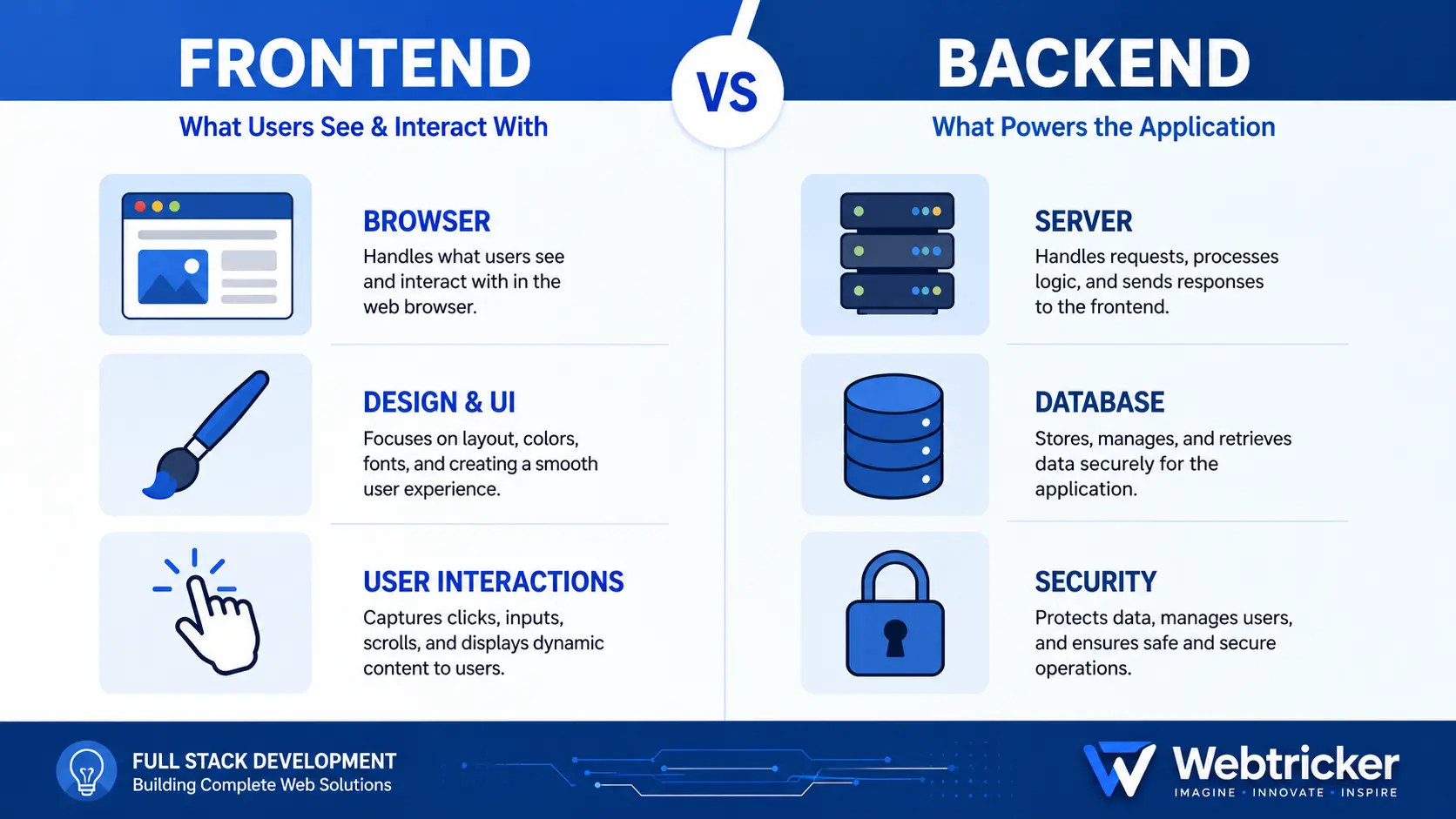
A full stack developer builds and maintains both the client-facing part of a website (the frontend) and the server-side logic, database, and infrastructure behind it (the backend). In practice, this means writing the code that renders a page in the browser, the code that processes a form submission on a server, and the queries that store or retrieve that data from a database.
Most full stack developers aren't equally strong on every layer, and that's normal. The goal of following a full stack developer roadmap isn't to master everything at the same depth, but to be capable enough on both sides to build a working application end to end, and to know enough about each layer to communicate effectively with specialists who go deeper in one area.
2. Step One: Learn the Building Blocks of the Web
Every full stack developer roadmap starts in the same place, regardless of which framework or language you end up specializing in.
HTML structures content on a page.
CSS controls how that content looks.
JavaScript makes a page interactive, handling things like form validation, dynamic content updates, and user interactions without reloading the page.
Spend real time here before jumping to a framework. A developer who understands plain JavaScript deeply will pick up React, Vue, or Angular far faster than one who skips straight to a framework and treats it as a black box. The MDN Web Docs JavaScript guide is one of the most reliable free references for getting these fundamentals solid. This first stage of the full stack developer roadmap is the one most beginners are tempted to rush, and it's also the one that pays off the most later.
3. Step Two: Pick a Frontend Framework
Once the fundamentals are solid, the next stage of the full stack developer roadmap is choosing a frontend framework or library. The three most common choices are:
React — the most widely used option, with the largest job market and ecosystem. A reasonable default choice if you're unsure.
Vue — known for a gentler learning curve and clear documentation, popular for small to mid-sized projects.
Angular — a more opinionated, full-featured framework often used in larger enterprise applications.
Whichever you pick, focus on the same core ideas: components, state management, and how data flows through the application. These concepts transfer across frameworks even when the syntax doesn't, which is why this part of the full stack developer roadmap matters more than the specific framework name on your resume.
4. Step Three: Learn a Backend Language and Framework
The backend handles the logic that should never run in the user's browser: authentication, business rules, and communication with the database. At this stage of the full stack developer roadmap, common language and framework combinations include:
Node.js with Express — a natural next step if you're already comfortable with JavaScript, since the same language runs on both the frontend and backend.
Python with Django or Flask — popular for its readability and strong ecosystem, especially when a project may later involve data processing or automation.
PHP with Laravel — still widely used, particularly in WordPress-adjacent and small-to-medium business projects.
At this stage, learn how to build a REST API: how to handle GET, POST, PUT, and DELETE requests, how to validate input, and how to return proper error responses. None of this needs to be memorized perfectly — knowing where to look things up matters more than knowing every detail by heart.
5. Step Four: Understand Databases
Every application needs somewhere to store data. This stage of the full stack developer roadmap covers being comfortable with at least one type of database, and ideally understanding the difference between the two main categories:
Relational databases (PostgreSQL, MySQL) store data in structured tables with defined relationships, and are queried using SQL.
NoSQL databases (MongoDB) store data in flexible, document-based formats, which can be easier to work with for rapidly changing data structures.
Learn how to design basic schemas, write queries, and understand indexing well enough to know why a slow query is slow. No full stack developer roadmap is complete without solid database fundamentals, since weak data handling tends to cause the most painful bugs later in a project — usually the kind that only show up once real users are on the site.
6. Step Five: Learn Version Control
Git is non-negotiable for any developer working on real projects, solo or on a team, and it's a fixed checkpoint on every serious full stack developer roadmap. At minimum, be comfortable with:
Committing changes with clear messages
Working with branches
Merging and resolving conflicts
Pushing to a remote repository on GitHub or GitLab
This is also where developers typically start collaborating on open-source projects or sharing portfolio work publicly. For a deeper reference, the official Git documentation covers every command in detail.
7. Step Six: Learn Deployment and Basic DevOps
A full stack developer should be able to take an application from a local machine to a live, accessible website. This doesn't require deep DevOps expertise, but this stage of the full stack developer roadmap does require familiarity with:
Hosting platforms such as Vercel, Netlify, Render, or a traditional VPS through a provider like DigitalOcean.
Docker, for packaging an application so it runs consistently across different environments.
Basic CI/CD concepts, so that pushing code can trigger automatic testing and deployment rather than manual uploads.
8. Step Seven: Build Real Projects
Tutorials teach syntax. Projects teach problem-solving. Once the fundamentals from this full stack developer roadmap are in place, build something end to end rather than continuing to follow along with courses.
Good starter projects include a task manager with user authentication, a blog platform with a database-backed CMS, or a simple e-commerce site with a product catalog and cart. Each of these forces you to connect frontend, backend, and database work into a single working system, which is the actual skill being tested in a full stack role and the real proof that you've completed this stage of the full stack developer roadmap.
If you'd rather follow a structured curriculum than figure this stage out alone, Webtricker's training program walks through these exact project types with guided support.
9. Soft Skills That Matter Just as Much
Technical skill alone doesn't make someone effective on a team, and most discussions of a full stack developer roadmap skip this part entirely. Full stack developers benefit heavily from:
Clear communication — they often act as a bridge between frontend-focused, backend-focused, and non-technical stakeholders.
Comfort with ambiguity — full stack work often involves figuring out which layer a bug or a missing feature actually belongs to.
Time management — juggling frontend polish, backend logic, and deployment concerns on the same project requires prioritizing well.
These skills rarely show up in a course curriculum, but they're often what separates a full stack developer who's pleasant to work with from one who technically knows the same amount but is harder to collaborate with.
10. A Realistic Timeline
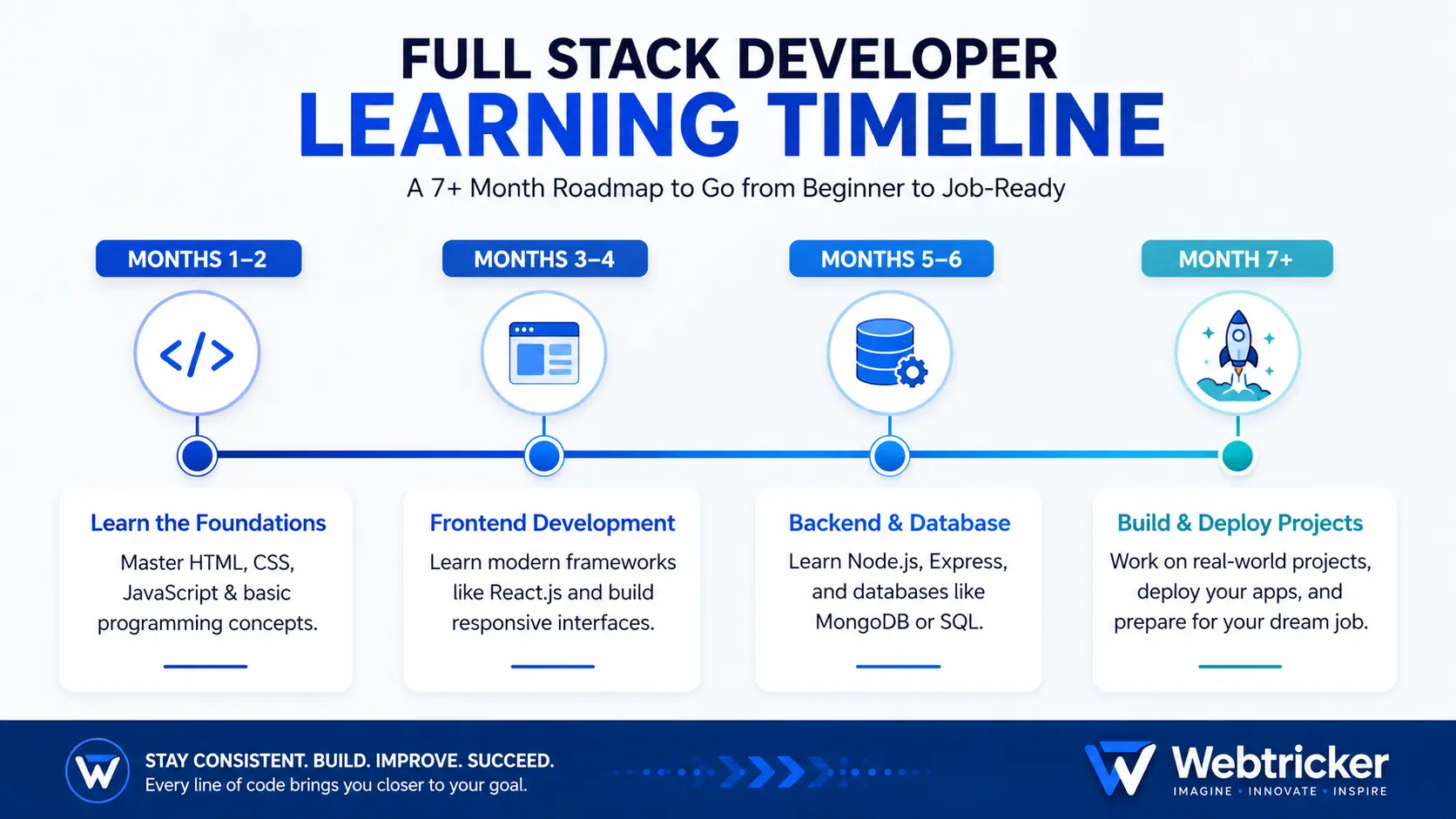
There's no fixed timeline that applies to everyone, but a reasonable structure for this full stack developer roadmap looks like this for someone learning consistently:
Timeframe
Focus
Months 1–2
HTML, CSS, and JavaScript fundamentals
Months 3–4
A frontend framework, plus enough backend basics to build a simple API
Months 5–6
Databases, authentication, and a first full end-to-end project
Month 7+
Deployment, a stronger portfolio, and increasingly complex projects
Developers coming from a related background, such as design or QA, often move through this full stack developer roadmap faster because they already understand part of the picture. On the other hand, someone studying part-time around a full-time job might reasonably take longer — and that's fine too. The timeline matters less than staying consistent and not skipping the project-building stage to rush toward a "finished" feeling that a roadmap alone can't give you.
Frequently Asked Questions
Do I need a computer science degree to become a full stack developer? No. Many full stack developers are self-taught or come from bootcamps, often using a self-directed full stack developer roadmap instead of formal education. What matters most to employers is a portfolio of working projects and the ability to explain your decisions, not the credential itself.
Should I learn frontend or backend first? Frontend is usually the more approachable starting point in most full stack developer roadmap structures because the results are immediately visible in the browser, which helps with motivation early on. That said, either order works as long as you eventually cover both.
How long does it take to become job-ready as a full stack developer? With consistent study, six to twelve months is a realistic range for a beginner following a structured full stack developer roadmap to reach a junior-level skill set, though this varies based on prior experience and time invested per week.
Is it better to specialize instead of going full stack? Specializing can lead to deeper expertise and is valuable at senior levels, but completing a full stack developer roadmap is particularly useful early in a career and for smaller teams or startups where one person often needs to handle multiple layers of a project.
What is the difference between a full stack developer and a software engineer? A software engineer is a broader title that can apply to any area of software, including full stack, backend-only, mobile, or systems work. A full stack developer is a specific type of software engineer whose scope spans both the frontend and backend of web applications, which is exactly what a full stack developer roadmap is designed to prepare you for.
Can I follow a full stack developer roadmap without prior coding experience? Yes. A full stack developer roadmap is designed to start from zero, beginning with HTML, CSS, and JavaScript fundamentals before introducing any framework or backend language. Prior experience can speed up certain stages, but it isn't a requirement to begin.
Conclusion
Becoming a full stack developer is less about memorizing every tool in the ecosystem and more about understanding how the pieces fit together: a request from the browser, handled by a server, backed by a database, and returned as something a user can see and interact with. Following a clear full stack developer roadmap, learning each layer with that connection in mind, and building real projects rather than only following tutorials turns the breadth that once felt overwhelming into an advantage instead.
Explore AI Integration Services→