


Published 10 Jul 2024
Custom Web Development: Tailored Solutions for Your Business
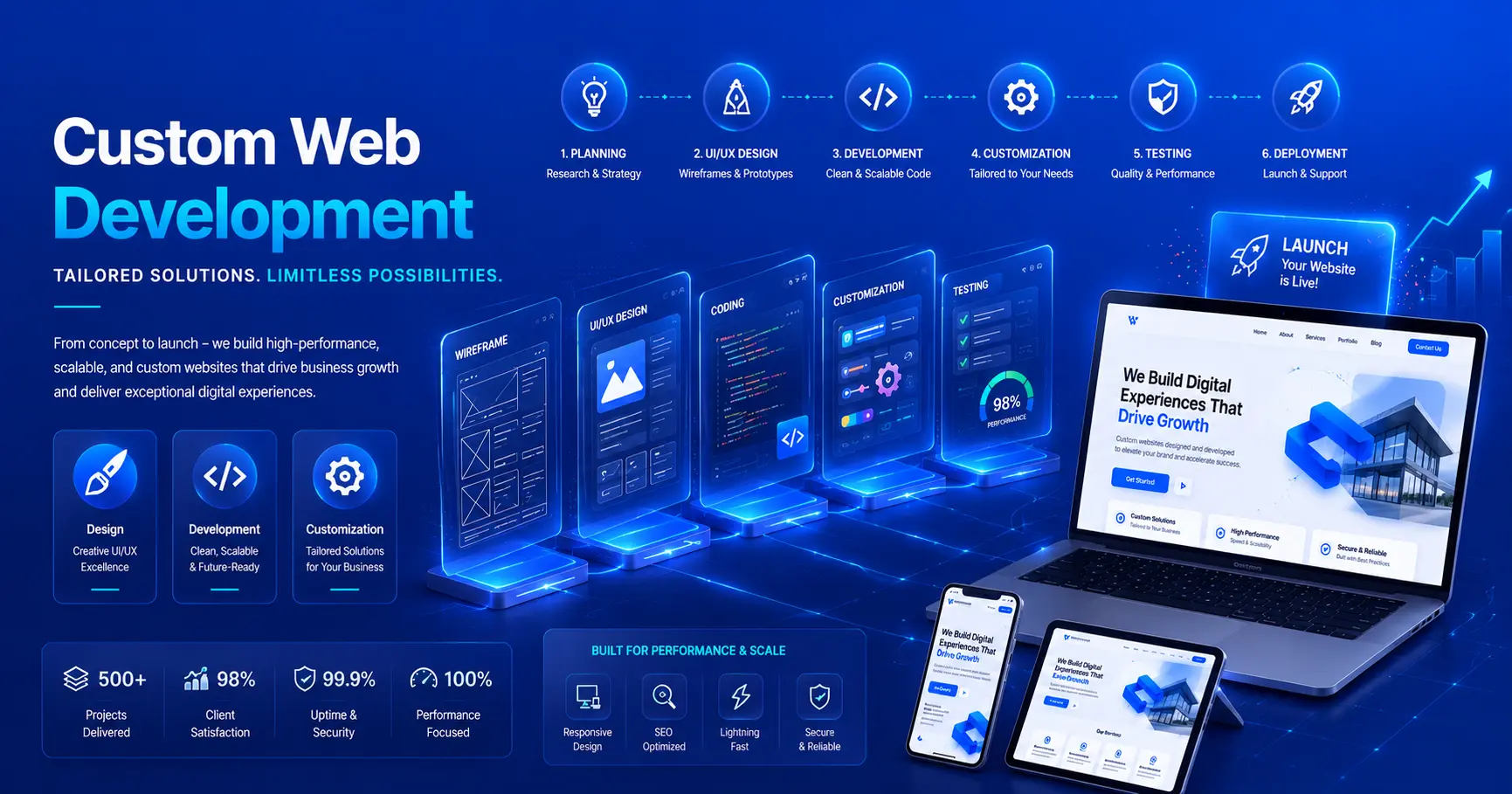
Discover what custom web development involves and how it gives your business a site built to grow. Get your free quote from Webtricker today.
Custom Web Development: Tailored Solutions for Your Business
Most websites on the internet look kind of the same — same layout, same button styles, same generic sections — because everyone grabbed the same template. Custom web development takes a different approach, building everything around your business instead of squeezing your business into someone else's design.
Quick Answer: Custom web development is the process of building a website from scratch around your specific business goals, rather than starting from a pre-made template. It gives you more flexibility, better long-term performance, and stronger security than template-based sites. Businesses that expect to grow, need unique functionality, or want to stand out from competitors are the best fit for custom web development.
Instead of starting with someone else's design and trying to make your business fit it, custom web development starts with your business and builds the website around it. Everything — from how it looks to how it works — gets made specifically for you.
In this guide, we'll walk through what custom web development actually involves, how the process works, and why it's often the smartest long-term investment a business can make.
What Is Custom Web Development?
Custom web development is the process of designing and coding a website from scratch to match the exact needs of a business or individual. Every part of the site — the layout, the visual design, the features, and the backend logic — is built around what that specific client actually needs.
Think of it this way: a template is like buying a house from a catalog. It's quick and affordable, but you get what you get. Custom web development is more like hiring an architect to design your home from the ground up. It takes more time and investment, but the result fits you perfectly.
This approach trades the speed and low upfront cost of templates for real flexibility. A custom-built site can support an e-commerce platform with unusual product configurations, a booking system with specific rules, or a tool that connects to your internal business software — things no off-the-shelf theme was ever designed to handle. Performance is part of that flexibility too: Google's own research with SOASTA found that as page load time stretches from one second to ten seconds, the probability of a mobile visitor bouncing rises by 123%, and that as the number of visual elements on a page climbs into the thousands, conversion probability can drop by as much as 95%. A site built only with what it actually needs, rather than padded with unused template code, has real room to perform better on both fronts.
What Are the Key Features of Custom Web Development?
So what actually makes a custom-built website different from one built on a template? Here are the qualities that consistently set them apart:
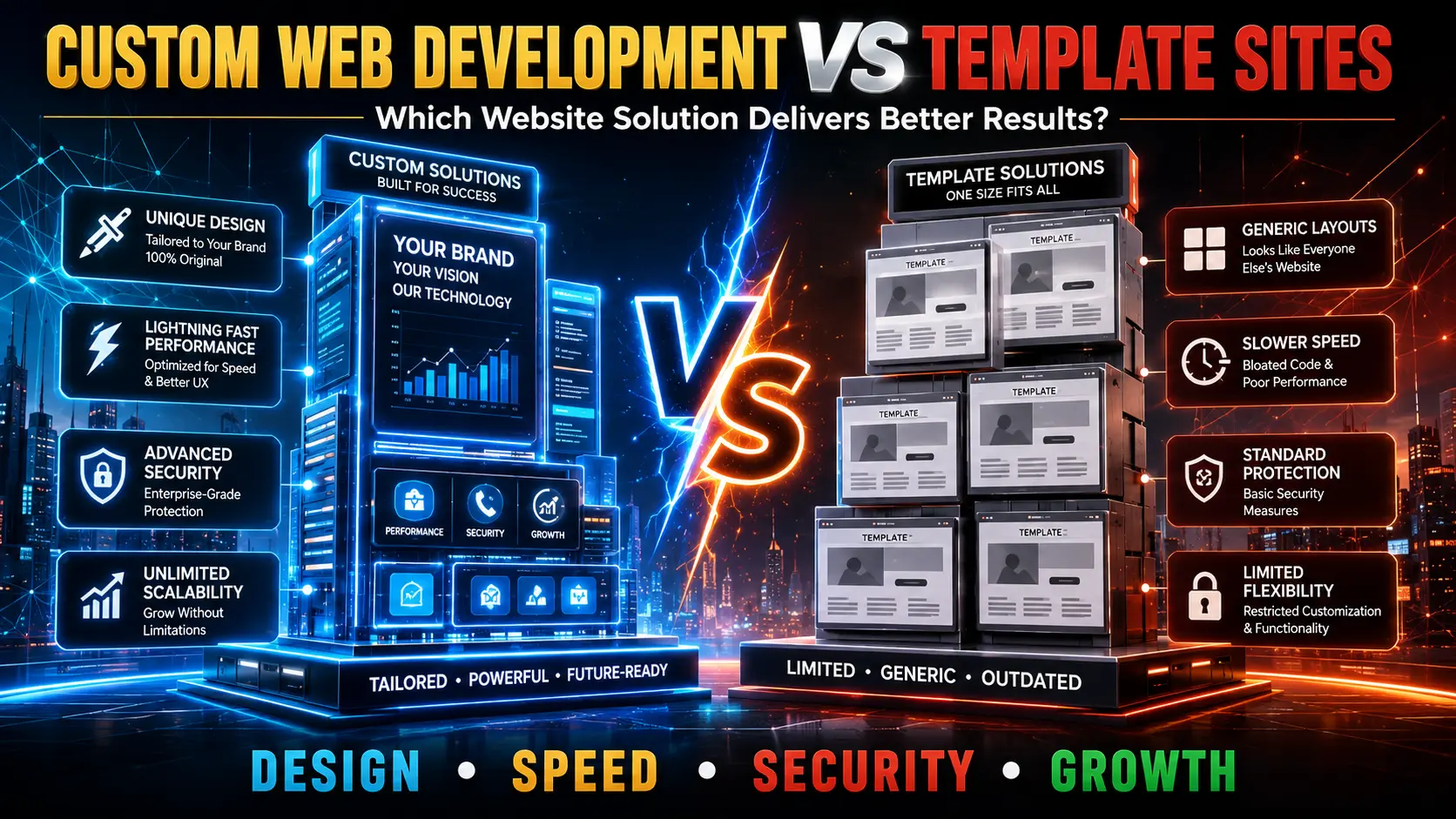
Unique design — your site reflects your brand, not a theme shared by thousands of other businesses. That alone helps you stand out from competitors using the same template from the same marketplace.
Tailored functionality — features are built around what your business actually does. Whether that means a custom checkout flow, a specialized content management system, or an integration with your CRM, it's built for your workflow, not a generic use case.
Scalability — as your business grows, your website can grow with it. New features can be added without being limited by what a template's structure was originally designed to support.
Better performance — template-based sites often carry code for features you never use, which adds unnecessary load time. A custom build only includes what's actually needed, which typically means faster page loads.
Stronger security — security measures can be designed around the specific risks your business faces rather than relying on generic protections built into a mass-distributed template. A good development team also builds with practices aligned to standards like the OWASP Top 10, which matters considerably if you handle payments or sensitive customer data.
Complete ownership — with a custom-built site, you own everything: the design, the code, the data. You're not locked into a platform's pricing changes or policy updates.
If you want to see what this looks like in practice, you can take a look at our custom development portfolio.
See Our Custom Web Development Services→

How Does the Custom Web Development Process Work?
Every custom web development project is different, but most follow a similar sequence of stages. Here's what you can typically expect:
Discovery and planning — before any design or code work begins, the team takes time to understand your business goals, your target audience, and the features your site needs. This stage defines the scope of the project and sets the foundation for everything that follows.
Design — a visual direction is created around your brand, covering layout, color scheme, typography, and the overall look and feel of the site.
Development — this is where the actual building happens, covering both the frontend (what visitors see and interact with) and the backend (the server logic, database, and integrations running behind the scenes).
Quality assurance — the finished site is tested thoroughly, checking that every feature works as intended, that it loads quickly, and that it looks right across different devices and browsers.
Launch and ongoing maintenance — the site goes live, and from that point on it typically needs monitoring, updates, and occasional improvements to stay secure, fast, and effective as the business evolves.
Why Do Businesses Choose Custom Web Development Over Templates?
The case for going custom usually comes down to a few practical advantages that add up over time.
Your website actually looks like your brand. Templates are shared with thousands of other businesses, and there's nothing worse than a potential customer recognizing your website layout from a competitor's site. A custom design avoids that entirely.
Functionality built around your actual business. A template might offer a basic contact form and a product catalog, but what if you need a multi-step quote calculator, a custom booking flow, or an integration with your internal inventory system? That's where custom development earns its cost.
Room to grow without starting over. Businesses that outgrow their template-based sites often face a full rebuild a few years down the line. A custom site, built with scalability in mind from the start, can usually absorb new features without that kind of disruptive overhaul.
Faster load times, with less bloat. Page speed isn't a minor detail — research cited by Google's own performance team has found that bounce probability increases by 32% as load time goes from one to three seconds, and a single additional second of load time has been measured to cut conversion rates by an average of 4.42% in some studies. A custom build that only ships the code it actually needs has a real structural advantage here over a template carrying features it never uses.
Security that fits your risk profile. A business handling payments or sensitive customer information has very different security needs than a simple portfolio site. Custom development allows security to be matched to your specific situation, not a one-size-fits-all template setting.
What Does Custom Web Development Cost Over the Long Term?
Custom web development almost always costs more upfront than a template-based site. That difference is real and worth planning for.
But here's what often gets missed: template-based sites frequently require expensive rebuilds once a business outgrows their limitations. Plugin conflicts, security vulnerabilities, slow load times, and outdated designs all pile up over time, and the cost of fixing those problems — or starting over entirely — can easily exceed what a custom site would have cost from the beginning.
The right comparison isn't just the sticker price at launch. It's the total cost over several years, factoring in how often each option is likely to need a significant rework. A well-built custom site tends to behave like an investment that keeps paying off, rather than a recurring expense that keeps growing.
Is Custom Web Development Right for Your Business?
Custom web development tends to make the most sense for businesses in one or more of these situations:
You have functionality needs that standard templates and plugins don't handle well.
Brand differentiation matters, and looking like your competitors is a real concern.
You expect meaningful growth or changes in the next few years and want a site that can adapt.
You handle sensitive data or transactions and need security built around your specific needs.
You want to own your platform completely rather than stay locked into a third-party service.
That said, a simple personal blog or a very small local business with modest needs may be perfectly well served by a good template, and there's nothing wrong with that choice if it genuinely fits the situation. The goal is matching the solution to the actual need, not overcomplicating things for the sake of it.
What Should You Look for in a Custom Web Development Partner?
Choosing the right team to build your custom site matters just as much as deciding to go custom in the first place. Here's what to look for:
A clear process — a good development partner should be able to walk you through exactly how they work, from discovery to launch, without vague answers.
Relevant experience — look for a team that has built sites with similar complexity or in a similar industry. Past work tells you a lot more than promises do.
Transparent communication — you should always know where your project stands, with regular updates and issues flagged early rather than at the last minute.
Post-launch support — a website needs ongoing maintenance, so make sure your partner offers continued support after launch rather than a handoff and goodbye.
Honest advice — the best partners will tell you if a template would actually serve your needs better. If someone is trying to sell you a custom build you don't actually need, that's a red flag worth taking seriously.
Frequently Asked Questions About Custom Web Development
How much more expensive is custom web development compared to a template?
A:Custom web development typically costs more upfront since everything is designed and built specifically for your business. The exact difference depends on the complexity of the features involved, and the better question is usually total cost over time — on that measure, custom often comes out ahead.
How long does a custom web development project take?
A: Timelines vary by scope, but a custom business website commonly takes anywhere from a few weeks for a straightforward site to several months for a complex platform with extensive functionality.
Can a custom website still use plugins or third-party tools?
A: Yes. Custom web development doesn't mean avoiding all existing tools — it often means combining custom-built features with select third-party integrations where they make sense, rather than relying entirely on a pre-packaged template.
Is custom web development worth it for a small business?
A: It depends on the specific needs involved. A small business with straightforward requirements may do well with a quality template, while one with unusual functionality needs, growth plans, or strong brand differentiation concerns often benefits more from a custom approach, even at a higher initial cost.
What technologies are typically used in custom web development?
A: It varies by project, but common choices include HTML, CSS, and JavaScript for the frontend, with backend options like Node.js, Python, or PHP. Databases like PostgreSQL or MongoDB are common too, with the right stack depending on what the site actually needs to do.
Will I be able to update my own website after it's built?
A: Yes. A good custom development team will build a content management system into your site that lets you update text, images, blog posts, and other content without touching any code.
Is Custom Web Development Worth It in the End?
Custom web development isn't the right fit for every project, but for businesses with specific functionality needs, growth plans, or a real reason to stand apart from competitors using the same templates, it tends to pay off well beyond the initial build.
A site designed around your actual business, rather than adapted from something generic, is easier to scale, generally performs better, and can be secured more precisely around the risks that matter most. That's the real promise of custom web development — not just a different-looking website, but one built to actually carry your business forward.
Get a Custom Web Development Quote→
Talk to Our Web Development Team→