



Published 24 Jun 2024
Ecommerce Website Builder for Online Stores: The Complete Guide

Discover how to choose and use the right ecommerce website builder to launch, grow, and scale your online store. Get your free quote from Webtricker today.
Ecommerce Website Builder for Online Stores: The Complete Guide
Quick Answer: An ecommerce website builder is a platform or service that helps you create a fully functional online store without needing advanced coding skills. The right ecommerce website builder gives you the tools to design your storefront, manage products, process payments, and grow your business — all in one place. Whether you're just starting out or scaling an existing store, choosing the right ecommerce website builder is one of the most important decisions you'll make for your online business.
The way people shop has changed completely. Customers no longer need to visit a physical store to browse, compare, and buy — they do it from their phones, their laptops, and even their smart TVs, at any hour of the day or night.
If you want to reach those customers, you need more than just a presence online. You need a well-built, fast, and trustworthy online store. And to build that store, you need the right ecommerce website builder.
In this guide, we'll walk you through everything you need to know about choosing and using an ecommerce website builder for your online store — from planning and design to marketing, operations, and ongoing optimization.
1. What Is an Ecommerce Website Builder?
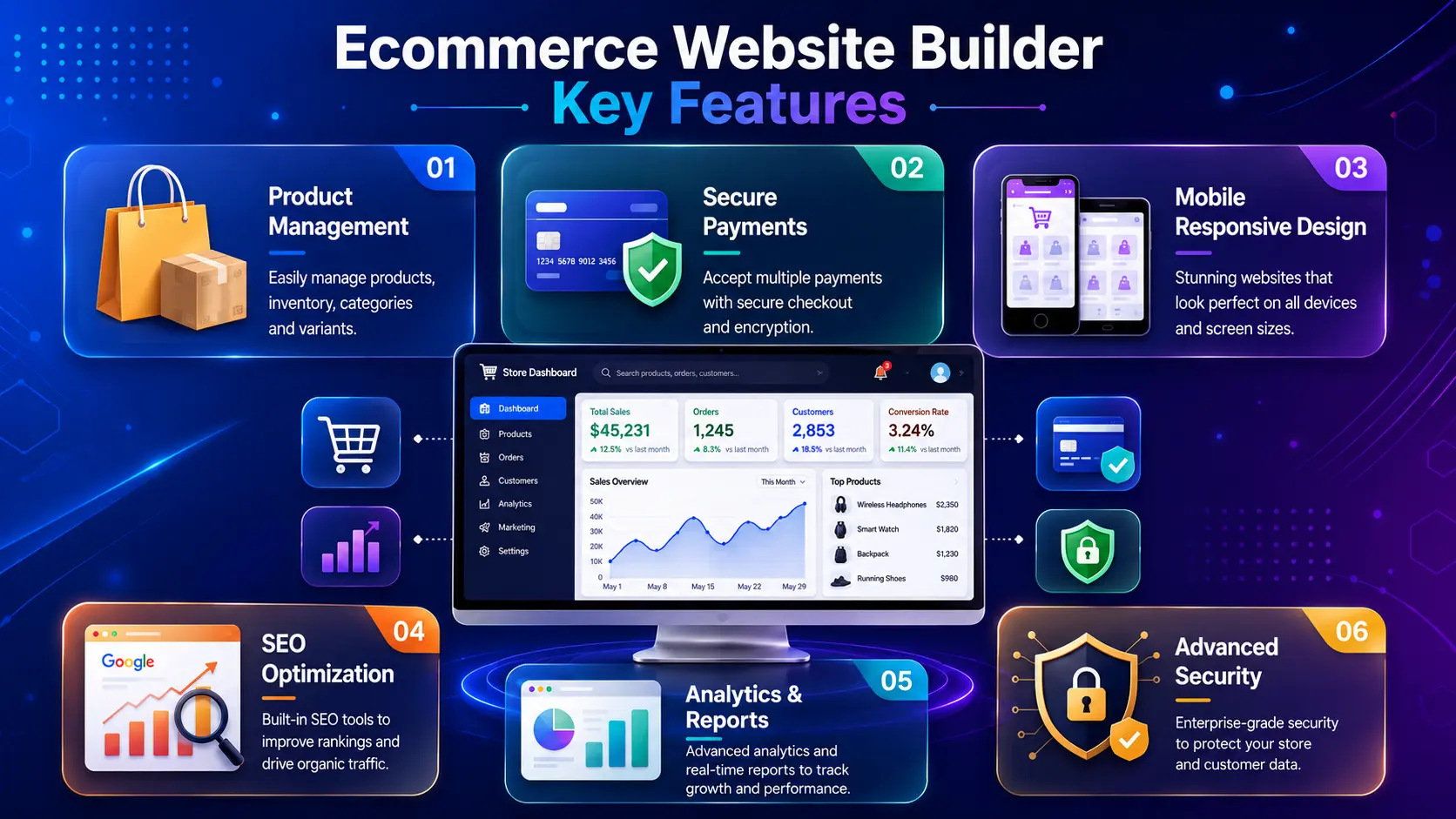
An ecommerce website builder is a tool or platform that allows businesses and individuals to create, customize, and manage an online store. Unlike a standard website builder, it's designed specifically for selling — it includes features like product management, shopping cart functionality, secure payment processing, and order tracking built right in.
The best ecommerce website builders on the market today make it possible for someone with zero coding experience to launch a professional online store in a matter of days. At the same time, they offer enough flexibility and depth that more experienced developers can customize every aspect of the store to match specific business needs.
Some of the most widely used platforms include Shopify, WooCommerce, BigCommerce, and Magento. Each one has its own strengths depending on the size and type of business you're running.
An ecommerce website is more than just a digital catalog. It's a 24/7 sales channel that lets customers browse your products, add items to a cart, complete a secure purchase, and receive confirmation — all without any manual involvement on your end. When built correctly with the right ecommerce website builder, your online store becomes one of your most powerful business assets.
2. Planning and Strategy: Before You Choose an Ecommerce Website Builder
Before you choose an ecommerce website builder and start designing your store, you need a clear plan. Skipping this step is one of the most common reasons online stores fail to gain traction even after launch.
Define your goals. Start by writing down exactly what you want your online store to accomplish. Do you want to sell handmade products to a local audience, or build a global brand around a specific product category? Your goals should be specific, measurable, and realistic — and they should directly inform every decision you make when setting up your store.
Understand your target audience. Who are your customers? How do they shop? What devices do they use? What problems are they trying to solve? The answers shape everything from store design to the tone of your product descriptions. A good ecommerce website builder gives you the tools to serve your audience — but first, you need to know who that audience is.
Research your market. Look at what competitors in your space are doing. What's working for them? Where are the gaps? Use this research to position your store in a way that stands out, and let it guide your choice of platform too — some are better suited to certain industries or product types than others.
Plan your budget. Every ecommerce website builder comes with its own pricing structure. Some charge a monthly fee, others take a percentage of each transaction, and some require separate hosting costs. Map out your expected costs before you commit to a platform, and make sure your budget covers marketing, inventory, and ongoing maintenance too — not just the builder itself.
3. Choosing the Right Ecommerce Website Builder
Not every ecommerce website builder is the right fit for every business. Here's a breakdown of the most popular options and what they're best suited for:
Shopify — One of the most widely used platforms in the world. It's beginner-friendly, comes with a large selection of themes, and offers built-in tools for payment processing, shipping, and marketing. A great choice for businesses that want to launch quickly and scale without managing complex technical infrastructure.
WooCommerce — A free ecommerce website builder plugin that runs on WordPress. Highly flexible and gives you complete control over your store, but it requires more technical knowledge than Shopify. A strong choice for businesses that already use WordPress or want maximum customization without a monthly platform fee.
BigCommerce — A powerful platform built for businesses that are scaling fast. It handles large product catalogs well, supports multiple sales channels, and comes with strong built-in SEO features — solid for mid-to-large businesses that need enterprise-level features without full custom development.
Magento — An open-source ecommerce website builder designed for large, complex online stores. It offers unmatched flexibility and customization but requires significant technical resources to set up and maintain — best suited for enterprises with dedicated development teams.
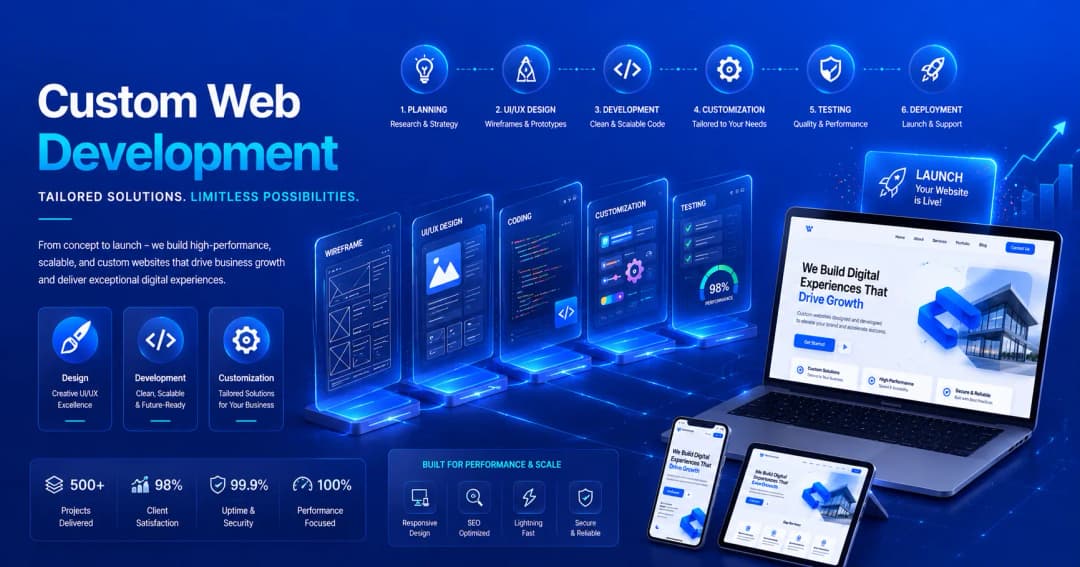
Custom development — For businesses with very specific requirements that no off-the-shelf builder can meet, custom development is the answer. At Webtricker, we build fully custom ecommerce solutions designed around your exact needs, from unique checkout flows to complex integrations with internal business systems.
4. Design and User Experience
Once you've chosen your ecommerce website builder, the next step is designing a store that looks great and works even better. Design and user experience aren't just about aesthetics — they directly affect whether visitors stay on your site, trust your brand, and complete a purchase.
Visual design. Your store should reflect your brand consistently across every page — colors, fonts, and logo used throughout. A well-designed store creates a strong first impression and builds the kind of credibility that encourages visitors to buy.
Navigation. Clear, logical navigation is essential. Customers should be able to find what they're looking for in seconds. Organize products into clear categories, use a search bar, and make sure your menu structure makes sense from the customer's perspective, not just your own.
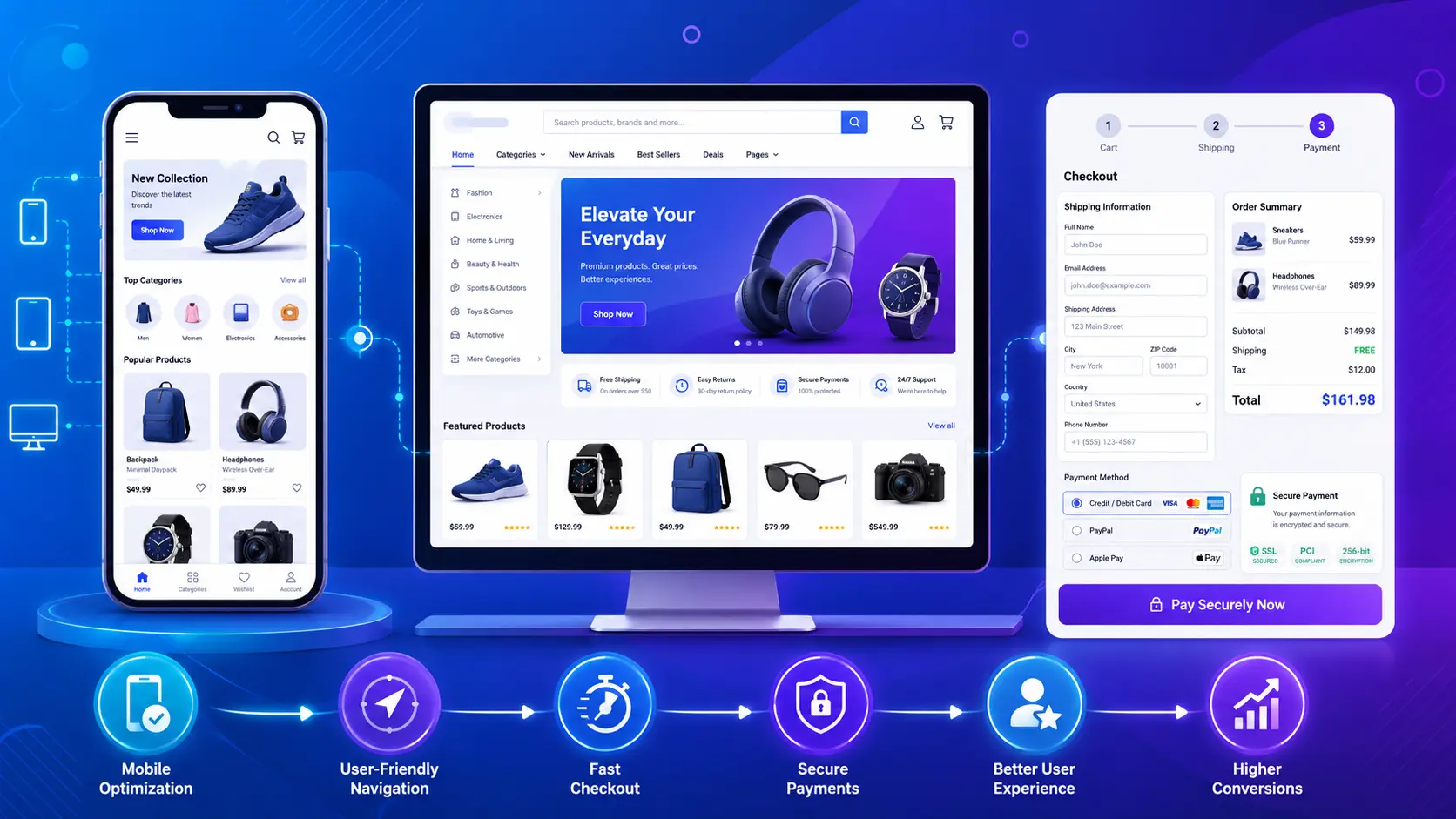
Mobile responsiveness. More than half of all online shopping happens on mobile devices. Every serious ecommerce website builder will offer responsive design, but it's important to actually test your store on a phone before launching. A store that looks great on desktop but breaks on mobile will lose a significant share of its potential customers.
Checkout process. A complicated checkout is one of the biggest causes of cart abandonment. Keep the number of steps as low as possible, offer multiple payment options, and make sure the process feels secure and straightforward. The best platforms offer streamlined checkout flows that reduce friction at this critical moment.
2. Planning and Strategy: Before You Choose an Ecommerce Website Builder
Before you choose an ecommerce website builder and start designing your store, you need a clear plan. Skipping this step is one of the most common reasons online stores fail to gain traction even after launch.
Define your goals. Start by writing down exactly what you want your online store to accomplish. Do you want to sell handmade products to a local audience, or build a global brand around a specific product category? Your goals should be specific, measurable, and realistic — and they should directly inform every decision you make when setting up your store.
Understand your target audience. Who are your customers? How do they shop? What devices do they use? What problems are they trying to solve? The answers shape everything from store design to the tone of your product descriptions. A good ecommerce website builder gives you the tools to serve your audience — but first, you need to know who that audience is.
Research your market. Look at what competitors in your space are doing. What's working for them? Where are the gaps? Use this research to position your store in a way that stands out, and let it guide your choice of platform too — some are better suited to certain industries or product types than others.
Plan your budget. Every ecommerce website builder comes with its own pricing structure. Some charge a monthly fee, others take a percentage of each transaction, and some require separate hosting costs. Map out your expected costs before you commit to a platform, and make sure your budget covers marketing, inventory, and ongoing maintenance too — not just the builder itself.
3. Choosing the Right Ecommerce Website Builder
Not every ecommerce website builder is the right fit for every business. Here's a breakdown of the most popular options and what they're best suited for:
Shopify — One of the most widely used platforms in the world. It's beginner-friendly, comes with a large selection of themes, and offers built-in tools for payment processing, shipping, and marketing. A great choice for businesses that want to launch quickly and scale without managing complex technical infrastructure.
WooCommerce — A free ecommerce website builder plugin that runs on WordPress. Highly flexible and gives you complete control over your store, but it requires more technical knowledge than Shopify. A strong choice for businesses that already use WordPress or want maximum customization without a monthly platform fee.
BigCommerce — A powerful platform built for businesses that are scaling fast. It handles large product catalogs well, supports multiple sales channels, and comes with strong built-in SEO features — solid for mid-to-large businesses that need enterprise-level features without full custom development.
Magento — An open-source ecommerce website builder designed for large, complex online stores. It offers unmatched flexibility and customization but requires significant technical resources to set up and maintain — best suited for enterprises with dedicated development teams.
Custom development — For businesses with very specific requirements that no off-the-shelf builder can meet, custom development is the answer. At Webtricker, we build fully custom ecommerce solutions designed around your exact needs, from unique checkout flows to complex integrations with internal business systems.
4. Design and User Experience
Once you've chosen your ecommerce website builder, the next step is designing a store that looks great and works even better. Design and user experience aren't just about aesthetics — they directly affect whether visitors stay on your site, trust your brand, and complete a purchase.
Visual design. Your store should reflect your brand consistently across every page — colors, fonts, and logo used throughout. A well-designed store creates a strong first impression and builds the kind of credibility that encourages visitors to buy.
Navigation. Clear, logical navigation is essential. Customers should be able to find what they're looking for in seconds. Organize products into clear categories, use a search bar, and make sure your menu structure makes sense from the customer's perspective, not just your own.
Mobile responsiveness. More than half of all online shopping happens on mobile devices. Every serious ecommerce website builder will offer responsive design, but it's important to actually test your store on a phone before launching. A store that looks great on desktop but breaks on mobile will lose a significant share of its potential customers.
Checkout process. A complicated checkout is one of the biggest causes of cart abandonment. Keep the number of steps as low as possible, offer multiple payment options, and make sure the process feels secure and straightforward. The best platforms offer streamlined checkout flows that reduce friction at this critical moment.
5. Development: Building Your Online Store
Setting up an ecommerce website builder involves more than just picking a theme and adding products. The development stage is where your store gets its technical foundation, and getting this right matters enormously for performance, security, and long-term growth.
Frontend development. Everything your customers see and interact with. A well-built frontend loads quickly, looks clean on every device, and guides customers naturally through browsing and buying. Key priorities include fast image loading, clear product displays, and intuitive interactive elements.
Backend development. The logic your customers never see but always depend on — product databases, order processing, user accounts, and payment integrations. Whether you're using a hosted platform like Shopify or a self-hosted solution like WooCommerce, the backend needs to be stable, secure, and scalable.
Security. Non-negotiable for any online store. Your store handles sensitive customer data and financial transactions, and any breach can destroy customer trust overnight. Essential measures include SSL certificates, secure payment gateways aligned with PCI DSS standards, regular software updates, and strong data protection practices.
Testing before launch. Never launch a store without thorough testing. Check every product page, every link, every payment method, and every form, across multiple devices and browsers. A bug or broken checkout on launch day can cost you sales and damage your reputation before you even get started.
6. Content Creation for Your Ecommerce Store
Great content is what separates a store that ranks and converts from one that disappears in search results. Your ecommerce website builder gives you the structure — your content fills it with value.
Product descriptions. Every product needs a clear, specific, and persuasive description. Avoid copying manufacturer descriptions, since that creates duplicate content that hurts your SEO. Write descriptions that highlight key benefits, address common questions, and speak directly to the customer most likely to buy.
Product images and videos. High-quality visuals are essential. Use multiple images per product showing different angles and contexts, and include short product videos where possible. Customers can't physically handle your products, so your images need to do that work for them.
Blog content. A blog built into your store is one of the most effective long-term SEO tools available. Regular posts on topics relevant to your products bring in organic traffic, build authority, and give customers reasons to trust your brand before they're ready to buy.
Customer reviews. Reviews and testimonials are among the most powerful conversion tools any store has. Make it easy for customers to leave reviews, display them prominently on product pages, and respond to both positive and negative feedback professionally.
7. Marketing and Sales Strategy
Building your store on the right ecommerce website builder is just the beginning. Getting customers to find it, trust it, and buy from it requires a consistent, multi-channel marketing strategy.
Search engine optimization. The most cost-effective long-term marketing channel for any online store. Optimize product pages with relevant keywords, write unique meta descriptions, use clean URL structures, and build internal links between related products and content. Most platforms offer built-in SEO tools to help with this.
Social media marketing. Instagram, Facebook, and Pinterest are powerful channels for driving traffic to your storefront. Post regularly, use high-quality visuals, and engage with your followers. Social media is also an excellent channel for running paid campaigns targeting specific customer profiles.
Email marketing. Email remains one of the highest-ROI marketing channels available. Use your store's tools to collect email addresses and build an automated sequence for new subscribers, with regular updates about new products, promotions, and content.
Pay-per-click advertising. PPC through Google Ads or social platforms can drive immediate, targeted traffic to your storefront. Use it to promote high-margin products, test new offerings, or capture demand that SEO hasn't yet reached.
Conversion optimization. Getting traffic to your store is only half the job. Use Google Analytics alongside your platform's built-in reporting to understand where visitors are dropping off, which products are getting views but no purchases, and what changes might improve your conversion rate.
8. Operations and Customer Service
An ecommerce website builder handles the customer-facing side of your business — but behind the scenes, you need solid operations to fulfill orders accurately, manage inventory, and keep customers happy.
Inventory management. Use your platform's inventory tools to track stock levels, set low-stock alerts, and avoid overselling. Nothing damages customer trust faster than placing an order and then being told the item is out of stock.
Order fulfillment. A clear, efficient fulfillment process is essential. Whether you handle shipping yourself or use a third-party fulfillment service, make sure orders are processed and shipped quickly, with accurate tracking information.
Customer support. Excellent support turns one-time buyers into loyal, repeat customers. Offer multiple support channels — live chat, email, and a thorough FAQ section at minimum — and respond quickly to inquiries and complaints alike.
9. Analytics and Ongoing Optimization
Launching your store is not the end — it's the beginning. The stores that succeed long-term are the ones that consistently review their data and make improvements based on what they find.
Traffic analytics. Use tools like Google Analytics alongside your ecommerce website builder's built-in reporting to understand where visitors are coming from, which pages they visit, and how long they stay. This data tells you what's working and where you're losing people.
Sales data. Track your best-selling products, your average order value, and your conversion rate. These metrics reveal the health of your store and point toward the highest-impact areas for improvement.
Continuous testing. Run A/B tests on key storefront elements — product page layouts, CTA button text, checkout flows, and pricing displays. Small improvements in conversion rate can translate into significant revenue gains over time.
No platform runs itself. The businesses that get the most out of their ecommerce website builder treat launch day as the starting line, not the finish line.
Frequently Asked Questions
What is the best ecommerce website builder for beginners?
A: Shopify is widely considered the most beginner-friendly option. It's easy to set up, comes with a large selection of themes, and handles payment processing and shipping out of the box. For businesses already using WordPress, WooCommerce is a strong alternative.
How much does it cost to build an online store with an ecommerce website builder?
A:Costs vary widely depending on the platform you choose. Hosted platforms like Shopify start from around $29 per month, while open-source options like WooCommerce are free to install but require separate hosting and development costs. Custom-built ecommerce solutions from a team like Webtricker involve a higher upfront investment but offer complete flexibility and long-term scalability.
Do I need coding skills to use an ecommerce website builder?
A:Most modern platforms are designed to be used without any coding knowledge — you can set up a fully functional store using drag-and-drop tools and pre-built templates. That said, some technical knowledge becomes useful once you want to customize your store beyond the standard options.
Can an ecommerce website builder handle a large product catalog?
A:Yes. Platforms like BigCommerce and Magento are specifically built to handle large catalogs efficiently, and Shopify also scales well with the right plan. If your catalog is very large or has complex product variations, it's worth discussing your needs with a development team before committing to a platform.
How important is mobile responsiveness for an ecommerce website builder?
A:Extremely important. More than half of all online shopping now happens on mobile devices. Any platform you choose should offer fully responsive themes, and you should test your store thoroughly on mobile before launching.
Can I migrate from one ecommerce website builder to another?
A: Yes, migration between platforms is possible, though it can be complex depending on the size of your store and the platforms involved. Product data, customer records, and order history can usually be transferred, but design and custom functionality often need to be rebuilt. Working with an experienced development team makes this process significantly smoother.
Conclusion
Choosing and building with the right ecommerce website builder is one of the most impactful decisions you'll make for your online business. The right platform gives you a solid foundation — but it's the strategy, design, content, and ongoing optimization built on top of that foundation that ultimately determines whether your store grows or stagnates.
At Webtricker, we help businesses build ecommerce stores that are fast, secure, and designed to convert. Whether you need help choosing the right ecommerce website builder, setting up your store from scratch, or taking an existing store to the next level, our team is ready to help.
Get Your Free Ecommerce Website Consultation →
Explore Our Ecommerce Development Services →