Published 30 Aug 2025
Web App Development
Webtricker's Web App Development service builds SPAs and full multi-page applications in React, Next.js, Node.js, PHP, MySQL & MongoDB — design to deployment.
Explore our achievements and let yourself beconvinced!
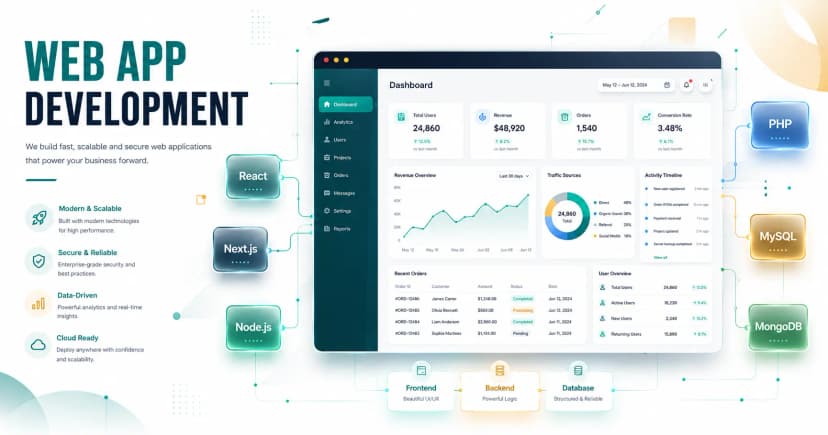
Webtricker's Web App Development service builds SPAs and full multi-page applications in React, Next.js, Node.js, PHP, MySQL & MongoDB — design to deployment.
Web App Development
A web application is software your customers can use anywhere without installing anything. Webtricker's Web App Development service builds them end to end, single-page applications, full multi-page platforms, and everything in between, using React, Next.js, Node.js, PHP, MySQL, and MongoDB.
Quick Answer: Web App Development at Webtricker means building complete, functional web applications from scratch, through the full pipeline of design, coding, deployment, testing, debugging, and finalization, using whichever combination of React, Next.js, Node.js, PHP, MySQL, and MongoDB fits the project.
Table of Contents:
• What Is Web App Development?
• What Technologies Does Webtricker Use for Web App Development?
• What Types of Web Applications Does Webtricker Build?
• What Does the Development Process Actually Look Like?
• Why Choose Webtricker for Web App Development?
• Frequently Asked Questions
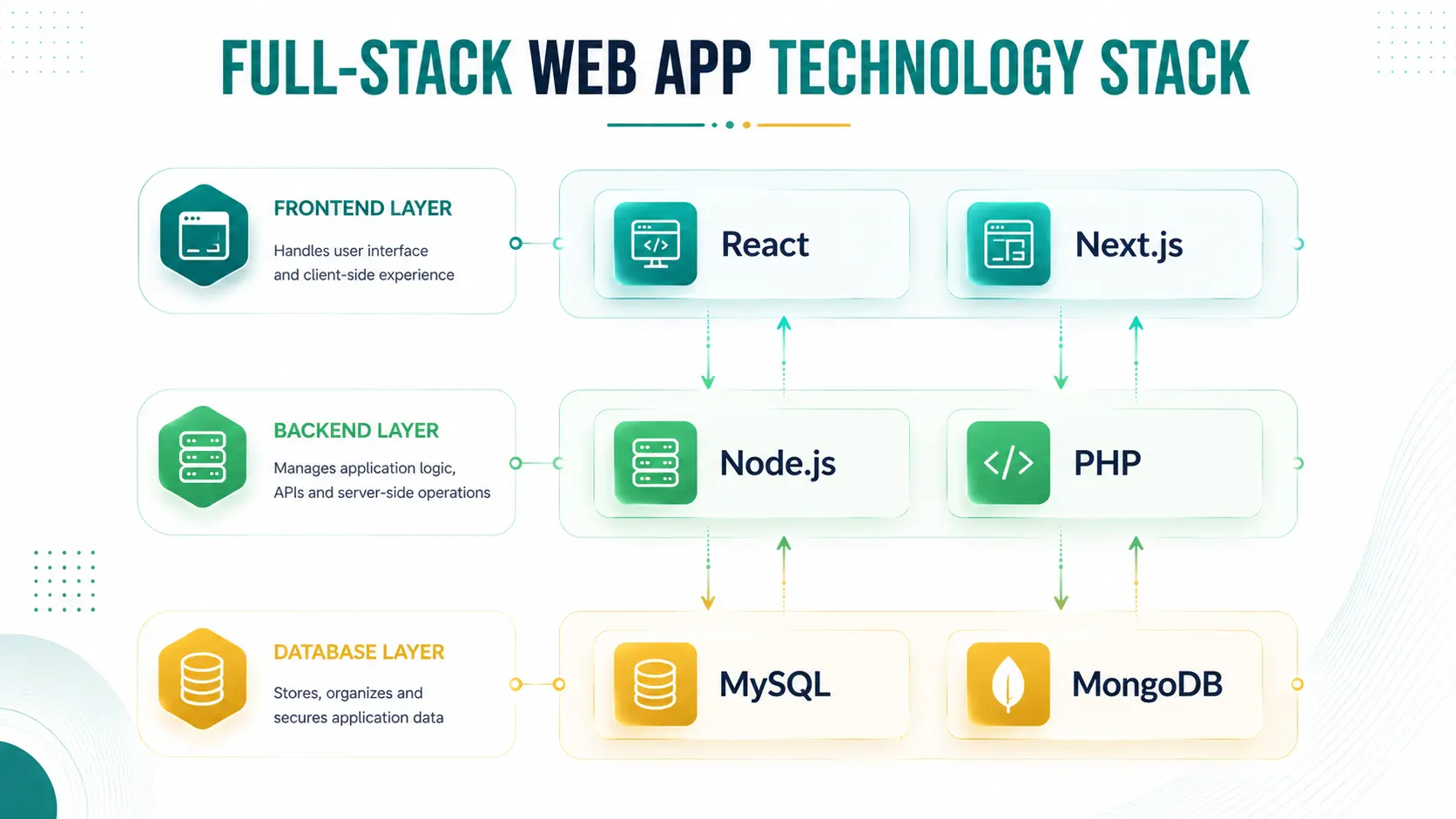
Webtricker builds web applications using:
• React and Next.js (frontend and server-side rendering)
• Node.js (backend runtime and API layer)
• PHP (server-side scripting for traditional and CMS-based stacks)
• MySQL and MongoDB (relational and NoSQL databases)
Here's what each part of that means in practice, and what the build process actually looks like from idea to launch.
What Is Web App Development?
A web application is software that runs in a browser instead of being installed on a device. Users access it through a URL, it updates in real time, it works across devices without platform-specific builds, and it scales with demand in ways that downloaded software can't.
The web development services market reached roughly $89 billion in 2025 and is growing at 8.2 percent annually, according to Colorlib's 2026 web development statistics report. Building on the most widely-used frameworks, React is used by 44.7 percent of developers and Node.js by 48.7 percent according to the Stack Overflow Developer Survey 2025 via Statista, keeps that investment in tools with the strongest available ecosystem of community support, documentation, and talent.
Web apps sit in a useful middle ground between simple websites and native desktop or mobile applications. They can offer highly interactive, dynamic user experiences without requiring download or installation, and they can reach any device with a browser, which is essentially all of them.
What Technologies Does Webtricker Use for Web App Development?
The tech stack varies by project, but Webtricker's core tools span the full stack.
React. A JavaScript library for building component-based user interfaces, used across the frontend on most projects because its Virtual DOM makes updates fast and its component architecture keeps large UIs manageable as they grow. Next.js. A React framework that adds server-side rendering, static generation, and edge performance. Used when page load speed, SEO, or initial render time matters more than a pure client-side single-page application. Node.js. The backend runtime for building the API layer, handling server-side logic, and connecting the frontend to databases and external services. Lets the frontend and backend share the same language, which reduces context-switching and integration friction. PHP. A proven server-side language for applications that pair well with WordPress or that have traditional backend requirements where PHP's maturity and hosting availability are an advantage. MySQL. A relational database used for structured data with complex relationships, transactions, and queries that benefit from a consistent schema. MongoDB. A document-oriented NoSQL database used when data is flexible or hierarchical, when schemas need to evolve quickly, or when the application is part of a MERN stack build.
What Types of Web Applications Does Webtricker Build?
Single-page applications. SPAs load once and update content dynamically without reloading the full page, built in React or Next.js for fast, app-like experiences in the browser. Multi-page web applications. Traditional multi-page architectures where each route loads its own page, suited to content-heavy platforms, e-commerce, dashboards, and applications where search indexability matters from the start. Custom business platforms. Internal tools, dashboards, admin panels, and workflow applications that solve specific operational problems rather than serve a general audience. API-driven applications. Frontend applications built to consume data from an existing or custom-built API, often part of a larger system where the data layer is managed separately. Progressive web applications. Web apps that behave like native apps, including offline support and push notifications, built for users who need app-like functionality without requiring an app store download.
What Does the Development Process Actually Look Like?
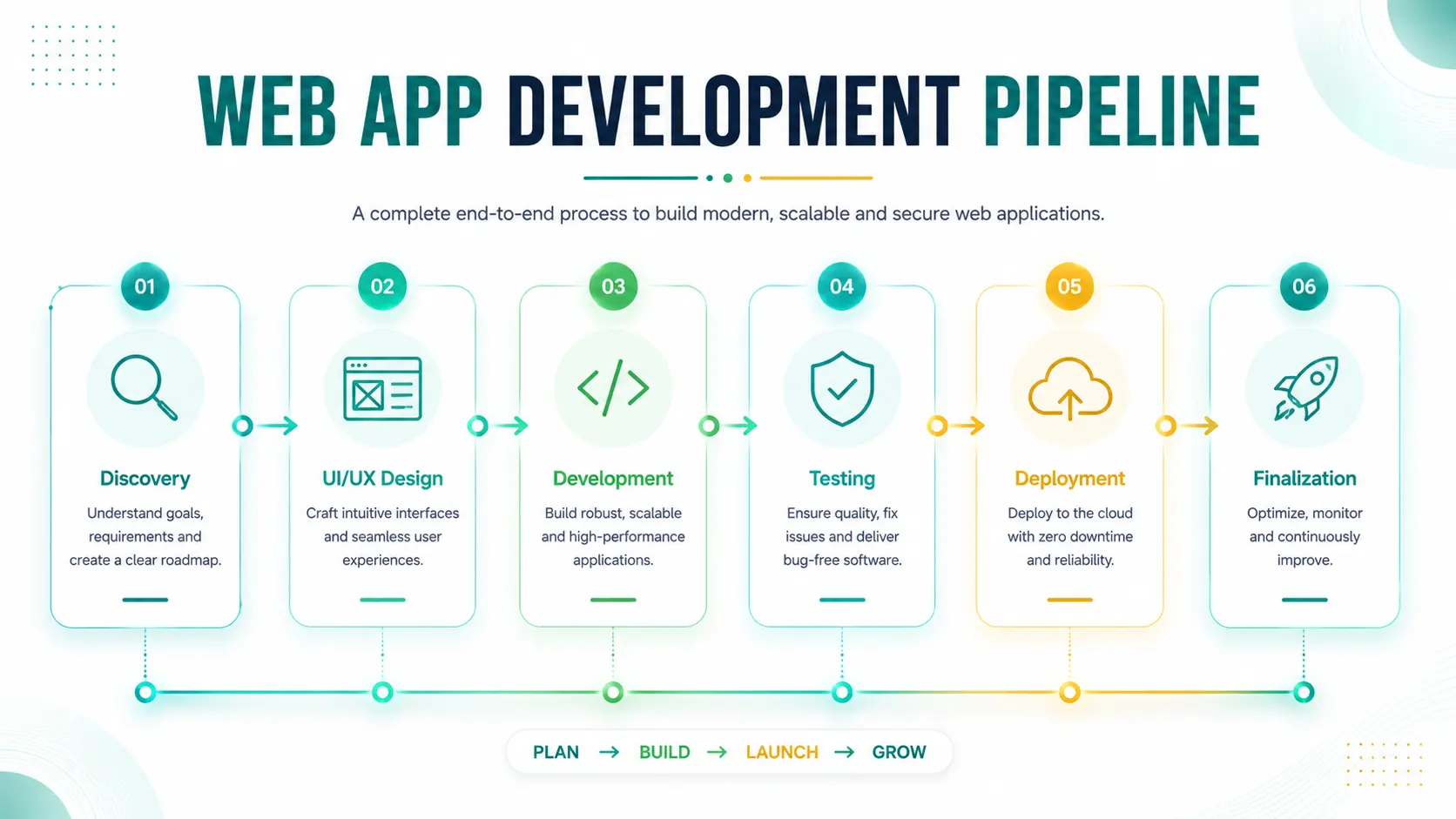
Every project follows a start-to-end pipeline, not a handoff between separate teams.
Discovery and brainstorming. Understanding the requirements, the intended users, and the constraints before a single line of code is written. This is where the project scope, feature priorities, and technology stack get defined. UI and UX design. Translating the brief into wireframes and UI templates, reviewed and approved before development begins. Design decisions made here directly affect build time and user experience quality. Development. Building the application in the approved stack, frontend and backend in parallel where possible, with regular checkpoints rather than one delivery at the end. Testing and debugging. Functional testing, integration testing, and edge case handling before deployment. Bugs caught before launch are cheaper to fix than bugs caught in production. Deployment. Taking the application live in the right environment, configured for performance, security, and the expected traffic load. Finalization and handoff. Confirming everything works as specified, documenting what was built, and establishing what happens next, ongoing support, future feature development, or a clean handoff to the client's team.
This work pairs naturally with our API Development services when the application needs a custom backend or third-party integrations, and with our SEO Development services for web apps where organic search visibility matters.
Why Choose Webtricker for Web App Development?
Full-stack capability. React, Next.js, Node.js, PHP, MySQL, and MongoDB covered in one team, so the frontend, backend, and database layer don't have to be managed separately. Start-to-end ownership. From brainstorming through deployment and finalization, the same team handles the whole pipeline rather than handing off between separate designers, developers, and QA teams. Technology matched to the project. The stack gets chosen based on what the application actually needs, not defaulted to the same tools for every project regardless of fit. Commitment to what ships, not just what's built. Development, deployment, testing, and debugging are all part of the engagement, not add-ons to negotiate separately.
Our web development services cover the broader landscape if the requirement is a website rather than a full web application.
Frequently Asked Questions
Q: What is the difference between a website and a web application?
A: A website primarily delivers content, a web application primarily lets users do something, log in, submit data, interact with a dashboard, or trigger actions. The line isn't always sharp, but web applications involve more dynamic, stateful behavior than a content site.
Q: Can Webtricker build both the frontend and backend of a web application?
A: Yes. The team covers the full stack, React or Next.js on the frontend, Node.js or PHP on the backend, and MySQL or MongoDB for the database layer, so the whole application is built in one engagement.
Q: Do I need to know which technology stack I want before starting?
A: No. Part of the discovery phase is recommending the right stack based on your requirements, budget, expected traffic, and what the application needs to do.
Q: Can Webtricker take over development on an existing web application?
A: Yes. Inheriting and extending an existing codebase is a regular part of our work, including auditing the current state, identifying what needs refactoring or replacement, and continuing development from there.
Q: What happens after the web application goes live?
A: Ongoing support and further feature development are available after launch. The post-launch plan gets defined before handoff so there's a clear path forward rather than a gap between launch and whatever comes next.
Q: Can a web application be built to work on mobile as well as desktop?
A: Yes. Responsive design is standard, so the application adapts to any screen size. For projects that need a dedicated mobile app experience, that's a separate conversation about React Native or a different mobile approach.
Build the Web Application Your Business Actually Needs
A web application that covers the full pipeline, design, development, deployment, testing, and support, is the difference between a project that ships and one that stalls somewhere in the middle. Webtricker's Web App Development service handles the whole thing.