

Published 14 Jun 2024
Learn About SEO Services: Introduction and More
New to SEO services? Learn what they include, why they drive growth, and how to choose the right approach for your business. Get your free SEO audit today!
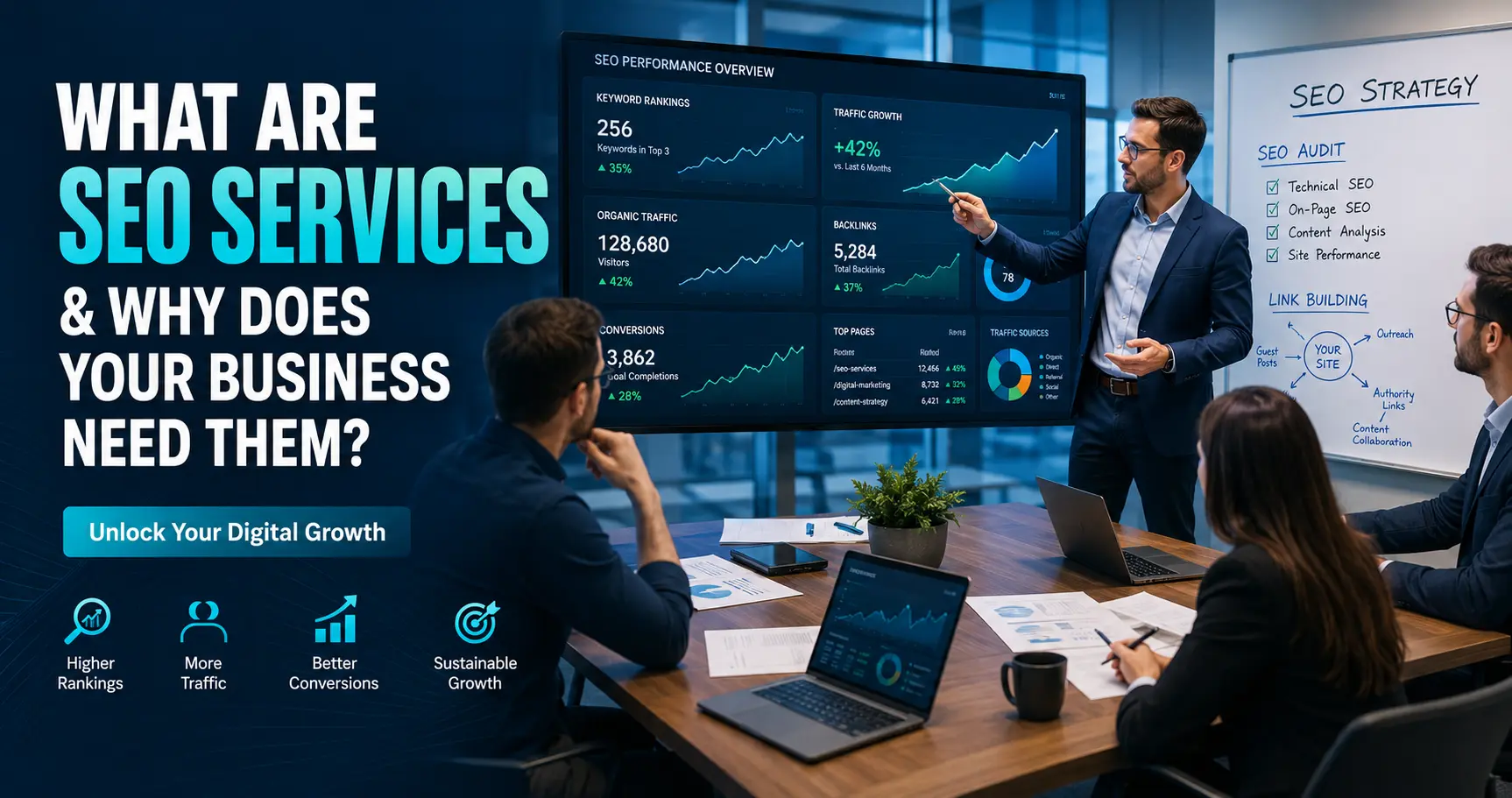
What Are SEO Services and Why Does Your Business Need Them?
A great-looking website doesn't help much if nobody can find it. SEO services are how businesses fix that — by making a site genuinely easier for search engines and AI platforms to understand, trust, and recommend.
Quick Answer: SEO services are professional efforts to improve a website's visibility in search engines and AI-driven answer platforms, covering technical site health, content optimization, and authority building. Businesses invest in them because organic search consistently drives more traffic and a stronger return than most other marketing channels.
What Do SEO Services Actually Include?
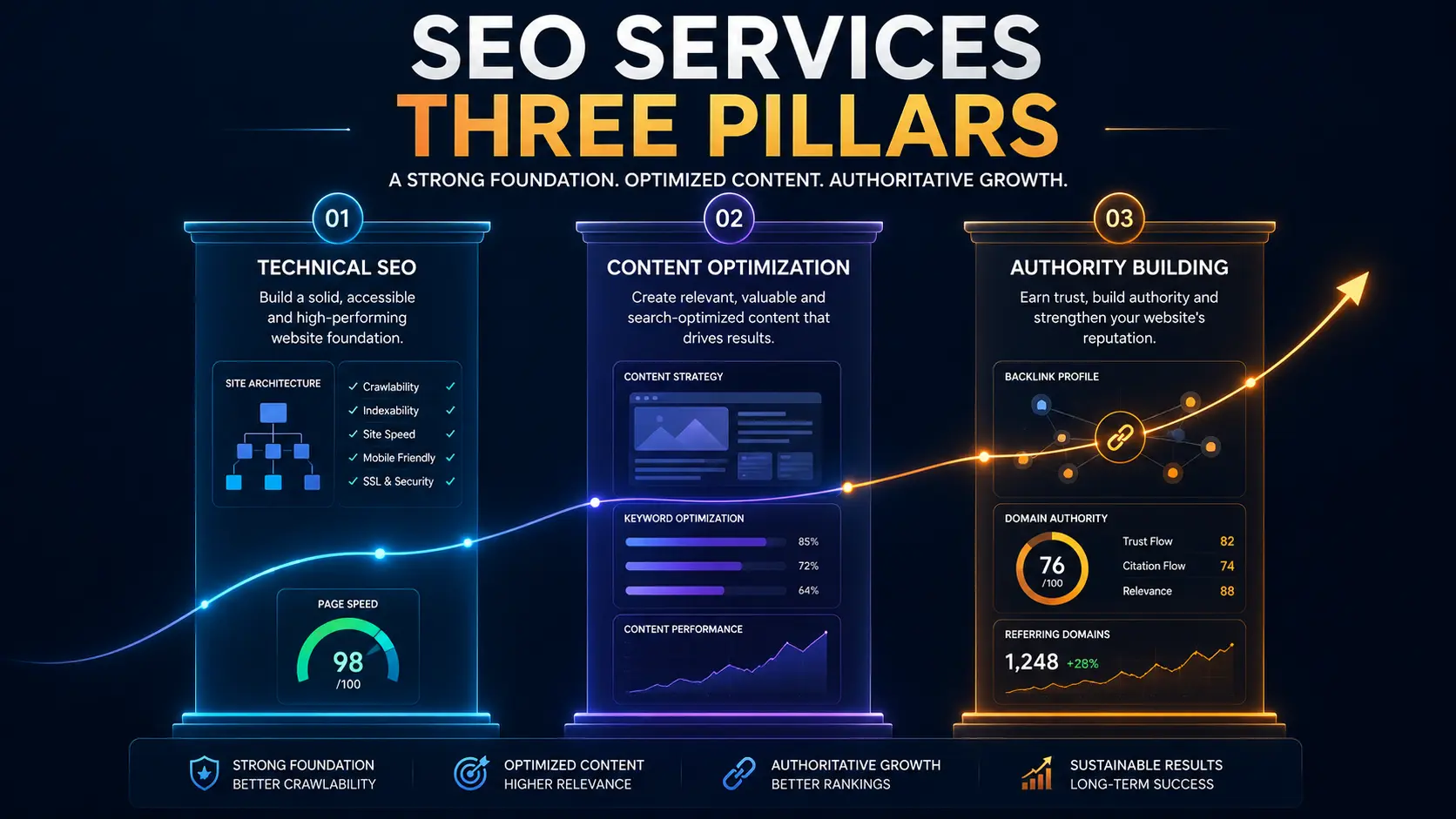
Search Engine Optimization is the process of fine-tuning a website so that search engines — and increasingly AI platforms like ChatGPT, Gemini, and Perplexity — can crawl, understand, and recommend its content. Professional SEO services typically cover three connected areas:
Technical SEO: making sure a site is fast, secure, and structurally easy for crawlers to navigate.
On-page optimization: producing high-quality content that answers a searcher's question more completely and clearly than competing pages.
Authority building: earning the external signals — backlinks, brand mentions, digital PR — that establish a site as a trustworthy source in its space.
These three pillars reinforce each other rather than working in isolation. A technically flawless site with weak content rarely ranks well, and excellent content on a slow, poorly structured site struggles just as much. The data backs up why this combination matters: organic search drives roughly 53% of all website traffic across the web, making it the single largest traffic channel for most businesses (BizIQ, citing SEO Inc.).
Takeaway: SEO services aren't one tactic — they're three interlocking disciplines, and skipping any one of them caps how well the other two can perform.
How Are AEO and GEO Changing What SEO Services Cover?
SEO services used to be judged almost entirely on rankings. That's no longer the full picture — visibility now extends into how AI platforms describe and recommend a business when someone asks a question directly.
Answer Engine Optimization (AEO): structuring content so it can be cleanly extracted and used as a direct answer, whether that's a voice assistant or a chatbot.
Generative Engine Optimization (GEO): strengthening a site's data, citations, and authority so generative AI models are more likely to name it as a trusted source.
This isn't a separate discipline bolted onto traditional SEO — it's an extension of it. Roughly 38% of the URLs cited in Google's AI Overviews already rank in the traditional top 10 organic results, which means the fundamentals that win rankings are largely the same fundamentals that earn AI citations (Ahrefs, via FindSkill.ai). Adding clear statistics and properly attributed citations to a page has also been shown to lift AI visibility by roughly 40%, according to Princeton's generative engine optimization research — far more impact than structured data alone provides (Princeton GEO study, via FindSkill.ai).
In practice, this means the content itself needs to do more work than it used to. A page that simply ranks well isn't automatically a page that gets cited by an AI Overview or named by ChatGPT — the content also needs to be structured so an answer engine can lift a clean, self-contained passage out of it. That typically means leading sections with a direct answer, backing claims with named sources rather than vague qualifiers, and organizing headings the way a person would actually phrase a question. The businesses treating this as a natural extension of existing SEO work — rather than a brand-new discipline requiring a separate budget line — tend to adapt fastest, since most of the underlying groundwork (clean structure, genuine expertise, credible sourcing) was already the goal of solid SEO in the first place.
Takeaway: the fastest way to show up in an AI-generated answer is usually to already be doing SEO well — AEO and GEO reward the same fundamentals, just with sharper formatting on top.
Why Do Businesses Need Professional SEO Services Instead of Doing It Themselves?
Plenty of business owners start by trying to handle SEO on their own, and for a small site with limited competition, that can work for a while. The challenge is that search algorithms update constantly, and what worked even a year ago can quietly stop working without anyone noticing until traffic has already slipped.
There's also a depth problem that's easy to underestimate. Effective SEO isn't a single skill — it spans technical website auditing, content strategy, keyword research, link building outreach, and increasingly AI-search monitoring, each of which usually takes years to get genuinely good at. A business owner or generalist marketer juggling all of those alongside their actual day-to-day responsibilities is rarely able to go deep enough in any one area to compete against a site that has dedicated, specialized attention on each front.
Professional SEO services typically provide three things that are hard to replicate without dedicated focus:
Time efficiency — a dedicated team handles ongoing technical maintenance and content production while the business focuses on its actual operations.
Data-driven decisions — proper analytics and reporting show what's working and where to redirect effort, instead of guessing.
Competitive monitoring — ongoing tracking of competitor movement in the search results, so opportunities don't go unnoticed.
The cost comparison against paid alternatives is worth knowing too. Organic channels generate leads at roughly $31 per lead, compared to about $181 per lead through paid search — meaning a well-executed SEO strategy can produce close to 5.8 times more leads per dollar spent than PPC over time (HubSpot, via SEOprofy). Paid search delivers results immediately for as long as the budget keeps flowing, but that visibility disappears the moment spending stops — whereas the visibility built through SEO services tends to persist and keep compounding long after the initial work is done.
Is SEO Only Worth It for Large Companies?
No — and this is one of the more persistent misconceptions about SEO services. Search is one of the few channels where a smaller, well-optimized site can genuinely outperform a much larger competitor, because rankings reward relevance and content quality rather than company size or ad budget.
A locally focused business with a tightly optimized site, clear content that actually answers what people are searching for, and a clean technical foundation can absolutely outrank a larger competitor that's neglected those basics. SEO doesn't have an entry fee tied to company size — it has a quality bar, and that bar is reachable for businesses of nearly any scale.
How Do SEO Services Differ for E-Commerce vs. B2B Businesses?
The fundamentals stay the same, but the application shifts depending on what a business is actually trying to achieve.
E-commerce SEO usually centers on product catalog structure, category page optimization, and ensuring product listings are easy for both shoppers and search engines to evaluate.
B2B SEO tends to focus more on lead generation, in-depth content that builds topical authority, and nurturing visitors who are further from an immediate purchase decision.
Neither approach is inherently "better" — they're solving for different buyer journeys. A B2B SaaS company optimizing for long sales cycles needs different content depth than an e-commerce store optimizing for immediate purchase intent, and a competent SEO strategy adjusts its priorities accordingly rather than applying a single template to both. Knowing which model your business fits before the strategy is built is usually what separates a campaign that ramps quickly from one that spends its first few months figuring out the right approach by trial and error.
How Long Does It Take to See Results From SEO Services?
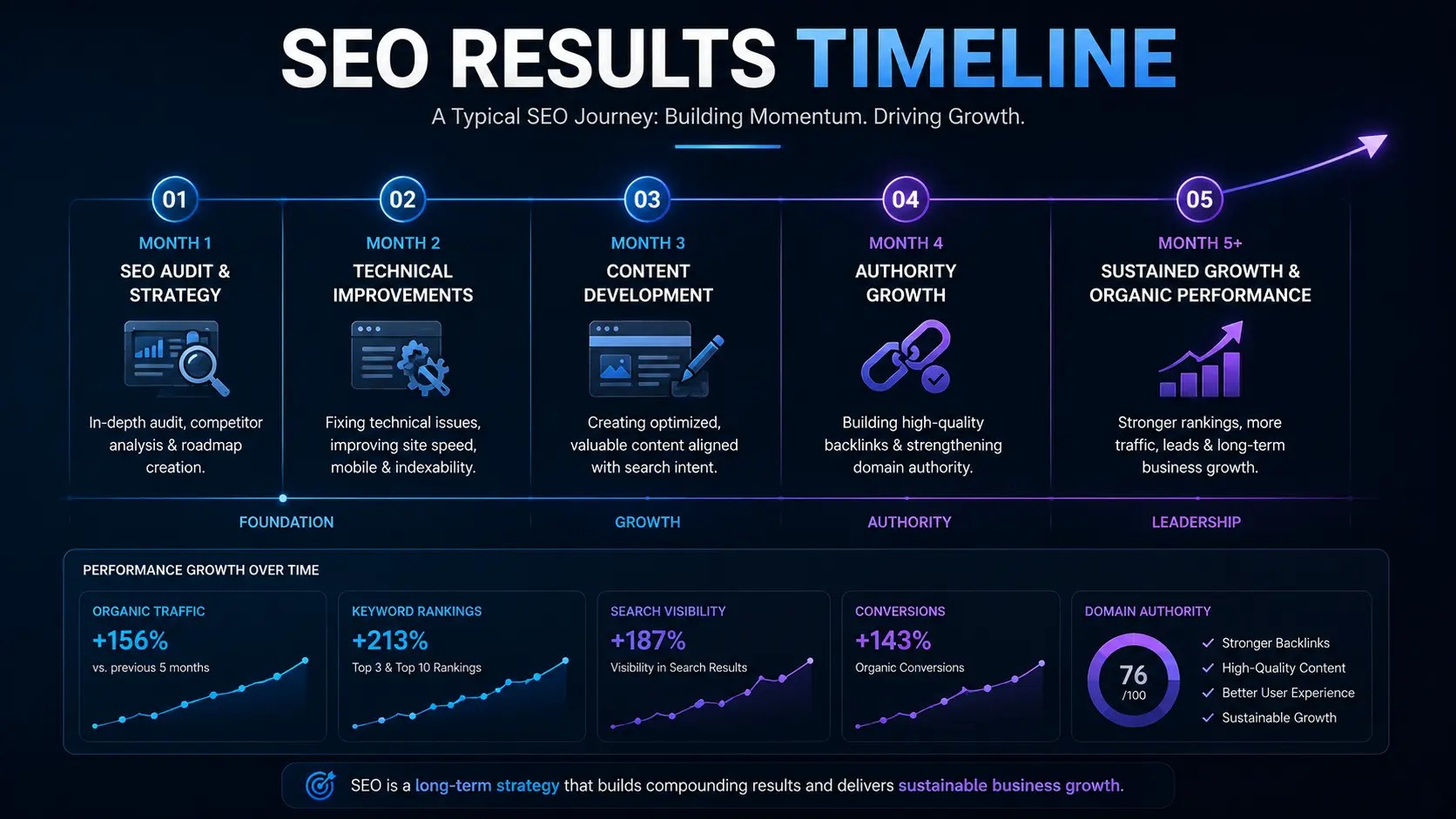
This is usually the first question business owners ask, and it deserves a direct answer: SEO is a long-term investment, not an instant one. Some technical fixes — resolving crawl errors, fixing broken links, cleaning up page speed issues — can produce visible improvements in site health within days. Meaningful growth in organic traffic, though, typically builds steadily over three to six months, and continues compounding well beyond that initial window as content matures and authority accumulates.
The return tends to justify the wait. SEO delivers an estimated 8x return on investment — roughly double what paid search typically produces — based on aggregated industry data (BizIQ). For context on where that return tends to land by ranking position, the number one organic search result captures close to 40% of all clicks for a given query, while the third-place result earns only around 10% — underscoring why the compounding climb toward page one is worth the patience (SE Ranking, via BizIQ).
What Should You Look for When Choosing an SEO Services Provider?
Not all SEO engagements are built the same way, and the differences matter more than most pricing pages let on. A few questions are worth asking before committing to any provider:
Does the strategy connect to revenue and business outcomes, or only to rankings and traffic as standalone metrics?
Is there a clear plan for both traditional search visibility and emerging AI-driven discovery channels?
Are technical SEO, content strategy, and authority building all addressed, or is the engagement narrowly focused on just one pillar?
A provider that can only speak to one of the three core pillars covered earlier is likely to plateau a site's growth well before its real ceiling. The strongest engagements treat technical health, content quality, and authority building as one connected strategy rather than three separate line items.
For a deeper look at how the technical side of that strategy works in practice, our technical SEO services page breaks down what a thorough site audit typically uncovers, and our content marketing services page covers how ongoing content strategy supports the same goals from the content side.
Frequently Asked Questions
What are SEO services?
A: SEO services are professional efforts — covering technical site health, content optimization, and authority building — designed to improve how a website ranks and appears across search engines and AI-driven answer platforms.
How long until I see results from SEO services?
A: Some technical fixes produce visible improvements within days, but significant growth in organic traffic typically builds steadily over three to six months and continues compounding well beyond that.
Is SEO only for big companies?
A: No. SEO is one of the more level playing fields in digital marketing — a well-optimized smaller business can outperform a larger competitor that has neglected technical health, content quality, or both.
Do SEO services handle e-commerce and B2B equally well?
A: The core fundamentals apply to both, but the focus shifts — e-commerce work tends to emphasize product catalog and category structure, while B2B work tends to emphasize lead generation and topical authority through in-depth content.
What's the difference between SEO and AEO/GEO?
A: SEO focuses on ranking in traditional search results. AEO and GEO extend the same fundamentals toward earning citations and direct answers inside AI platforms like AI Overviews, ChatGPT, and Perplexity — the two now work together rather than as separate strategies.
What's a realistic ROI to expect from SEO services?
A: Industry data points to roughly an 8x return on investment for SEO on average, about double what paid search typically delivers, though the exact figure varies by industry and the depth of the engagement.
Conclusion: Choosing the Right Partner for Your SEO Strategy
SEO services aren't a one-time setup — they're an ongoing process of technical maintenance, content development, and authority building that compounds over time rather than producing a single fixed outcome. Businesses that treat all three pillars as connected, rather than picking just one, tend to see the strongest and most durable results.
The shift toward AI-driven search hasn't changed that equation as much as it might seem — it's extended it. The fundamentals that earn strong rankings are largely the same fundamentals that earn AI citations, which means a well-executed SEO strategy today is built to perform across both surfaces, not just one.