




Published 12 Jul 2024
Introduction to Amazon Affiliate Marketing: A Beginner's Guide

This introduction to Amazon affiliate marketing shows beginners how to pick a niche, build trust, and earn commissions. Get a free consultation today
Introduction to Amazon Affiliate Marketing: A Beginner's Guide
This introduction to Amazon affiliate marketing breaks down exactly how the Amazon Associates program works, why most beginners struggle to earn their first commission, and what it actually takes to build a website that turns clicks into income.
Quick Answer: Amazon affiliate marketing means earning a commission by promoting products through the Amazon Associates program — when someone clicks your unique link and buys a qualifying item, you get paid a percentage of that sale. It costs nothing to join, but ranking and earning consistently takes a real content and SEO strategy.
If you've been searching for a practical introduction to Amazon affiliate marketing, you've probably noticed two kinds of advice online: vague encouragement ("just share your links!") and dense technical guides written for people who already have a six-figure site. This guide sits in between. It's written for someone starting from zero — no website traffic, no audience, no idea where to even begin — and walks through the realistic path from sign-up to a first commission, and beyond.
The Amazon Associates program is one of the largest affiliate networks in the world, largely because it's free to join and Amazon already sells almost everything a shopper could want. That scale is also the catch: a huge number of beginners join, post a handful of links, and quit within a few months because nothing converts. The difference between those sites and the ones that actually generate income usually comes down to strategy, not luck.
What Does This Introduction to Amazon Affiliate Marketing Actually Cover?
At its core, the Amazon Associates program lets you earn a commission by recommending Amazon products to your audience. You sign up for a free account, generate a unique tracking link for any product, and share that link through a blog, YouTube channel, or social media post. When someone clicks your link and completes a qualifying purchase, Amazon pays you a percentage of that sale.
A genuinely low barrier to entry. Unlike dropshipping or launching your own physical product line, affiliate marketing requires no inventory, no shipping logistics, and very little upfront cash. Amazon handles fulfillment, customer service, and returns. The real investment is time: the time it takes to build a website, publish useful content, and earn enough trust that people act on your recommendations.
Why the program rewards patience. Because you're not creating a product from scratch, the learning curve is mostly about content and search visibility rather than manufacturing or logistics. That's a meaningful advantage for beginners, but it also means the competition is wide, which is exactly why niche selection and content quality matter so much.
What Should an Introduction to Amazon Affiliate Marketing Teach You About Commissions and Cookies?
This is the part most beginner guides get wrong, partly because Amazon updates its rules more often than people realize. Here's what's actually true right now.
Commission rates vary dramatically by category. Amazon uses a tiered structure, and depending on what you promote, your commission can range from roughly 1% up to 20% of the sale price. Amazon Games sits at the top of that range at 20%, while most everyday physical product categories — electronics, home goods, grocery — typically fall between 1% and 4.5%, according to Amazon's published Associates Program rate structure. That spread is the reason experienced affiliates think carefully about which products they feature, not just whether a product is popular.
The cookie window is shorter than people assume, and it recently got more specific. Amazon's standard tracking cookie lasts only 24 hours from the click. If a shopper adds something to their cart inside that window, the purchase can still qualify even if checkout happens later. Older guides describe this as a broad "halo effect," where any item added to the cart earns a commission regardless of category. That description is now outdated.
Amazon has updated its Associates Program Operating Agreement so that onsite commission income is calculated based on the specific product (or its direct variant) that was linked, rather than on everything else a shopper happens to add to their cart in the same session, according to Amazon's own Associates Central documentation. The agreement also now requires that a qualifying purchase be shipped, streamed, or downloaded, and paid for, within a defined window after the original click, rather than crediting purchases indefinitely.
Earnings vary enormously, and most of that variance comes down to traffic and conversion, not the headline commission rate. A 3% rate on a $1,000 laptop and a 4.5% rate on a $40 kitchen gadget can produce surprisingly similar payouts once you factor in how often each one actually sells. This is one of the most overlooked numbers for beginners deciding which niche to pursue.
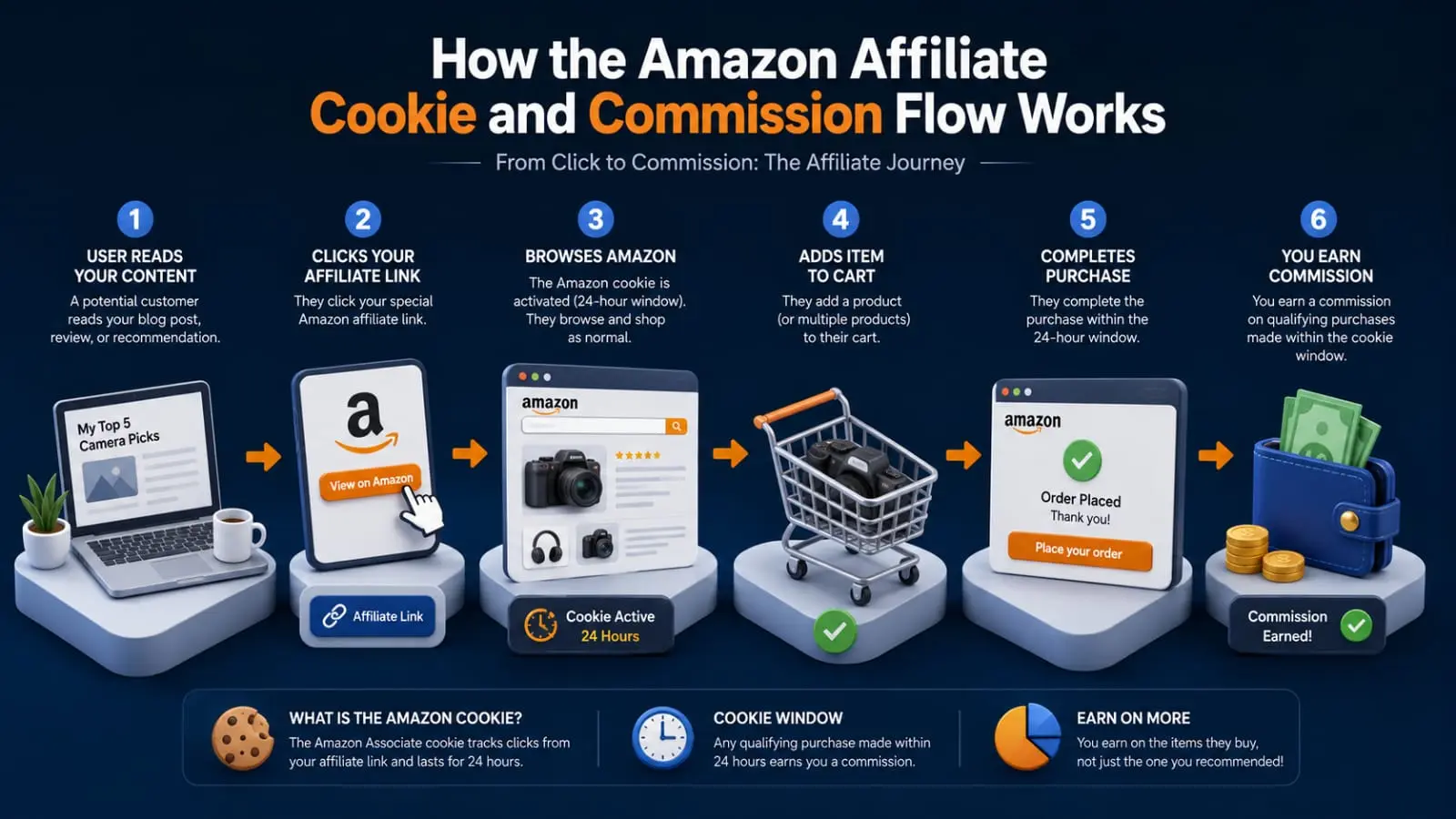
The practical takeaway: don't build an entire content strategy around "linking to anything and hoping for a cart-wide bonus." Build it around products you'd genuinely recommend, in categories where the commission rate and purchase frequency both work in your favor.
Why Do Most Beginners Fail at Amazon Affiliate Marketing?
You might assume that pasting a handful of Amazon links onto a free blog is enough to start generating sales. In reality, this approach almost always produces zero traffic and zero commissions, and it's worth understanding exactly why before building a site the same way.
The "thin content" trap. If a website is essentially a list of Amazon links with no real analysis, search engines treat it as thin content and rarely rank it. Google and other search engines reward in-depth, genuinely helpful articles that walk a buyer through an actual decision, not pages that exist purely to redirect clicks.
Ignoring search intent. Beginners often write about what they personally want to say rather than what a buyer is actually searching for. If content doesn't target high-intent buyer queries — phrases like "best budget laptop for video editing" or "is this espresso machine worth it" — traffic will skew toward casual readers who were never going to buy anything in the first place.
Treating it like a side hustle instead of a small business. The sites that succeed tend to be run with the same discipline as a small business: a content calendar, a clear niche, and ongoing investment in both writing quality and the website itself. The sites that fail are usually treated as a weekend project that gets abandoned the moment the first month doesn't produce income.
How Do You Choose a Profitable Affiliate Niche as a Beginner?
Niche selection is the decision that quietly determines whether everything else actually works. Get this step wrong, and even great content struggles to rank or convert.
Avoid broad, saturated categories like "general electronics" or "all home goods" — the competition there comes from established publishers with years of backlinks and authority. Instead, look for hyper-specific micro-niches: specialized outdoor or farming equipment, a particular sub-category of fashion, gear for a specific creative hobby, or tools built for one type of small business owner. The goal is finding the overlap between genuine search interest and manageable competition, which usually means digging into actual keyword and search-volume data rather than guessing based on what seems popular.
It also helps enormously to pick a niche with some real personal familiarity. Affiliate content increasingly needs to demonstrate experience and expertise to both readers and search engines — generic, surface-level reviews are easy for both groups to spot.
What Makes an Affiliate Website Convert Visitors Into Buyers?
An ugly, slow, or confusing website undermines even excellent content. Visitors decide whether to trust a site within seconds, and that first impression directly affects whether they click through to Amazon at all.
A handful of elements are genuinely non-negotiable for a high-converting affiliate site: fast loading speed, since slow pages lose visitors before they ever read a recommendation; mobile-friendly layouts, since most shopping research now happens on a phone; and clean, visually clear product comparison tables that let a reader scan pros, cons, and pricing at a glance instead of digging through paragraphs of text. A professional web design and development team can usually diagnose and fix these issues far faster than trial and error, especially for someone building their first site.

Trust signals matter too — an author bio, genuine photos or screenshots instead of generic stock images, and transparent affiliate disclosures all signal to a reader that a real person stands behind the recommendation.
How Do You Drive Traffic to a New Amazon Affiliate Website?
Relying solely on organic search to discover a brand-new site can take months, especially in competitive niches. Most successful beginner sites combine a few different traffic sources rather than waiting on one.
Search engine optimization is still the foundation — it's the channel that keeps producing visitors long after a single piece of content is published, which is why investing early in solid on-page SEO and a logical site structure pays off for years. Beyond organic search, social media promotion can accelerate early growth considerably; short-form video and well-targeted posts can put a new comparison guide or review in front of exactly the audience that's likely to convert. Email is the most underused channel for beginners — even a small list of engaged subscribers tends to convert far better than cold organic traffic, because those readers already trust the recommendations they're getting.
A dedicated digital marketing team that understands both SEO and paid promotion can shorten the time between launching a site and seeing a first real month of commissions, which is often the hardest stretch for a solo beginner to push through.
What Content Formats Generate the Fastest Amazon Affiliate Commissions?
Some content formats consistently convert better than others, especially for a brand-new site without much domain authority yet. If the goal is a first commission as quickly as possible, start here:
In-depth product reviews — detailed reviews of a single product genuinely understood, covering real pros, cons, and use cases rather than rephrased spec sheets.
"Best of" buyer's guides — round-up posts like "Top Budget Tools for Beginner Photographers" attract readers who are already comparing options and close to a purchase decision.
Product A vs. Product B comparisons — helping a reader decide between two competing items is one of the highest-converting formats in affiliate marketing, since the reader has already decided to buy something and just needs help choosing which one.
How-to tutorials — teaching a skill (how to start a podcast, how to set up a home gym) allows naturally recommending the equipment a reader needs to follow along.
Mix these formats rather than relying on just one, and prioritize whichever format matches how people actually search in your specific niche.
Frequently Asked Questions About This Introduction to Amazon Affiliate Marketing
How much does it cost to start an Amazon affiliate website? You can start very lean. Expect a domain name (roughly $10 per year) and reliable web hosting (commonly $5-$10 per month). Beyond that, the main investment is the time spent creating high-quality content.
How long does it take to get approved for Amazon Associates? You get access to your affiliate links immediately after signing up. Amazon then requires a small number of qualifying sales within a set window after joining to keep the account permanently approved, so it's worth publishing and promoting content right away rather than waiting.
Can I share my Amazon affiliate links on social media? Yes. You can share them on platforms like Facebook, YouTube, and Instagram, provided you clearly disclose that you're an affiliate. The FTC's endorsement guidelines require that any financial relationship be disclosed clearly and conspicuously, not buried in a footer or bio link.
Do I need to buy every product I review? Hands-on experience strengthens a review and helps with what search engines call E-E-A-T (Experience, Expertise, Authoritativeness, Trustworthiness), but beginners can also start by researching thoroughly, summarizing verified customer feedback, and clearly noting when a recommendation is based on research rather than personal use.
Do I need my own website to become an Amazon affiliate? Amazon accepts applications based on a website, blog, YouTube channel, or active social media presence, but a website you control gives the most flexibility for SEO, design, and long-term traffic ownership.
How much can a beginner realistically expect to earn? Earnings vary enormously based on niche, traffic, and conversion rate, so there's no single honest number. What's clear is that outcomes sit on a wide spectrum — some beginners earn a small side income, while experienced affiliates running optimized, well-trafficked sites can earn a full-time income. Treat any specific income promise seen online with skepticism.
Your Introduction to Amazon Affiliate Marketing Starts Now
Amazon affiliate marketing isn't a get-rich-quick scheme — it's a legitimate, patient business model that rewards strategy, consistency, and a genuine focus on helping the reader choose well. The beginners who succeed are the ones who understand search intent, invest in a website that earns trust on sight, and stay current as Amazon updates its commission and attribution rules rather than relying on outdated advice.
This introduction to Amazon affiliate marketing was meant to give you the realistic starting point most guides skip over. The next step is simply building: pick a niche, publish your first genuinely useful piece of content, and apply what you've learned here as you go.
Get a Free Strategy Consultation→
Explore Web Design Services for Affiliate Sites→