

Published 30 Aug 2025
MERN Stack Development
Webtricker's MERN Stack Development service builds scalable web apps on MongoDB, Express.js, React.js, and Node.js — full-stack JavaScript from database to UI.
Explore our achievements and let yourself beconvinced!
Webtricker's MERN Stack Development service builds scalable web apps on MongoDB, Express.js, React.js, and Node.js — full-stack JavaScript from database to UI.
MERN Stack Development
JavaScript across the entire stack, one language from the database to the UI, is the core appeal of MERN. Webtricker's MERN Stack Development service uses MongoDB, Express.js, React.js, and Node.js to build web applications that are fast, scalable, and maintainable.
Quick Answer: MERN Stack Development combines MongoDB (database), Express.js (backend framework), React.js (frontend library), and Node.js (runtime) into a full-stack JavaScript architecture, letting a single team build, test, and ship both sides of a web application without switching languages.
Table of Contents:
• What Is the MERN Stack and Why Does It Matter?
• What Makes Each MERN Technology Worth Using?
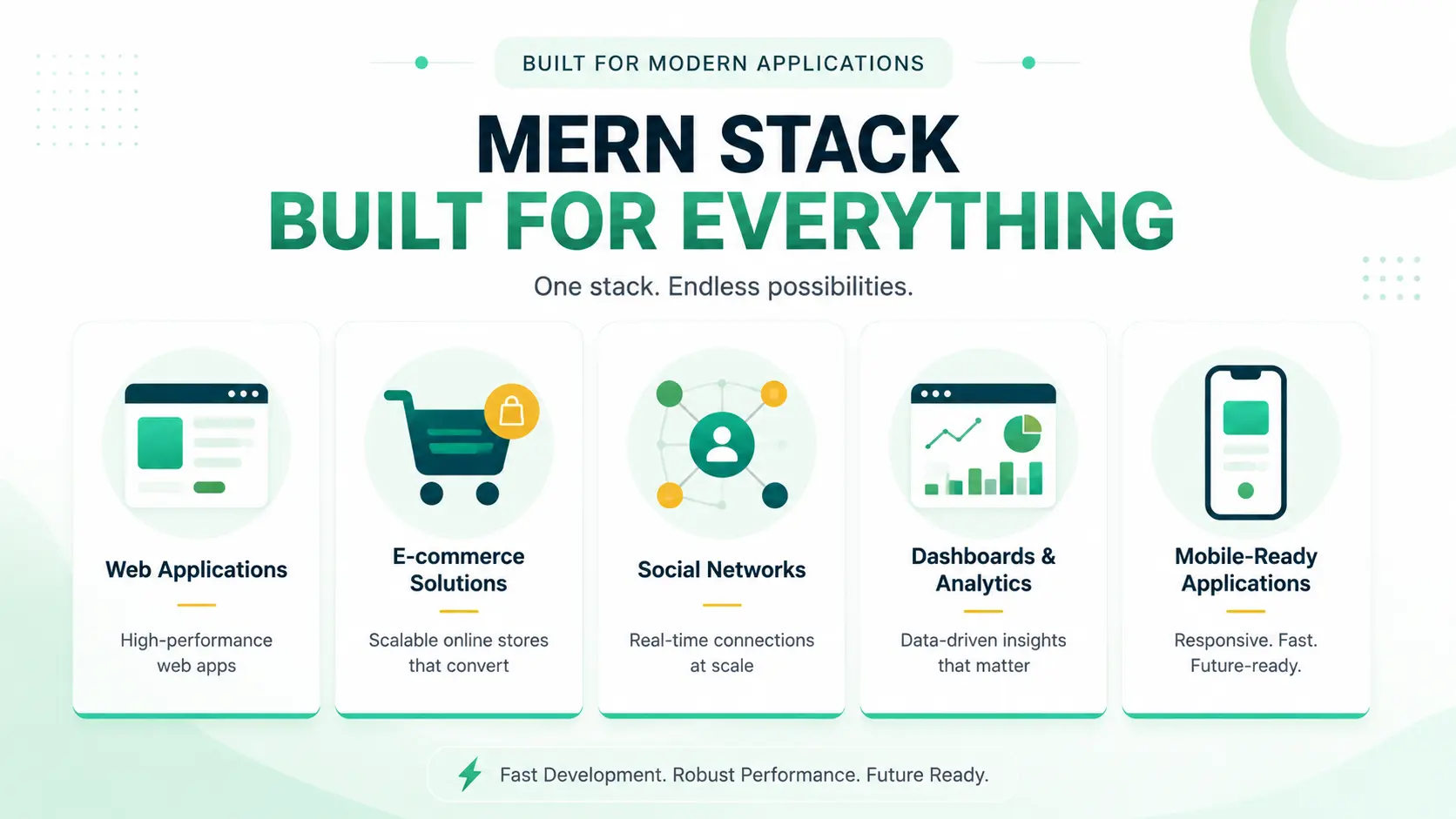
• What Can You Build With MERN Stack Development?
• What Tools Does Webtricker Use for MERN Development?
• Why Choose Webtricker for MERN Stack Development?
• Frequently Asked Questions
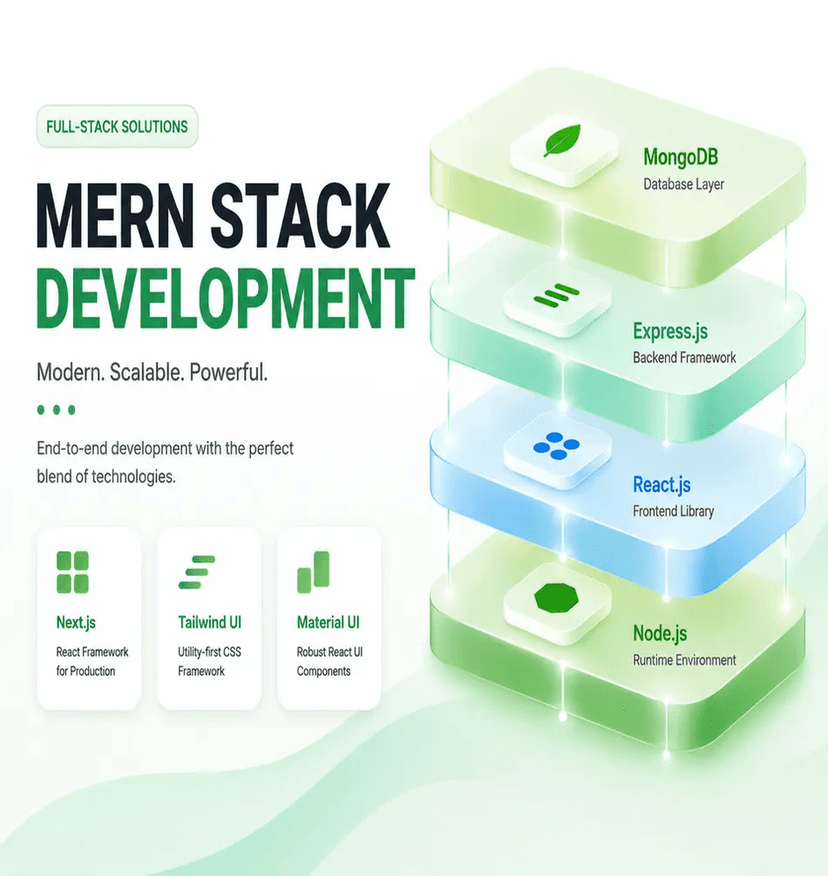
The MERN stack consists of:
• MongoDB — flexible NoSQL database
• Express.js — lightweight backend framework for Node.js
• React.js — component-based frontend library
• Node.js — JavaScript runtime for server-side logic
Webtricker also uses Next.js, Tailwind UI, and Material UI on top of the core stack for projects that benefit from server-side rendering, edge performance, or consistent design systems.
What Is the MERN Stack and Why Does It Matter?
MERN is one of several JavaScript-based full-stack architectures, sitting alongside MEAN (which uses Angular instead of React) and MEVN (which uses Vue). What sets MERN apart is React's dominance, according to the Stack Overflow Developer Survey 2025, Node.js is used by 48.7 percent of developers and React.js by 44.7 percent, making them the two most-used web frameworks globally. Building on the most widely adopted tools means better community support, more available packages, easier hiring, and code patterns that are better-documented than almost any alternative.
The case for using one language across the full stack goes beyond convenience. Shared data models between the frontend and backend, seamless API design, and a single development team that can work fluidly on both sides without constant context-switching tend to produce faster iteration cycles and fewer integration bugs than a mixed-language architecture.
What Makes Each MERN Technology Worth Using?
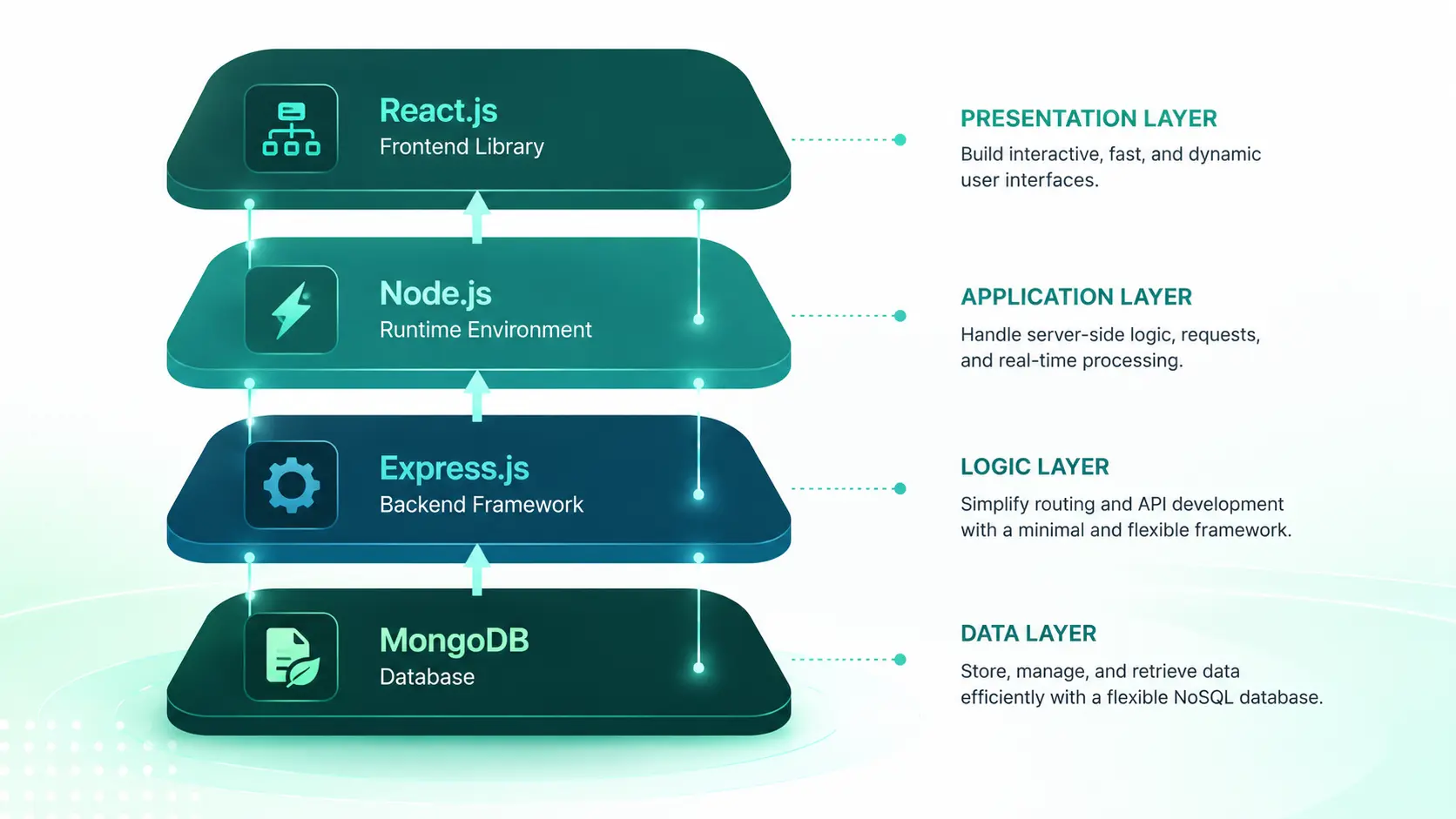
Four technologies, four different roles, all running JavaScript.
MongoDB. A document-oriented NoSQL database that stores data as flexible JSON-like documents rather than rigid rows and columns. This makes it a natural fit for applications with evolving schemas, large volumes of semi-structured data, or requirements that change faster than a traditional relational database can accommodate. MongoDB also scales horizontally, so adding capacity as the application grows doesn't require re-architecting the database layer. Express.js. A minimalistic framework for Node.js that provides routing, middleware handling, and the structure needed to build REST APIs and web applications without imposing an opinionated architecture. Express.js has 51,955 GitHub stars and is consistently ranked as the most-used Node.js backend framework, its thin layer of abstraction keeps the codebase readable and easy to extend. React.js. A JavaScript library for building user interfaces through reusable, composable components. React's Virtual DOM makes updates fast by only re-rendering what actually changed, and its component-based model makes large UIs easier to reason about and maintain. React runs on nearly 70 percent of all websites using a JavaScript framework as of 2026, according to market analysis from Ouranostech, which reflects both its performance and its ecosystem depth. Node.js. A JavaScript runtime that allows server-side scripting, making it possible to write the backend in the same language as the frontend. Node.js is used by more than 40 percent of professional developers in production, according to Stack Overflow's developer surveys, and its non-blocking, event-driven architecture makes it particularly well-suited for real-time applications, APIs, and services handling high volumes of concurrent connections.
What Can You Build With MERN Stack Development?
MERN's combination of a flexible database, lightweight backend, reactive frontend, and scalable runtime makes it a good fit for a wide range of application types.
Custom web applications. Business tools, dashboards, and platforms that need real-time data updates, complex state management, or functionality that can't be delivered through a templated CMS build. E-commerce platforms. WooCommerce and Shopify cover most standard cases, but custom checkout flows, unique product configurations, or platform integrations that require backend control benefit from a full-stack MERN build. Social and community platforms. User profiles, activity feeds, messaging, and notification systems, the kind of interactive, real-time features that MERN handles well because of React's UI performance and Node.js's ability to manage concurrent connections efficiently. SaaS applications. Multi-tenant platforms, subscription flows, and role-based access control are areas where MERN's flexibility in both the data layer (MongoDB) and the application layer (React + Node) tends to outperform more constrained alternatives. Once a SaaS platform is built, pairing it with our SEO Development services helps it get found by the right audience. Cross-platform apps. The React expertise that goes into a MERN web build transfers directly to React Native for mobile, so businesses that need both a web application and a mobile app don't have to start from scratch on a different stack.
What Tools Does Webtricker Use for MERN Development?
Beyond the four core technologies, the tools we use most often on MERN projects:
Next.js. A React framework that adds server-side rendering, static generation, and edge performance, used on projects where SEO, page speed, or initial load time matters more than a pure single-page application approach. Tailwind UI. A utility-first CSS framework that speeds up UI development with consistent, pre-built design tokens while keeping the output lightweight and fully customizable. Material UI. A component library built to Google's Material Design system, used when projects need accessible, well-tested UI components out of the box without designing from scratch.
Why Choose Webtricker for MERN Stack Development?
Specialization in the stack. React.js, Node.js, Next.js, and MongoDB are what our development team works with day to day, not a footnote in a larger list of languages we'll take on. Adaptable and scalable builds. Applications built on MERN are designed to grow, MongoDB's horizontal scalability and Node.js's concurrency model mean the stack can handle growing traffic without re-platforming. Cross-platform reach. The React expertise from a MERN web build extends to React Native for mobile, giving businesses a wider audience without a second team or a second codebase. Full delivery, not just development. Design, development, and deployment handled together, rather than handed off between separate teams at each stage.
This work pairs naturally with our web development services and our CMS Development services for businesses evaluating MERN alongside other technology options.
Frequently Asked Questions
Q: What is the difference between MERN, MEAN, and MEVN?
A: All three are JavaScript full-stack architectures using MongoDB, Express.js, and Node.js. The difference is the frontend framework: MERN uses React.js, MEAN uses Angular, and MEVN uses Vue.js. React's developer adoption and ecosystem depth make MERN the most widely used of the three.
Q: When is MERN the right choice over a CMS like WordPress?
A: MERN makes sense when an application needs custom backend logic, complex data models, real-time functionality, or a user experience that a CMS template can't deliver. For content-driven sites where the main requirement is publishing, a CMS is usually faster and cheaper.
Q: How long does a MERN stack application take to build?
A: It depends on the scope, a lightweight web application can ship in a few weeks, while a multi-feature SaaS platform or social application typically takes several months. We scope a realistic timeline before work starts.
Q: Can Webtricker build both a web and mobile app on the same project?
A: Yes. React on the web and React Native on mobile share component logic and development patterns, so teams experienced in MERN can extend a web build into a mobile app without switching stacks.
Q: How does Next.js relate to the MERN stack?
A: Next.js is a React framework layered on top of Node.js, so it fits naturally into a MERN architecture. It adds server-side rendering and static generation, which benefits projects where page load speed and SEO matter more than a pure client-side single-page application approach.
Q: Does Webtricker handle deployment and hosting, not just development?
A: Yes, delivery includes deployment setup, not just the code. Whether that is a cloud provider, a managed hosting environment, or a containerized deployment, we handle the technical setup so the application is running, not just finished.
Build Something That Can Actually Scale
A MERN application built right can handle whatever traffic it needs to, because the stack is designed to scale from the database layer up. Webtricker's MERN Stack Development service covers the full build, MongoDB to React, with the tools and experience to ship applications that hold up in production.