


Published 8 Jul 2024
Web for Marketing: Your Complete Guide to Online Excellence
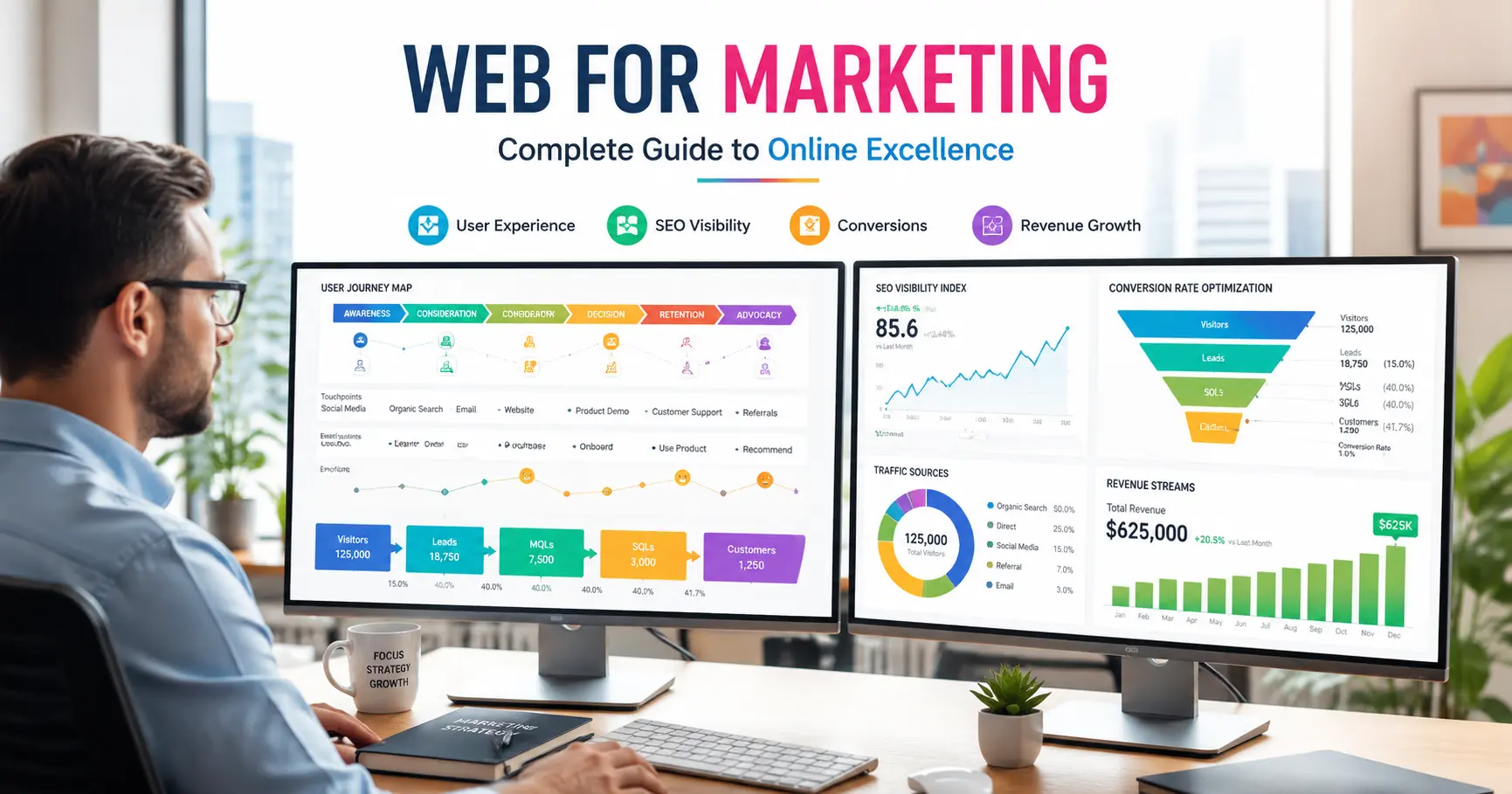
Master web for marketing with this complete guide. Learn how to optimize your digital ecosystem, scale traffic, and drive conversion excellence. Get a free cons
Web for Marketing: Your Complete Guide to Online Excellence
Using a website as an active tool for web for marketing — rather than a passive company brochure — is one of the most high-leverage shifts a business can make in its digital strategy.
Quick Answer: Web for marketing means engineering an entire website to serve as an active revenue system — combining technical performance, structured content architecture, conversion rate optimization, and behavioral analytics to turn traffic into measurable business outcomes. Businesses that treat their website as a performance asset consistently outperform those that treat it as a design project.
Every ad that runs, every piece of content published, every search ranking earned sends traffic to one place: the website. What happens when visitors arrive determines whether that investment pays off. And yet, many organizations treat their web infrastructure as a design asset rather than an active revenue engine. They invest heavily in visual graphics while ignoring technical architecture, conversion optimization, and systematic intent alignment. The result is a website that looks professional but generates very little business. This guide walks through each layer of a proper web for marketing system.
What Are the Architectural Pillars of a High-Performing Marketing Website?
To build a strong web for marketing presence, a platform needs to be designed around clear conversion paths. A marketing website must guide every visitor from initial awareness down to a tracked business outcome — nothing should be left to chance.
Every core page must serve a unique tactical purpose within the user funnel:
The homepage establishes immediate authority, communicates a clear value proposition, and directs visitors toward specific products or services. This page has one job: get the right visitors to the right next page.
Commercial target pages — service and product pages — are engineered to remove buyer friction, highlight key benefits, address objections, and feature strong, specific calls to action. These are where decisions get made.
The content hub — blog posts, guides, and resource archives — is designed to capture long-tail search queries and build industry trust over time. This is where organic traffic enters the funnel.
When these page categories work together as a coordinated system, web infrastructure becomes an automated growth engine, moving prospects from cold discovery into genuine purchase consideration. The difference between a website and a marketing asset is intentional architecture. One is built to exist; the other is built to convert. Our web development services are built around exactly this kind of architecture-first thinking.
How Does Technical Optimization Shape Your Web for Marketing Performance?
The most compelling copy in the world won't matter if a site takes too long to load — most visitors will leave before reading a single word. According to Google research, 53% of mobile visitors abandon a site if it takes longer than three seconds to load. And multiple studies have consistently shown that a one-second delay in page load time can reduce conversions by around 7%. Technical performance isn't a nice-to-have; it's the foundation everything else builds on.
Search engines and ad platforms alike penalize slow, unoptimized web properties. Google's Core Web Vitals are now direct ranking signals, meaning technical performance directly affects organic visibility and paid media costs simultaneously.
Here are the performance benchmarks every web for marketing build should target:
Technical Metric Underperforming Threshold Target Standard
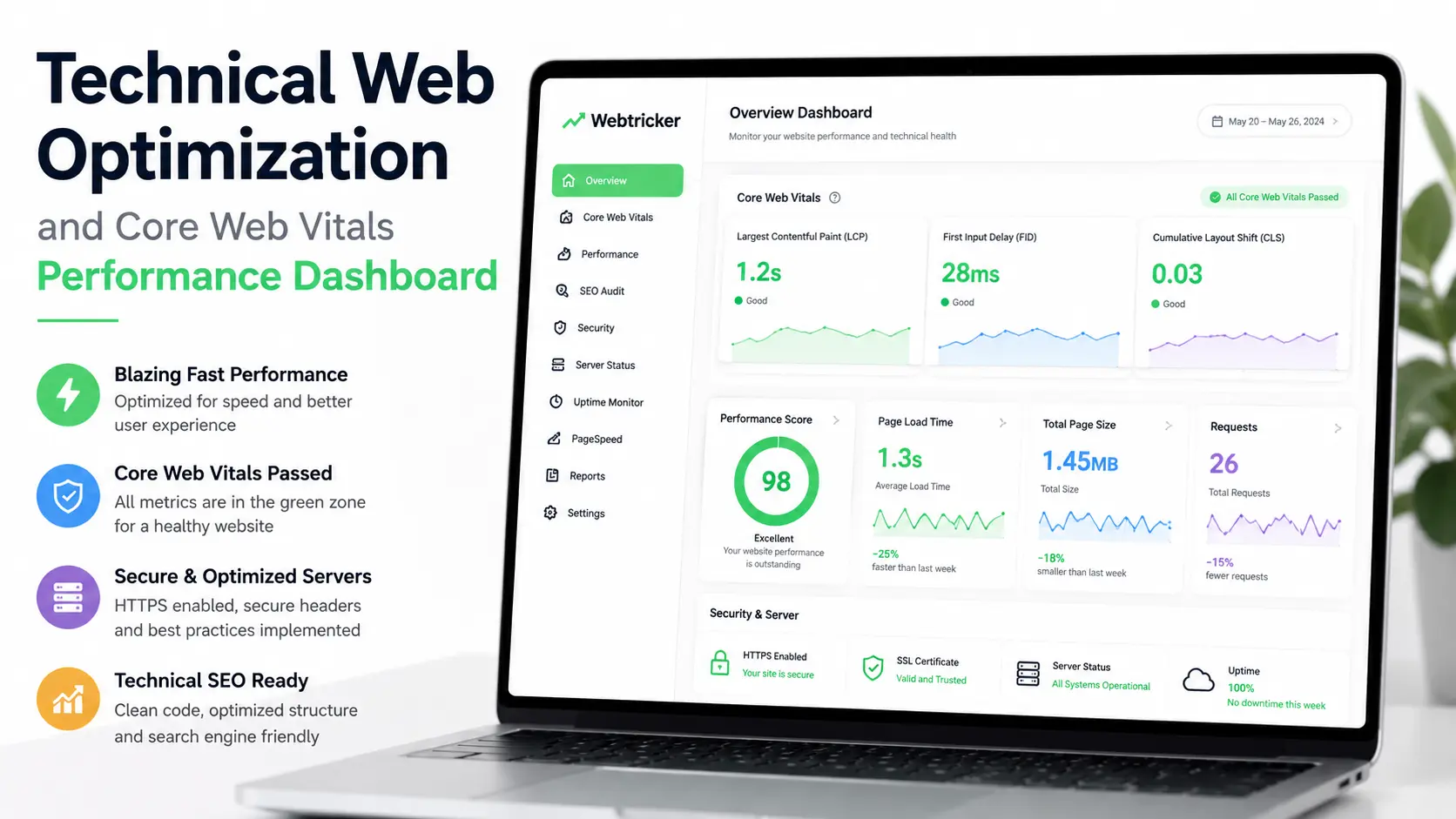
Largest Contentful Paint (LCP) Greater than 4.0 seconds Under 2.5 seconds
Interaction to Next Paint (INP) Greater than 500 milliseconds Under 200 milliseconds
Cumulative Layout Shift (CLS) Greater than 0.25 Under 0.10
Here are the performance benchmarks every web for marketing build should target:Note:
INP (Interaction to Next Paint) has replaced FID as Google's official responsiveness metric. Any audits still referencing FID should be updated to INP going forward.
Beyond raw speed, technical optimization includes mobile responsiveness, accessibility compliance, HTTPS security, clean crawlability for search bots, and structured data markup. These aren't optional extras — they're baseline requirements for any site competing for organic visibility. Teams whose current site falls short of these benchmarks can explore our technical web development services built around closing exactly this kind of performance gap.
Why Does Semantic Search Optimization Matter for Web for Marketing?
Driving high-intent organic traffic without constantly buying ads requires understanding how modern search engines actually work — and today's algorithms are significantly more sophisticated than the keyword-matching systems of a decade ago.
Modern search analysis focuses on user intent and topical depth, not keyword frequency. To rank consistently at the top of results, content needs to be organized into a clear topic cluster structure: a comprehensive core pillar page covering a primary subject in depth, surrounded by targeted sub-topic articles that address specific related questions and link back to the core page.
This architecture does two things simultaneously. It signals to search engines that a domain has genuine authority on a topic — not just surface-level coverage — and it creates multiple entry points for organic traffic across different search queries and intent levels.
Organic search remains one of the largest traffic channels for most businesses. A well-structured content architecture is what captures and compounds that traffic over time, rather than requiring constant ad spend to stay visible. For every core service or product a business operates in, a definitive pillar page paired with a cluster of supporting content covering adjacent questions, objections, and long-tail queries is how web for marketing strategies build durable, compounding traffic rather than renting visibility through paid channels.
How Do You Turn Website Traffic Into Revenue With a Conversion Framework?
Attracting thousands of visitors to a website is only half the strategy. There is consistent and substantial performance variance between businesses that treat conversion as an afterthought and those that engineer it deliberately — the gap between average pages and top-quartile pages is large across nearly every published landing page benchmark study.
Implementing a real conversion framework requires systematic Conversion Rate
Optimization (CRO) applied across every page where a visitor makes a decision. The core principles:
Reduce visual noise. Every element on a landing page either moves a visitor toward conversion or distracts them from it. Eliminate design elements that serve no conversion purpose — decorative sliders, generic stock imagery, and cluttered navigation all increase cognitive load and suppress action.
Simplify your forms. Form abandonment is a well-documented and significant problem across industries. Multi-step capture sequences — breaking a long form into two or three short stages — dramatically reduce perceived effort and increase completions. Lead with easy fields before requesting sensitive information.
Use social proof strategically. Placing verified testimonials, case study results, client logos, or specific outcome data directly adjacent to the primary conversion form reduces purchase anxiety at the exact moment a decision is being made.
Build retargeting infrastructure. Most visitors won't convert on the first visit. A structured follow-up sequence combining retargeting ads, email automation, and strategic re-engagement touchpoints recovers a meaningful share of traffic that would otherwise be permanently lost.
Reviewing our portfolio of past projects is a useful way to see these conversion principles applied in practice across real builds.
How Do You Build Advanced Tracking and Behavioral Analytics Into Your Web Strategy?
Scaling a web for marketing ecosystem with precision requires abandoning guesswork entirely. Every major design decision, content change, or funnel modification should be informed by actual behavioral data — not assumptions about what users want.
Standard pageview tracking captures only a fraction of the available signal. To understand how users actually interact with a site, custom event tracking needs to be configured across every meaningful interaction point: scroll depth, link clicks, video views, form starts, form abandonment, CTA engagement, and exit intent patterns.
This behavioral layer reveals the specific friction points where a funnel breaks down. A page with strong traffic but weak conversion isn't just "underperforming" — it's signaling something precise about where users are losing confidence, losing interest, or encountering a barrier. Heat mapping tools make this even more specific, showing exactly which elements attract attention and which are being ignored entirely.

The output of this tracking infrastructure is a continuous improvement loop: data surfaces friction points, targeted tests address them, results inform the next round of optimization. Over time, this compounds into measurable conversion lift that would be impossible to achieve through periodic gut-feel redesigns. It's not glamorous work — but it's where the real gains hide.
Why Should Paid Media Channels Connect Directly to Your Web Core?
A website doesn't exist in isolation — it's the landing pad for every paid marketing channel a business operates. The connection between web infrastructure and paid media isn't just technical; it's the mechanism that determines whether ad spend generates profitable returns or simply drives expensive traffic to a site that can't close it.
The most important element of this integration is clean, accurate conversion tracking. Installing server-side tracking APIs and properly configured conversion pixels ensures that every action taken by paid traffic — form completions, phone calls, purchases, micro-conversions — is fed back to ad networks accurately and promptly.
This matters because modern paid social and search algorithms are fundamentally learning machines. When a website passes clean first-party conversion data back to platforms like Meta and Google, those algorithms learn exactly which user profiles convert and
automatically optimize delivery to find more of them. Poor tracking means the algorithm is learning from incomplete data, which degrades targeting quality and inflates cost per acquisition over time. Clean data in equals better targeting out — and that pays back through lower CPAs and higher ROAS across every paid channel a business operates.
How Do Continuous UI Testing and Future-Proofing Complete Your Web Strategy?
The digital landscape shifts constantly — consumer behavior evolves, search algorithms update, and new technologies change how users find and interact with content. A web for marketing system that's optimized today needs ongoing refinement to stay optimized tomorrow.
Continuous A/B testing means testing one major element at a time: the primary headline angle, CTA button copy and placement, hero section layout, form structure, or pricing presentation. Running multiple variables simultaneously makes it impossible to attribute performance changes accurately. Letting each test reach statistical significance before applying the winning variant avoids premature decisions based on small sample sizes.
Future-proofing for AI search matters. As AI-powered search interfaces become more integrated into how users find information, traditional web visibility patterns are shifting. The most durable response is to prioritize genuine human expertise and original research that automated systems can't easily replicate. Ensuring a site features complete structured schema markup helps AI crawlers accurately index business information, services, and content for direct knowledge panels and AI-generated answer formats.
Businesses that build this infrastructure now — structured data, original research assets, authentic expert content — are positioning their web for marketing strategy to remain effective regardless of how the search landscape continues to evolve. Curious about how AI integration fits into a broader web strategy? Our training and consultation programs cover exactly this territory.
Frequently Asked Questions About Web for Marketing
What does "web for marketing" actually mean? Web for marketing means treating a website as an active, engineered revenue system rather than a passive online presence. It encompasses every dimension of a website's performance — technical speed, content architecture, conversion optimization, analytics tracking, and paid channel integration — all working together toward turning visitors into customers at a measurable, scalable rate.
What is the ideal website conversion rate for B2B lead generation? Industry benchmarks vary considerably and shift over time, but a healthy B2B conversion rate generally sits in the low single digits for standard web pages, with optimized, targeted landing pages regularly exceeding that. The more precisely a page addresses a specific user intent — rather than serving a broad general audience — the higher the conversion rate tends to be.
Should a business website be built on WordPress or a custom headless setup? For the majority of marketing and content-driven sites, modern WordPress paired with quality hosting delivers excellent speed, flexibility, and scalability. Enterprise organizations with complex data architecture, security requirements, or performance demands at significant scale often benefit from a headless CMS setup that maximizes control and page speed. The right choice depends on specific technical requirements and growth trajectory, not on a general preference for one platform over another.
How often should a business run technical website audits? Automated checks for broken links and crawling errors should run weekly on any active site. For high-traffic platforms, a thorough manual audit of technical SEO structure, Core Web Vitals scores, and full user journey flows should happen quarterly. Any major site update — new section, redesign, CMS migration — warrants an immediate post-launch technical review regardless of the regular schedule.
How does mobile responsiveness affect search engine visibility? Significantly. Search engines use mobile-first indexing, meaning the mobile version of a website is the primary version evaluated for ranking purposes. A poor mobile experience — slow load times, unreadable text, broken layouts, frustrating navigation — will actively suppress rankings across all devices, including desktop. Mobile optimization is no longer a separate consideration; it's the baseline standard the entire site is measured against.
What is the fastest way to improve conversion rates on an existing website? The highest-impact, lowest-effort improvements are typically simplifying and shortening primary conversion forms, adding specific social proof (testimonials with outcomes, not just names) directly adjacent to CTAs, improving page load speed to under 2.5 seconds, and ensuring the mobile experience is genuinely frictionless. These changes consistently produce measurable lift without requiring a full redesign.
Why Web for Marketing Outperforms Treating a Website as a Design Project
Building a high-converting web for marketing system requires a strategic blend of clean technical performance, structured semantic content, and user-focused conversion design. Treating a website as a simple visual project caps digital growth at a fraction of its potential.
The businesses that dominate their categories online aren't spending more — they're converting better. They've built web for marketing infrastructure that turns traffic into leads, leads into customers, and customer data into better targeting. The gap between a website that looks good and one that actually performs comes down to the disciplines covered in this guide: architecture, technical optimization, content strategy, conversion engineering, behavioral analytics, and continuous testing.
Every visitor a website fails to convert is revenue that goes to a competitor — and the good news is that this is an engineering problem, which means it has systematic solutions.
Get Your Free Web Marketing Consultation→
Explore Our Web Development and Marketing Services→