




Published 6 Jan 2025
Amazon Affiliate Content Writer: The Key to Traffic and Increased Earnings

Discover how a professional Amazon affiliate content writer boosts traffic and earnings. Get expert content help from Webtricker today!
Amazon Affiliate Content Writer: The Key to Traffic and Increased Earnings
Quick Answer: An Amazon affiliate content writer is a specialist who creates SEO-optimized, high-converting content for affiliate marketing websites. They combine deep product research, persuasive writing, and strategic SEO to turn casual readers into buyers. With AI content flooding the internet, professional human writers are more valuable than ever for building trust, authority, and long-term affiliate income.
In the competitive world of Amazon Associates, traffic is only half the battle. You can have thousands of visitors landing on your site every day, but if your content doesn't connect with them — if it doesn't answer their questions, build their trust, and guide them toward a decision — your earnings will stay flat no matter how many people show up.
The secret weapon of the most successful affiliate marketers isn't just their domain authority or their backlink profile. It's their content — and specifically, the quality of writing behind it.
An Amazon affiliate content writer isn't just someone who puts words on a page. They're a strategist, a researcher, and a persuasive communicator all in one. This guide breaks down exactly why hiring a professional Amazon affiliate content writer is one of the smartest investments you can make for your affiliate business, and what great affiliate content actually looks like in practice.
It's worth saying upfront: this isn't about chasing word count or stuffing pages with generic product talk. The difference a skilled Amazon affiliate content writer makes shows up in metrics that actually matter to your bottom line — time on page, click-through rate on your affiliate links, and how often a reader comes back for your next recommendation instead of bouncing to a competitor's site.
1. What Makes an Amazon Affiliate Content Writer Different?
Anyone can describe a product. Not everyone can sell it.
A professional Amazon affiliate content writer understands the delicate balance between SEO (getting people to your page) and CRO (converting those visitors into buyers). These two goals don't always point in the same direction, and knowing how to serve both at once is a skill that takes time and experience to develop.
Here's what separates a professional from someone just filling a word count:
Understanding user intent. When someone searches "best noise-canceling headphones under $100," they aren't looking for a technical specification sheet. They want a clear, confident recommendation that solves their problem. A skilled writer knows how to frame the product as the answer and guide the reader naturally toward a decision.
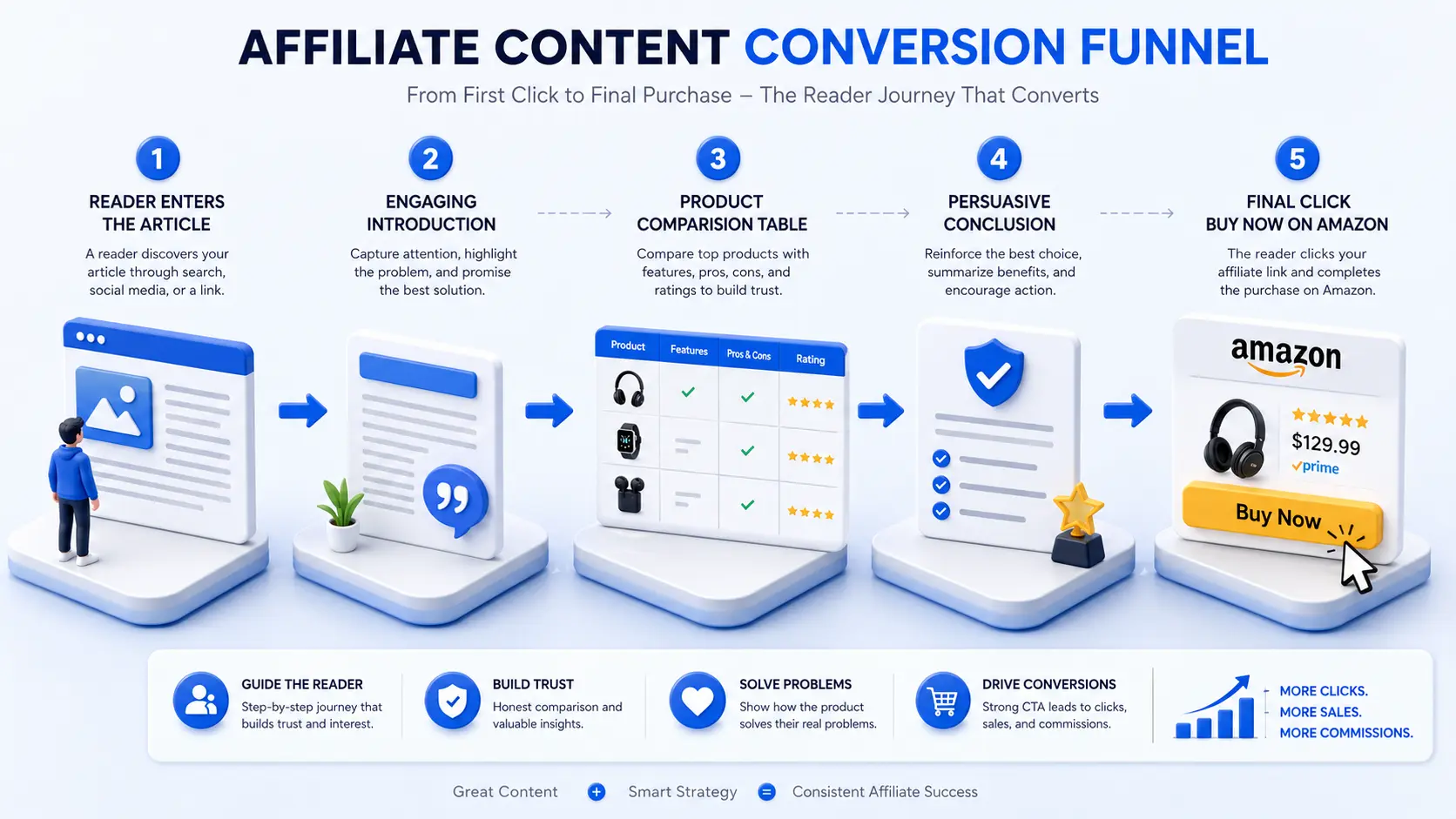
The art of the product review. Writing a review isn't copying bullet points from the Amazon listing. A skilled Amazon affiliate content writer performs deep research beyond the product page — studying real customer reviews, both positive and critical — to surface insights that feel genuine. They build comparison tables that let time-pressed readers scan key differences at a glance, and they inject a consistent, conversational personality that turns a one-time visitor into a returning reader.
Strategic placement of affiliate links. Knowing where to place links matters just as much as the links themselves. A professional Amazon affiliate content writer positions CTAs at the natural decision points in the content, not randomly scattered throughout, and not crammed in at the end once the reader has already moved on.
2. Why "Good Enough" Content Is Costing You Money
Here's something most new affiliate marketers don't realize until it's too late: writing your own content to save money often ends up costing far more in lost commissions.
The bounce rate problem. If your content is thin, hard to read, or poorly structured, visitors leave within seconds. When users hit the back button and return to the search results, Google registers that as a signal that your content didn't solve their problem. Over time, this pattern pushes your rankings down — and once rankings drop, it's a painful cycle to reverse.
Missing conversion triggers. Urgency language that reminds readers why waiting isn't in their interest, social proof woven naturally into the review rather than dropped in awkwardly, clear benefit-focused CTAs placed at the exact moment a reader is ready to act, and scannable formatting that keeps people engaged instead of overwhelmed by dense paragraphs — if these are missing, you're almost certainly leaving commissions behind.
The trust gap. Readers can tell surprisingly quickly whether a review was written by someone who genuinely knows the product category or someone who scraped together information to fill a page. That gap in trust directly affects whether they click your link or go back to find a source they feel better about.
3. How Our Amazon Affiliate Content Writers Build a Winning Strategy
At Webtricker, our approach to Amazon affiliate content goes deeper than keywords and word counts. We build content designed to rank, convert, and hold its value over time.
Phase 1 — Search intent mapping. Before a single word is written, we analyze the search results page for your target keyword. We look at what Google is already rewarding — a detailed listicle, a head-to-head comparison, a long-form buyer's guide — then build the content structure around what's already working, not just what sounds good.
Phase 2 — Building authority and trust. Google's E-E-A-T framework — Experience, Expertise, Authoritativeness, and Trustworthiness — has become increasingly important for affiliate content. Every Amazon affiliate content writer on our team packs each piece with practical, specific detail that signals genuine familiarity with the product category. Pros and cons stay honest rather than reading like marketing copy, and usage scenarios stay realistic and specific.
Phase 3 — Strategic internal linking. Every piece of content is an opportunity to strengthen your entire site. Our writers map internal links deliberately — connecting new product reviews to relevant buyer's guides, linking seasonal content to evergreen resources, and giving readers a clear path to more of your best content instead of a dead end.
4. Essential Content Types That Convert
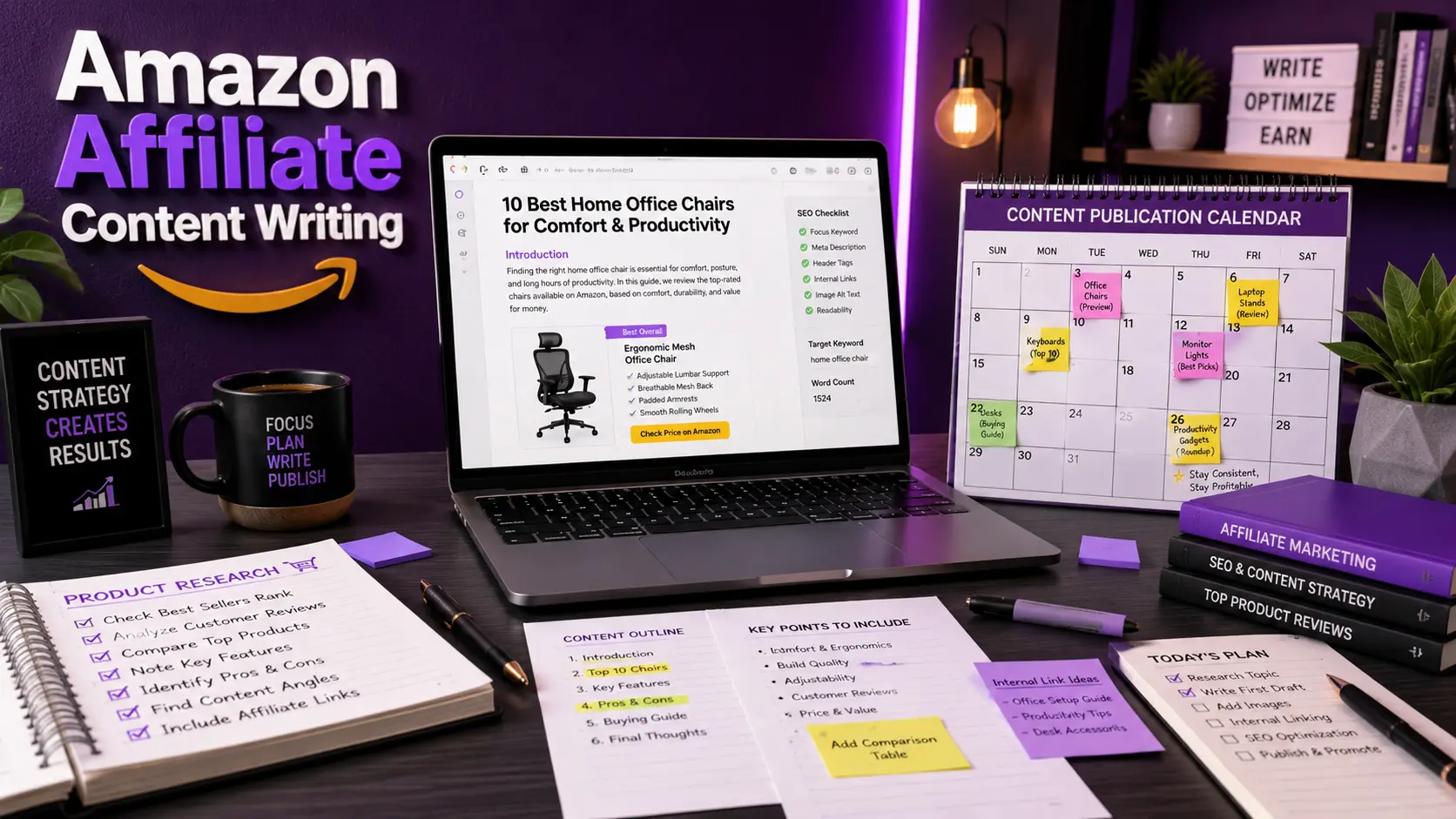
A strong Amazon affiliate site isn't built on just one type of content. Here's the mix that consistently performs best:
"Best [Product Category]" roundups — These capture readers who are ready to buy and just need a trusted recommendation. They're the highest-converting format in affiliate marketing when done well.
Product vs. product comparisons — Perfect for readers stuck between two specific options, making the decision easy and natural.
"How-to" guides with product integration — These deliver real value while naturally introducing products as the tools needed to get the job done.
In-depth single product reviews — Essential for readers who've already narrowed their choice and want detailed confirmation before buying.
Seasonal gift guides — Highly time-sensitive but extremely effective, especially around Prime Day, Black Friday, and the holiday season, capable of driving significant traffic spikes with the right preparation.
Most successful Amazon affiliate sites don't rely on just one of these formats — they layer several together, using roundups and comparisons to capture buyers close to a decision while how-to guides and single reviews build the kind of long-term organic traffic that compounds over time. A good Amazon affiliate content writer knows which format to reach for based on where a specific keyword sits in the buyer's journey, rather than defaulting to the same template for every article.
5. How to Evaluate Your Current Content
Before investing in new content, it's worth understanding where your existing content stands. Here are the key signals to look at:
Average time on page — If readers are leaving in under 60 seconds, the content isn't holding their attention.
Affiliate link CTR — A low click-through rate suggests the content isn't building enough trust, or the CTAs aren't placed well. You can check this directly in your Amazon Associates dashboard.
Bounce rate — High bounce rates combined with low rankings are a strong sign the content needs a structural overhaul.
Ranking position — Content stuck on page two or three often just needs a targeted update, not a full rewrite.
A content audit using these metrics will quickly show you where the biggest opportunities are, and where a professional Amazon affiliate content writer would have the highest immediate impact. It's usually faster — and far less risky — to fix two or three underperforming articles with strong rankings already in place than to start a new article from zero, since you're working with pages Google already trusts enough to show on page one or two.
6. The Long-Term Value of a Professional Amazon Affiliate Content Writer
One of the most important things to understand about Amazon affiliate content is that high-quality articles are assets, not expenses. A well-written, well-optimized piece can generate consistent commissions for years with minimal ongoing investment.
Low-quality content, on the other hand, tends to require constant attention — updates to recover lost rankings, rewrites to fix poor conversion rates, and eventually full replacements once a page simply stops performing. The short-term savings from cheaper content almost always end up being more expensive in the long run.
A professional Amazon affiliate content writer doesn't just save you time — they build something that keeps working for your business long after the initial investment. If you'd rather hand this off to a team that does it daily, you can explore our content writing services or talk through your specific site with us directly.
Frequently Asked Questions
Can I just use AI to write my Amazon affiliate content?
A: AI tools can be useful for outlining and research, but Google's systems are increasingly effective at identifying low-effort, AI-generated content. A human Amazon affiliate content writer is essential for fact-checking, maintaining a consistent brand voice, and building the kind of genuine trust that converts readers into buyers.
How do I know if my content is working?
A: Track your affiliate link click-through rate in your Amazon Associates dashboard and your average time on page in Google Analytics. If both are low, your content needs attention — either a structural improvement or a full rewrite.
Should I update my old content?
A: Yes, regularly. Amazon products change, new models are released, and prices fluctuate. Updating older "best of" articles is often the fastest way to recover lost rankings and get a quick traffic boost without starting from scratch.
What is the most important part of an Amazon review?
A: The pros and cons section and the final verdict. Most readers jump straight to these to make a quick decision — if they're vague or unhelpful, readers leave without clicking.
How long should an Amazon affiliate article be?
A: For competitive keywords, aim for 1,500 to 2,500 words. Longer content tends to rank better because it covers the topic thoroughly and answers more of the reader's questions in one place.
How many affiliate links should I include per article?
A:Place affiliate links naturally where they add value — typically 3 to 5 times per article. Avoid stuffing links throughout, as this can feel spammy and reduce the reader trust you've worked to build.
Conclusion: Invest in Your Most Important Asset
Your Amazon affiliate site isn't just a collection of links. It's a business asset, and like any asset, its value depends entirely on the quality of what goes into it.
A skilled Amazon affiliate content writer doesn't just fill pages with words. They build the kind of trust, authority, and strategic structure that turns organic traffic into consistent commission income. In a landscape where AI-generated content is everywhere, genuine human expertise and a distinct voice have never been more valuable. Stop guessing and start building content that actually works.